

Lester B. Pearson Scholarship

The Lester B. Pearson International Scholarship covers tuition, books, incidental fees and full residence support for four years at the University of Toronto. The Lester B. Pearson Scholarship is not a tuition discount. Not a stipend you stretch across rent. Your degree and your accommodation, both paid, for the whole four years.
Roughly 37 students worldwide receive it each year. In 2024 the programme distributed more than CAD 12 million.
Before you read further, check the calendar, because this scholarship has the earliest deadlines of any award on this site:
| Step | Deadline for September 2027 entry |
|---|---|
| Your school nominates you | 9 October 2026 |
| You submit your U of T admission application | 16 October 2026 |
| You submit the scholarship application | 6 November 2026 |
If you are reading this in the first week of October, you have days, not weeks, and the first step depends on somebody else your school.
That is the thing almost no guide explains properly. You cannot apply for this scholarship yourself. Your school nominates you, and each school may nominate only one student a year. Before you compete with students in forty countries, you compete with the students in your own classroom.
This guide covers how that nomination works, what to say to your school today, the eligibility rules that quietly exclude large groups, and one condition that disqualifies applications outright.
What the Scholarship Actually Covers
Most awards that call themselves fully funded do not cover everything. This one does.
Tuition, for four years of an undergraduate degree at the University of Toronto. International undergraduate tuition at U of T runs roughly CAD 60,000 a year depending on the programme, so this alone exceeds CAD 240,000 across the degree.
Books and incidental fees, which at most universities fall on the student and add up to thousands over four years.
Full residence support, for four years. This is the component that separates Pearson from nearly every other undergraduate scholarship in the world. Accommodation in Toronto is expensive, and most awards leave it entirely to the student. Pearson covers it.
Four years, which matches the length of a U of T undergraduate degree rather than funding one year and leaving you to find the rest.
What this means in practice: a Pearson Scholar arrives in Toronto with their degree and their housing paid. They still pay for flights, food, personal costs, health insurance and their study permit, so the award does not cover literally every expense, but it removes the two largest by a wide margin.
Who Can Apply, and Who Cannot
The eligibility rules are narrow and specific. Read them properly, because several of them exclude people who assume they qualify.
You must be an international student who requires a Canadian study permit. Canadian citizens and permanent residents fall outside the programme.
You must be in your final year of secondary school, in 2026/2027, or have graduated no earlier than June 2026. This is a school-leaver scholarship.
You must be starting at U of T in September 2027. Students beginning in January 2027 are outside the programme.
You must not already be in post-secondary education. This is the condition that removes the largest group of hopeful applicants. If you have started a bachelor’s degree anywhere in your own country, in Canada, anywhere, you cannot apply. A gap-year student who has not enrolled anywhere remains eligible; a first-year student at a home-country university does not.
Your school must nominate you, and U of T must recognize your school before it can.
Read that list again if you are a university student hoping to transfer. This award exists for students coming straight out of school, and no amount of academic strength changes that.
The Nomination: The Part That Decides Everything
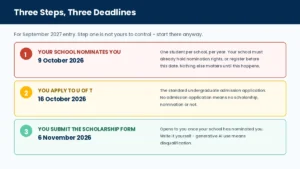
Here is how the process actually runs, and why starting with the scholarship form is starting in the wrong place.
Step one: your school nominates you, by 9 October 2026.
Schools submit nominations through a secure online form provided by U of T. Each school may nominate one student per year. One.
U of T’s admissions and outreach office must also verify your school. If your school has never nominated anyone, it can apply to participate, but it must do so by the nomination deadline, which means your school needs to act now rather than next month.
Step two: you apply for admission to U of T, by 16 October 2026.
The scholarship attaches to an admission application. No application, no scholarship, regardless of nomination.
Step three: you submit the scholarship application, by 6 November 2026.
This opens to you once your school has nominated you. Without the nomination there is nothing to submit.
What to do today if you are still at school
Go to the person at your school who handles university applications a counsellor, the head of sixth form, a principal, whoever it is in your system. Say this:
The University of Toronto runs the Lester B. Pearson International Scholarship. It covers four years of tuition and residence, and schools nominate one student each year. The nomination deadline is 9 October.
If our school has nominated before, I would like to put my name forward. If we have never participated, the school can register to nominate, but that also has to happen before the deadline.
Could I send you the link?
Then send them future.utoronto.ca/pearson-scholarships.
If your school has never heard of it, that is common and not a problem, but it does mean somebody at your school has to register the school before the deadline. Make that request today rather than at the end of the week.
If your school has already chosen someone else, accept it and move on to the awards that need no nomination. There are several, and this guide links to them at the end.
The Rule That Disqualifies Applications

The University of Toronto states that using generative AI in a Pearson application results in disqualification.
We are going to be unusually direct about this, because we build AI writing tools and this site links to thirteen of them.
Do not use our tools for this application. Not the SOP generator, not the personal statement generator, not any of them. Not ours, not anyone else’s.
That instruction costs us traffic and it is still the correct advice. A disqualified application wins nothing, and the whole point of this scholarship is that U of T wants to hear a seventeen-year-old’s own voice. The selectors read tens of thousands of words of teenage writing every year. They know what it sounds like, and they know what a language model sounds like.
What to do instead. Write the application yourself, badly, in your own words. Next read it aloud and fix what sounds wrong. Then give it to a teacher or a parent and ask what is unclear. Next rewrite it. That process produces something a model cannot produce, which is a real person thinking on the page.
If your English is not strong, write it anyway. Pearson selectors assess what you have done and who you are, across forty countries and many education systems. They do not mark your grammar against a native speaker’s. An honest, slightly awkward application from a student with a real story beats a polished one with nothing underneath it.
Our tools exist to help students who are drowning in paperwork for ordinary applications. This is not that, and we would rather tell you plainly than have you disqualified using something we built.
What Selection Rewards
U of T looks for exceptional academic achievement, creativity, and the potential to contribute positively to the global community. That phrasing sounds generic until you see how it plays out in who actually wins.
Academic achievement comes first and is not enough. Every nominated student is near the top of their school. Grades get you considered; they do not get you selected.
Creativity means making things, not having ideas. The student who built something, started something, wrote something, organized something or solved something sits ahead of the student who describes an interest. Specifics beat adjectives every time.
Contribution means evidence, not intention. What you did, for how long, for whom, and what changed. “I am passionate about education inequality” says nothing. “I ran free weekend math’s classes for twenty-three children in my neighborhood for two years, and eleven of them passed the entrance exam” says everything.
Leadership at your scale, not at an invented scale. Selectors do not expect a seventeen-year-old to have founded an NGO. They look for someone who took responsibility where they were a class, a team, a mosque or church group, a family business, a younger sibling’s education. Small and real beats large and inflated.
Your context matters, and you should state it. A student who achieved strong results while working afternoons in a shop, or who taught themselves from borrowed books, has done something harder than a student with tutors. Say so plainly, without self-pity. The committee reads applications from forty countries and understands that circumstances differ.
Your Real Odds
Thirty-seven awards, worldwide, each year.
Set against that, the number of secondary schools in the world that could nominate a student runs into the tens of thousands. Even assuming only a few thousand actually nominate, the ratio is severe.
But look at the structure before you decide against applying, because it works differently from most competitions.
The school nomination is a filter, not a lottery. If your school nominates you, you are already one of a few thousand rather than one of a few hundred thousand. The hard part for most students is winning the nomination, and that competition runs against your own classmates, where you know exactly who you face.
Every nominated student has a genuine chance. U of T is not selecting from a pool of a million; it is selecting from nominated students, and a strong application from a small school in a country U of T rarely hears from is not a weak entry. The programme explicitly values global representation.
The cost of applying is low. You were applying to universities anyway. The admission application is one you would have submitted; the scholarship application is a few hours of writing.
So the honest advice is: ask your school today, and if they nominate you, write the best application you can. Then apply for other things too, because thirty-seven is thirty-seven.
If You Are Not Eligible, Read This
A large share of people reading this page will not qualify, and the useful thing we can do is say where to go instead.
If you are already at university, Pearson is closed to you permanently. For undergraduate transfer there is very little in Canada; for postgraduate study there is considerably more.
If you are starting in January 2027, apply for September 2027 entry instead if you can wait, or look at U of T’s other international awards.
If your school nominated someone else, the Canadian landscape has few other fully funded undergraduate awards, so widen the search. Australia’s Monash offers full course fees to four students a year, Adelaide offers 50% with a form, and several European countries charge almost no tuition at all, which can beat a partial scholarship outright.
If you are a Canadian citizen or permanent resident, this programme is for international students, but U of T and the provinces run substantial domestic awards you should look at instead.
If you want Canada specifically and postgraduate study, the picture is better. Doctoral and postdoctoral funding in Canada is genuinely strong, and that is where the money concentrates.
The Timeline, Working Backwards
The September 2027 intake runs on fixed, tight dates. For anyone reading this with a year in hand, a student currently in year eleven, planning for September 2028, here is how to prepare properly.
Eighteen months out, around March. Tell your school you intend to seek the nomination next year. Ask whether the school already registers with U of T, and if not, ask them to do it. Doing this early removes the thing most likely to stop you.
Twelve months out, September. Build the record the application will describe. Not a list of clubs joined one or two things you actually carry responsibility for, sustained over months.
Nine months out, December. Sit or book your English test if your school system requires one for U of T admission.
Six months out, March. Ask teachers early whether they would support your nomination, and let them see what you have been doing. A teacher who knows your work argues for you in the staff room, which is where the school settles the nomination.
Three months out, June. Draft the application in your own words. Put it away for two weeks. Read it again and cut everything that sounds like somebody else.
At the deadlines, October and November. Nomination, admission, scholarship, in that order.
For the current cycle, compress all of that into this week: talk to your school today, start the U of T admission application tonight, and write the scholarship application over the following fortnight.
Winning the Nomination Inside Your Own School
Your first competition happens in a staff room, among people who already know you. Nobody writes about this, and it decides more Pearson outcomes than the U of T committee does.
Understand how schools actually choose.
Most schools do not run a formal competition. A counsellor or head teacher thinks of the students who come to mind, discusses two or three with colleagues, and picks one. That means visibility matters as much as merit, and visibility is something you can still change.
Ask early and ask directly.
Many students never ask, assuming the school will think of them. Teachers consistently report choosing the student who came and asked, because that student made the decision easy. One conversation puts you in the room.
Bring something to the conversation.
Do not arrive saying you would like the nomination. Arrive with a single page listing what you have done your results, the thing you built or ran or taught, how long you did it for, and what came of it. Teachers argue for students they can describe concretely.
Talk to the teacher who knows your work best,
not only to the most senior person. In most schools the decision gets made after a teacher speaks up for someone. You want that teacher to be yours, and they need to know you are interested.
Make the case on fit, not on need.
Every student who asks wants the money. The argument that works is that you match what the scholarship rewards academic strength, something you made, something you carried responsibility for. Show that and you have given your school a reason to put you forward rather than someone else.
If your school has never nominated, you are the person who has to make it happen.
Send the counsellor the U of T link, explain that the school registers once and can then nominate every year, and point out that it costs the school nothing. Schools often say yes to this because it benefits future students too, but somebody has to raise it, and this year that is you.
If the nomination goes elsewhere, be gracious.
Schools remember students who handled it well, and the same staff write your references for every other application you make.
Writing the Application Without Any AI
Since U of T disqualifies applications that use generative tools, here is how to produce something strong without one.
Start by talking, not typing. Ask a friend or a parent to interview you for twenty minutes. What did you actually do last year? Why did you keep going when it was tedious? What went wrong? Record it or take notes. People say truer things out loud than they write.
Write the ugly draft in one sitting. Do not stop to fix sentences. Get the whole story down badly. A finished bad draft is far more useful than three polished paragraphs.
Cut every sentence that could belong to someone else. “I have always been passionate about science” belongs to a hundred thousand applications. “I spent two summers counting mosquito larvae in the drains behind our street because nobody could tell me why the dengue cases clustered there” belongs to one.
Replace adjectives with numbers and time. Not “I was heavily involved in community work” but “every Saturday for two years, nineteen students, eleven passed.” Numbers do the convincing that adjectives attempt.
Say what went wrong somewhere. Applications that describe only success read as rehearsed. A paragraph about something that failed and what you changed afterwards shows judgement, which is what selectors are actually looking for.
Read it aloud to someone who does not know your subject. Where they look confused, rewrite. Where they lean in, expand.
Leave it for three days, then read it cold. You will delete a third of it, and the result will improve.
Let your English be your English. Selectors read applications from forty countries. An honest voice with small errors beats fluent emptiness, and they can tell which is which within a paragraph.
Studying at the University of Toronto
U of T ranks among the top universities in the world and is Canada’s largest, with roughly ninety thousand students across three campuses St George in downtown Toronto, Mississauga and Scarborough.
Pearson Scholars attend the campus their programme sits on, and the scholarship covers residence at that campus. Downtown St George puts you in the center of one of the most international cities in the world; Mississauga and Scarborough are quieter and considerably cheaper to live around.
The academic culture is demanding. U of T has a long-standing reputation for marking hard and for large first-year classes in popular programmes. Students who seek out office hours, study groups and smaller upper-year courses do far better than those who wait to be noticed.
Toronto itself is expensive, which is exactly why the residence component matters so much. A student with tuition covered but not housing can still find Toronto unaffordable. Pearson Scholars do not face that problem.
Frequently Asked Questions
What does the Pearson Scholarship cover?
Tuition, books, incidental fees and full residence support, for four years of undergraduate study at the University of Toronto.
How many does U of T award?
Approximately 37 each year, worldwide.
Can I apply directly?
No. Your school must nominate you, and each school may nominate only one student per year.
What if my school has never nominated anyone?
Your school can apply to participate, but it must do so by the nomination deadline. Ask them today.
Am I eligible if I have already started university?
No. The programme is for students in their final year of secondary school, or who graduated no earlier than June 2026.
Can Canadian citizens or permanent residents apply?
No. It is for international students who require a study permit.
What are the 2027 deadlines?
School nomination 9 October 2026, U of T admission application 16 October 2026, scholarship application 6 November 2026.
Can I use AI to write my application?
No. U of T states that using generative AI results in disqualification. Write it yourself, in your own words.