
The Vanier Canada Graduate Scholarships ran their final competition in 2025, with the last
results released in April 2025. Canada folded Vanier, the Banting Postdoctoral Fellowships and
the agency-specific awards into the new Canada Research Training Awards Suite.
Doctoral funding now runs through the Canada Graduate Research Scholarship – Doctoral,
worth CAD 40,000 a year for three years. Master’s students apply for the
Canada Graduate Research Scholarship – Master’s at CAD 27,000 for one year, and postdoctoral
researchers apply for the Canada Postdoctoral Research Award at CAD 70,000 a year for two years.
We have kept the guide below for reference, because the selection criteria and the application
advice still describe how Canadian doctoral competitions work.
Vanier Canada Graduate Scholarship
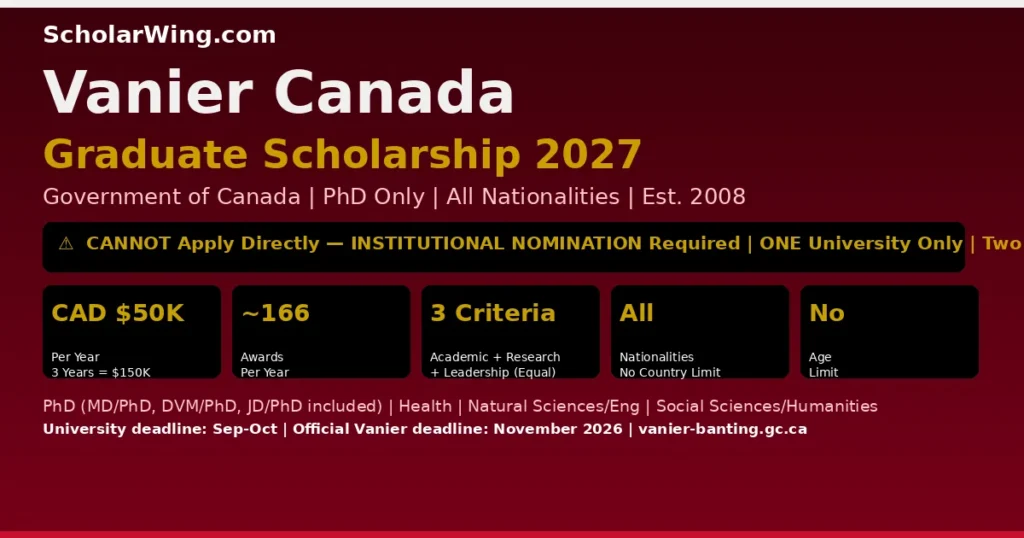
The Vanier Is CAD $150,000 Over Three Years — But You Cannot Apply for It Directly
The Vanier Canada Graduate Scholarship is one of the world’s most generous PhD scholarships and one of the most misunderstood. Every scholarship guide correctly states the amount:
CAD $50,000 × 3 years = CAD $150,000 total. At current exchange rates, this is approximately USD $110,000-115,000 or €100,000-105,000 over the doctoral program more than most PhD stipends anywhere in the world.
What most guides fail to state as prominently as the amount:
Candidates must be nominated by a Canadian institution with a quota to host Vanier scholars. Candidates should only seek a nomination from the institution at which they want to study.
You cannot apply to the Vanier Canada Graduate Scholarship directly. There is no application portal where individual students submit their candidacy to the Canadian government. Instead, you must first be accepted for a PhD at a Vanier-eligible Canadian university, and then that university must choose to nominate you from among all their eligible doctoral students.
You cannot apply directly without nomination.
This means the path to the Vanier has two distinct phases:
- Gain PhD admission at a Vanier-eligible Canadian university
- Be selected by that university to be nominated for the Vanier scholarship
The Government of Canada launched the Vanier Canada Graduate Scholarships program in 2008 to strengthen Canada’s ability to attract and retain world-class doctoral students and establish Canada as a global Centre of excellence in research and higher learning.
The 2027 cycle deadline is expected in November 2026. There is also a university-level internal deadline typically September-October 2026 that you must not miss.
Who Was Georges Vanier — Canada’s 19th Governor General
The Vanier Canada Graduate Scholarship bears the name of Georges Philias Vanier (1888-1967), one of Canada’s most respected public figures.
Vanier was a decorated veteran of World War I, a diplomat, and the 19th Governor General of Canada (1959-1967). He was the first French-Canadian to serve as Governor General, a historic appointment that reflected Canada’s commitment to its bilingual and bicultural identity. Vanier was known for his deep commitment to Canadian unity, service, and humanitarian values.
He and his wife Pauline Vanier (later Madame Pauline Vanier) were celebrated for their dignity, compassion, and dedication to Canadians during the post-war years of national building. The Vanier Institute of the Family, which they helped establish, continues their legacy.
The scholarship named after him represents Canada’s investment in the next generation of world-class researchers people whose excellence, potential, and leadership embody the values Vanier himself personified.
CAD $50,000/Year — What It Means in Practice
This scholarship provides $50,000 per year for a time period of 3 years.
Financial Impact:
| Duration | Annual | Total |
|---|---|---|
| 3 years of PhD | CAD $50,000/year | CAD $150,000 |
| USD equivalent | ~USD $37,000/year | ~USD $110,000 total |
| EUR equivalent | ~€34,000/year | ~€102,000 total |
For context, typical Canadian PhD stipends (from research grants) range from CAD $18,000-28,000/year. The Vanier at CAD $50,000/year is nearly double the standard, allowing recipients to focus entirely on research without financial pressure.
The scholarship covers:
- CAD $50,000/year stipend — for living expenses, research, and personal costs
- Typically combined with tuition waiver from the host institution
- No dependents funding mentioned — scholarship is for the scholar
Canada’s cost of living varies significantly by city:
- Toronto: CAD $2,500-3,500/month
- Vancouver: CAD $2,500-3,500/month
- Montreal: CAD $1,800-2,500/month
- Other cities (Ottawa, Calgary, Edmonton): CAD $2,000-3,000/month
CAD $50,000/year (~$4,167/month) is adequate in most Canadian cities and comfortable in smaller ones, allowing doctoral researchers to live without financial stress.
Three Selection Criteria — Equally Weighted
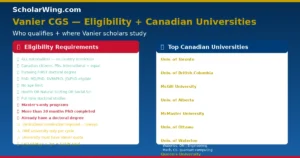
Vanier scholars demonstrate leadership skills and a high standard of scholarly achievement in graduate studies in the social sciences and humanities, natural sciences and/or engineering and health. Considers three equally weighted selection criteria: Academic Excellence, Research Potential, and Leadership (potential and demonstrated ability).
This equal weighting is the most distinctive feature of the Vanier selection. Most research scholarships weight academic excellence above everything else. Vanier explicitly weights leadership as equally important as academic grades and research potential.
Criterion 1: Academic Excellence
Outstanding academic record at the undergraduate and master’s level. Strong grades, academic prizes, awards, and distinctions. The threshold is genuinely high, Vanier recipients typically have GPA equivalents in the top 1-5% of their graduating class.
But high grades alone are not enough. The Vanier committee looks for evidence that the academic achievement is genuinely exceptional, not just high and that it reflects deep intellectual engagement, not just performance.
Criterion 2: Research Potential
Demonstrated research ability and potential publications, conference presentations, previous research experience, quality and significance of proposed doctoral research. The research proposal must demonstrate original thinking, methodological rigor, and genuine contribution to the field.
For early-career applicants without publication records, strong letters from supervisors and evidence of serious research engagement (undergraduate thesis, research assistantships, awards for research work) compensate.
Criterion 3: Leadership
This is the criterion most applicants underestimate. Leadership means both potential and demonstrated ability. Vanier is not looking for academic administrators, it is looking for people who influence communities, build things, mentor others, and drive change in their fields or in their broader social contexts.
Leadership evidence includes: establishing student organizations, community initiatives, mentoring programs, policy advocacy, entrepreneurship, sports leadership at competitive level, cultural leadership. Academic leadership alone (journal reviewer, graduate student representative) is rarely sufficient without broader impact evidence.
The Vanier committee has explicitly said that a student with exceptional grades but no demonstrated leadership is a weaker candidate than a student with strong (not exceptional) grades and clear, authentic leadership impact.
Eligible Fields — All Research Disciplines
PhD programs in health research; natural sciences and/or engineering research; and social sciences and/or humanities research. An eligible doctoral program must include a significant research component that leads to the completion of a thesis, major research project, dissertation, scholarly publication, performance, recital and/or exhibit that is merit/expert-reviewed.
Three Funding Streams:
CIHR (Canadian Institutes of Health Research): Health sciences, biomedical research, clinical research, public health, neurosciences, medicine.
NSERC (Natural Sciences and Engineering Research Council): Physics, chemistry, biology, mathematics, computer science, engineering, environmental sciences.
SSHRC (Social Sciences and Humanities Research Council): Economics, psychology, sociology, political science, history, languages, arts, education, law.
Combined programs: MD/PhD, DVM/PhD, JD/PhD, MBA/PhD (with demonstrated significant research component) are all eligible.
The Nomination Process — How It Actually Works
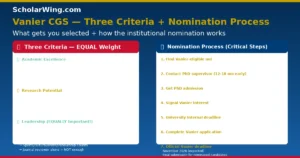
Candidates must be nominated by a Canadian institution with a quota to host Vanier scholars. Candidates should only seek a nomination from the institution at which they want to study. You can apply to ONE university only for Vanier.
Step 1: Identify a Vanier-Eligible Canadian University
Not every Canadian university has Vanier CGS quota. The major research universities consistently have quota: University of Toronto, University of British Columbia, McGill University, University of Alberta, McMaster University, University of Ottawa, Dalhousie, Queen’s, Western University, University of Calgary, Simon Fraser, York, Waterloo, and others. Check vanier-banting.gc.ca for the current full list.
Step 2: Find Your PhD Supervisor
Contact professors at your target university whose research aligns with your proposed doctoral work. A committed supervisor who believes in your potential is essential, they will be your primary champion in the nomination process. Email professors early 12-18 months before your intended start date.
Step 3: Apply for and Receive PhD Admission
Secure formal admission to the PhD program at your chosen university. The university must admit you before nominating you for Vanier.
Step 4: Signal Your Vanier Interest to the Graduate School
Inform your supervisor and graduate school that you want to be considered for Vanier nomination. The university’s graduate office coordinates the internal competition for Vanier nominations because the university has a limited quota, they select among their eligible doctoral students who to nominate.
Step 5: Complete Two Deadlines
There are two critical timelines you must track: the university’s internal deadline and the official Vanier deadline.
- University internal deadline: Typically September-October. Each university sets its own. Miss this and you cannot be nominated that year.
- Official Vanier deadline: Typically November. After nomination, you complete the formal Vanier application in ResearchNet.
Step 6: Complete the Vanier Application in ResearchNet
Log in to your ResearchNet account, click on “Find Funding Opportunities” and select “Apply for Funding.”
The application includes: academic record, research proposal, leadership portfolio, supervisor letters, and transcripts.
Step 7: Wait for Results
Around 166 Vanier scholarships are granted every year. Given the number of Canadian universities and the total nominations, even nominated candidates face significant competition.
Eligibility Requirements
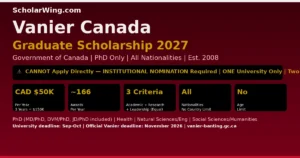
Canadian citizens, permanent residents of Canada, and foreign citizens are eligible to be nominated for a Vanier CGS.
Complete Requirements:
1. All nationalities welcome No country restriction. Canadian citizens, permanent residents, and international students from any country compete under the same criteria.
2. First doctoral degree Must be pursuing your first doctoral degree, including joint programs such as MD/PhD, DVM/PhD, or JD/PhD, MBA/PhD if it has a demonstrated and significant research component.
3. Doctoral study limit Must have completed no more than 20 months of doctoral studies as of 1 May of the relevant year. For joint graduate programs, no more than 32 months.
4. No age limit There is no age limit for the Vanier Scholarships.
5. Nominating institution eligibility Must be nominated by only one Vanier-eligible Canadian institution, the institution at which you will pursue your PhD.
6. Full-time doctoral studies Must intend to pursue full-time doctoral studies at the nominating institution.
Top Canadian Universities for Vanier Scholars
| University | Location | Research Strengths |
|---|---|---|
| University of Toronto | Toronto, ON | Ranked globally top 20 — all fields |
| University of British Columbia | Vancouver, BC | QS top 50 — sciences, medicine, social sciences |
| McGill University | Montreal, QC | Medicine, sciences, humanities |
| University of Alberta | Edmonton, AB | Sciences, engineering, health |
| McMaster University | Hamilton, ON | Health sciences, engineering, social sciences |
| University of Ottawa | Ottawa, ON | Law, social sciences, health, sciences |
| University of Calgary | Calgary, AB | Engineering, medicine, social sciences |
| Queen’s University | Kingston, ON | Sciences, health, law, humanities |
| University of Waterloo | Waterloo, ON | Engineering, mathematics, computer science |
| Simon Fraser University | Burnaby, BC | Sciences, social sciences, communication |
Quick Reference
| Element | Detail |
|---|---|
| Amount | CAD $50,000/year × 3 years = CAD $150,000 total |
| Level | PhD only (including MD/PhD, DVM/PhD, JD/PhD) |
| NOT for | Master’s-only programs |
| Countries | All — Canadian citizens, PRs, international students |
| Awards/year | ~166 |
| Application | ⚠️ Institutional nomination — cannot apply directly |
| ONE university | Only one can nominate you per cycle |
| Three criteria | Academic Excellence + Research Potential + Leadership (equal) |
| Fields | Health, Natural Sciences/Engineering, Social Sciences/Humanities |
| Administered by | CIHR + NSERC + SSHRC |
| PhD limit | No more than 20 months completed (32 for joint) |
| First doctorate | Must be first doctoral degree |
| Age limit | None |
| University deadline | September-October (varies) |
| Official deadline | November 2026 (expected for 2027 cycle) |
| Results | April-May |
| Platform | ResearchNet (Canada) |
| Official site | vanier-banting.gc.ca |
FAQ
How much is the Vanier scholarship?
CAD $50,000 per year for up to three years of doctoral study.
Is there an age limit?
No, there is no age limit for the Vanier Scholarships.
Is the Vanier for Master’s or PhD?
This is a PhD-level scholarship only. It does not support Master’s-only programs.
What are the selection criteria?
Three equally weighted criteria: Academic Excellence, Research Potential, and Leadership.
What is the deadline?
Two deadlines: the university’s internal deadline (typically September-October) and the official Vanier deadline (November 2026 expected).