
Banting Postdoctoral Fellowships
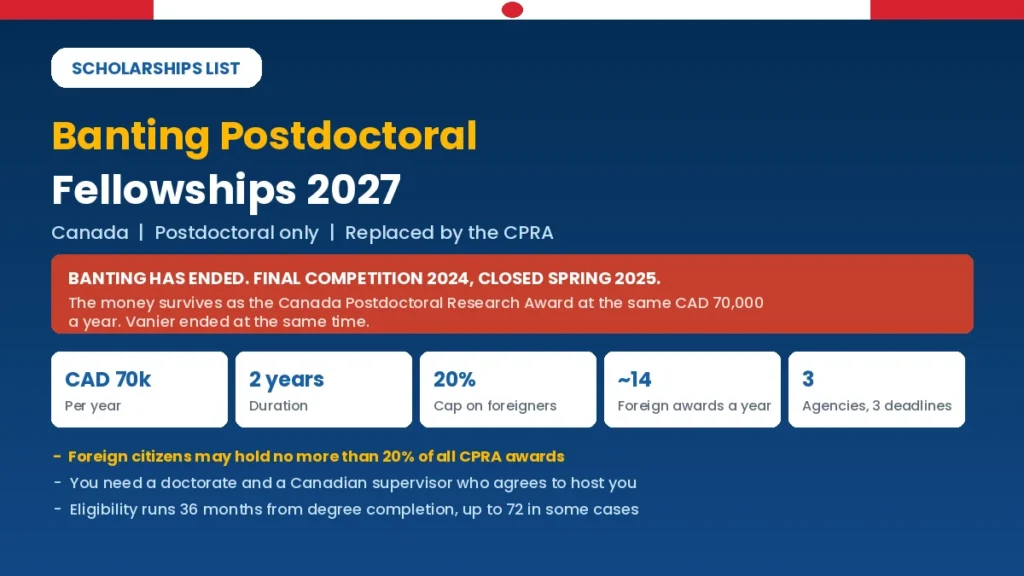
The Banting Postdoctoral Fellowship no longer exists. It ran its final competition in 2024, released those results in February 2025, and the programme concluded in spring 2025.
Canada did not cut the money. It restructured it. The three federal agencies folded Banting, the Vanier Canada Graduate Scholarships and every agency-specific graduate and postdoctoral award into a single new structure, the Canada Research Training Awards Suite. Its postdoctoral component is the Canada Postdoctoral Research Award, usually written as CPRA.
The CPRA pays CAD 70,000 a year for two years, exactly what Banting paid. If you were planning to apply for Banting, the money is still there. The name, the application route and some of the rules are not.
One of those rules deserves your attention before anything else. Foreign citizens may make up no more than 20% of CPRA awards. Banting was open to international researchers without a published cap of that kind. If you are not a Canadian citizen or permanent resident, you are now competing for a fifth of the available awards rather than all of them.
This guide covers what the CPRA is, what the 20% cap means in practice, the three different agencies with three different deadlines, the eligibility window that catches people out, and what to do if your profile no longer fits.
What Replaced What
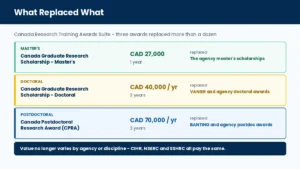
Canada’s three federal research agencies CIHR for health, NSERC for natural sciences and engineering, and SSHRC for social sciences and humanities ran separate award programmes for decades, each with its own name, value and rules. The harmonisation collapsed them into three awards with one value each.
| New award | Value | Duration | What it replaced |
|---|---|---|---|
| Canada Graduate Research Scholarship – Master’s | CAD 27,000 | 1 year | The agency master’s scholarships |
| Canada Graduate Research Scholarship – Doctoral | CAD 40,000 a year | 3 years | Vanier and the agency doctoral scholarships |
| Canada Postdoctoral Research Award | CAD 70,000 a year | 2 years | Banting and the agency postdoctoral fellowships |
Two things follow that matter to anyone who researched Canadian funding before 2025.
Vanier has gone too. The Vanier Canada Graduate Scholarships ran their final competition with results in April 2025. Doctoral applicants should now target the Canada Graduate Research Scholarship – Doctoral at CAD 40,000 a year for three years. Any guide still describing Vanier as open is describing a closed programme.
The value no longer varies by agency or discipline. A health researcher, an engineer and a historian all receive the same CAD 70,000. Under the old structure the amounts differed, which is one reason the harmonisation happened.
The 20% Rule, and What It Actually Means
This is the single most consequential fact for most readers of this site, and it appears almost nowhere.
Foreign citizens may comprise up to 20% of CPRA awards. Canadians and permanent residents compete for the rest.
Think about what that does to the odds. Banting funded roughly 70 new fellowships a year. If the CPRA runs at a similar scale, a 20% cap means somewhere around 14 awards a year reach international researchers across all three agencies and every discipline in Canada.
Fourteen. Across health, engineering, the sciences, the social sciences and the humanities, for every international postdoc in the country.
That is not a reason to skip the application, which costs you time rather than money. It is a reason to treat the CPRA as one item in a funding strategy rather than as the strategy. An international postdoc planning a Canadian career should apply for the CPRA and pursue supervisor-held grant funding, institutional postdoctoral awards and the fellowships of their own country in parallel.
Awards must also be held in Canada. There is no option to take the money elsewhere.
Who Is Eligible
You need a doctorate, or you must be in your final year of doctoral study. The CPRA funds postdoctoral work, not graduate study. If you are looking for master’s or doctoral funding, the other two awards in the suite are what you want.
The eligibility window runs to 36 months from the completion of your degree, with extension to 72 months possible in defined circumstances such as career interruptions. This window catches people out in both directions. A researcher four years past their PhD assumes they are out and may not be. A researcher who finished five years ago and takes no action certainly is.
Work out your own window precisely. The clock runs from your degree completion date as the agency defines it, which is not always the date on your certificate, it is often the date of your thesis defence or the date your degree was conferred, and the difference can be months.
Your citizenship determines which pool you compete in, as the previous section explains.
Your discipline determines your agency, and that choice is yours to make carefully. More on this below.
Three Agencies, Three Deadlines
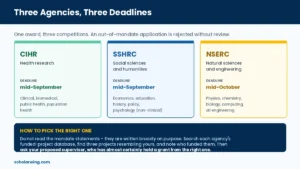
The CPRA is one award administered by three agencies, and each runs its own competition on its own schedule.
| Agency | Covers | Deadline has fallen around |
|---|---|---|
| CIHR | Health research | mid-September |
| SSHRC | Social sciences and humanities | mid-September |
| NSERC | Natural sciences and engineering | mid-October |
Deadlines shift between competition years, so confirm the current dates with your agency rather than relying on this table.
Choosing the right agency is a real decision, not a formality. Agencies reject applications that fall outside their mandate, and the rejection is administrative nobody assesses the science.
The boundaries blur in exactly the places you would expect. A health economist could sit at CIHR or SSHRC. A biomedical engineer could sit at CIHR or NSERC. A computational biologist could sit at NSERC or CIHR. Psychology splits depending on whether the work is clinical or experimental.
How to decide. Look at what each agency has funded recently in your area. All three publish funded-project databases. Find three projects resembling yours and note which agency funded them. That evidence beats your own reading of the mandate statements, which are written broadly on purpose.
Then ask your proposed supervisor. An established Canadian researcher knows which agency funds their field and has usually held grants from it. Their answer takes one email and settles the question.
The Host Supervisor Decides More Than You Think
Canadian postdoctoral funding runs through a host institution and a supervisor who wants you. That was true of Banting and it remains true of the CPRA.
You cannot apply in a vacuum. You need a Canadian researcher who agrees to host you, and under Banting the host institution also had to endorse and nominate the application, which meant institutional deadlines running months before the agency deadline. Several universities set their internal request dates in the early summer for a September competition.
Check your proposed host institution’s internal process early. Whether the CPRA keeps a formal nomination step or not, universities run their own review, letters of support take time, and a supervisor who hears from you in August cannot build a case by September.
How to approach a supervisor. Three or four short emails, each naming a specific recent paper and the connection to your own work, sent four to six months before the deadline. Attach your CV and nothing else. Expect one reply in three or four.
Here is the shape:
Dear Professor Tremblay,
I completed my PhD in atmospheric chemistry at the University of the Punjab in March, measuring brown carbon absorption in Lahore’s winter haze.
Your 2025 paper on secondary organic aerosol in cold-climate cities applies the chamber method I could not run in Lahore for lack of facilities. The Lahore dataset is unusual, a megacity with persistent winter inversions and a biomass-burning signature and I think it would test your model in a regime it has not seen.
I am preparing a Canada Postdoctoral Research Award application for the NSERC round and would like to ask whether you would consider hosting me. I can send a two-page proposal if that helps.
Kind regards, Dr Hira Qadeer
What makes a supervisor say yes. You bring something they do not have, a dataset, a technique, a field site, a theoretical angle. Postdocs who arrive asking for training get fewer yeses than postdocs who arrive offering a capability.
What the Application Assesses
Canadian postdoctoral competitions at this level weigh three things, and applicants consistently over-invest in the first.
Research excellence. Publications, citations, the quality of venues, prizes, and the trajectory those show. Real, but the pool is full of strong records, so this rarely separates anyone at the top.
Leadership potential. This is where Banting distinguished itself and where the CPRA continues. Committees look for evidence that you lead rather than follow supervising students, organizing a conference or seminar series, building a collaboration, securing your own small grants, leading outreach, founding something. An applicant with slightly fewer papers and a clear record of initiative often beats a stronger publication list with none.
The fit between you, the supervisor and the institution. Why this lab, why this country, why now. A proposal that could run anywhere reads as a relocation request. A proposal that needs a specific facility, dataset, cohort or research group in Canada reads as research.
Practical conclusions. Spend less time polishing your publication list and more on the leadership section, which most applicants write thinly. And write the fit section last, after your supervisor has shaped the proposal, so it reflects their lab rather than their webpage.
If the CPRA Does Not Reach You
Given the 20% cap, most international researchers reading this need a second plan, so here it is.
Supervisor-held grant funding. The most common route into a Canadian postdoc has nothing to do with national competitions. A professor with an active grant hires a postdoc directly, at a salary their grant covers. These positions never appear on scholarship sites because they are jobs rather than awards. They appear on university job boards, on lab websites and in the professor’s inbox when you email them.
Institutional postdoctoral fellowships. Most Canadian universities run their own, often with no citizenship cap. UBC’s Killam fellowships are a well-known example; Toronto, McGill, Alberta, Queen’s and others run equivalents. These are smaller in number but open to the applicants the national competitions squeeze out.
Your own country’s outgoing fellowships. Several countries fund their citizens to do postdoctoral work abroad, which solves the problem from the other direction, you arrive with your own money, which makes you considerably easier for a Canadian supervisor to say yes to.
Postdoctoral funding elsewhere. European programmes fund incoming postdocs generously and without comparable national-origin caps, and several pay through employment contracts with pension and labor protections rather than as stipends. For an international researcher, the arithmetic often favors Europe.
The honest framing: the CPRA is worth an application because an application costs time, not money. It should sit alongside four or five supervisor conversations rather than replacing them.
Building the Leadership Case
Leadership potential is where Canadian postdoctoral competitions separate applicants, and it is the section most people write in three vague sentences. It deserves better, because it is the part you can still build.
What committees count as leadership.
Not a job title. Evidence that you started something, carried responsibility for it, and produced a result someone else can verify.
Supervision.
Undergraduate students you trained, master’s students you co-supervised, technicians or field assistants you managed. Name the number and the period. “Trained six undergraduates in HPLC sample preparation across two field seasons” says more than “experience in mentoring”.
Organizing.
A seminar series you ran, a conference session you convened, a workshop you built, a journal club you kept alive for two years. Small things count when you name them precisely.
Funding you secured yourself.
Even a small travel grant, a departmental seed fund or a conference bursary demonstrates that you can write a case and win it. Many applicants leave these off because the amounts look modest. List them.
Collaboration you created.
A partnership with another lab, a data-sharing arrangement, a co-authored paper you initiated rather than joined. The word that matters is “initiated”.
Outreach and knowledge translation.
Teaching in schools, writing for the public, advising a government department, work with a community organization. Canadian agencies weigh this genuinely rather than decoratively.
Service.
Reviewing for journals, sitting on a departmental committee, representing graduate students. Modest individually, meaningful together.
How to write it.
One line per item, each with a number, a period and an outcome. Avoid adjectives entirely,a committee reading forty applications discounts “significant” and “extensive” automatically, and the numbers survive.
If your record here is thin.
treat that as a finding rather than a verdict. Most of these can be built within a year. Offer to co-supervise a student. Start the seminar series. Apply for the small grant. A researcher who spends the year before applying building this section arrives with a stronger file than one who spends it writing one more paper.
Where to Target in Canada
Choosing a host institution well matters as much as choosing an agency, because a supervisor with active funding in a field Canada prioritises can host you whether or not the national competition goes your way.
Artificial intelligence and machine learning. Montreal anchors this Mila, with the Université de Montréal and McGill alongside the Vector Institute in Toronto and Amii in Edmonton. Canada funds AI research heavily and the labs recruit internationally.
Health and biomedical research. Toronto, McGill, UBC and McMaster sit at the centre, each tied to major hospital research institutes. McMaster in particular built the methods behind evidence-based medicine and remains strong in clinical epidemiology.
Environmental, climate and northern science. The University of Alberta, UBC, Waterloo and the northern institutions lead here, and Canada’s Arctic gives its researchers access no other G7 country has.
Agriculture and food science. Guelph, Saskatchewan and Manitoba, serving one of the world’s major grain-exporting economies. For researchers from agricultural countries, these are often a better fit than the headline universities.
Resource and mining engineering. Queen’s, UBC, Laurentian and Alberta, connected to an industry that remains central to the Canadian economy.
Ocean science. Dalhousie and Memorial, with genuine international standing in fisheries, ocean observation and marine ecology.
Physics and astronomy. Perimeter Institute, TRIUMF and the Sudbury Neutrino Observatory anchor a research footprint well above what Canada’s size would predict.
A practical note: smaller Canadian universities receive far fewer international postdoctoral enquiries than Toronto, UBC and McGill. A researcher whose work fits Guelph, Dalhousie, Memorial, Saskatchewan or Laurentian has a materially better chance of a reply, and the fellowship is national rather than institutional, so the award is worth the same wherever you hold it.
A Timeline That Works
Working backwards from a September deadline:
Eight months out, January.
Write to the next four, and follow up once with anyone who has not replied. Expect two or three conversations from eight emails.
Seven months out, February.
Convert the strongest conversation. Share a two-page research outline and let the supervisor reshape it. Their edits are the most valuable feedback in the process.
Six months out, March.
Ask your host about the institution’s internal process and any internal deadline. Many Canadian universities review applications well before the agency date, and some run endorsement processes that close in early summer.
Five months out, April.
Request your referees. Give each one the proposal, your CV and the deadline. Ask the people who know your work rather than the most senior names available.
Four months out, May.
Write the leadership section. This is the part you cannot write in a weekend, and the part most applicants leave until last.
Three months out, June.
Draft the full proposal. Send it to your supervisor and to one person outside your field, because a committee contains both.
Two months out, July.
Rewrite after feedback. Confirm every administrative detail agency, eligibility window, documents, formats.
One month out, August.
Submit internally if your institution requires it, and leave the final weeks for the agency submission itself rather than for writing.
At the deadline, September or October.
Submit, then continue the supervisor conversations. The second plan matters more than the first.
Twelve months out, September.
Decide your field’s agency by looking at what each has funded in your area. Confirm your eligibility window from your degree completion date.
Ten months out, November.
Identify eight to ten Canadian researchers whose recent work connects to yours. Read one paper by each, properly.
Nine months out, December.
Write to the first four. Short, specific, naming the paper and what you bring. Attach your CV.
Six Mistakes to Avoid
Applying for Banting. It ended in 2025. Pages still describing it as open are describing history.
Chasing Vanier for doctoral funding. Also ended. The Canada Graduate Research Scholarship – Doctoral replaced it at CAD 40,000 a year for three years.
Choosing the wrong agency. CIHR, NSERC and SSHRC reject out-of-mandate applications administratively. Check what each has funded in your area before you choose.
Contacting a supervisor in August for a September deadline. Institutional processes, letters and proposal shaping all take months. Write in spring.
Miscounting the eligibility window. The clock runs from degree completion as the agency defines it, not from the date on your certificate. Confirm yours.
Treating the CPRA as your plan. With a 20% cap on foreign citizens, it is one application among several, not the strategy.
Working in Canada as a Postdoc
A CAD 70,000 stipend is a reasonable postdoctoral salary in Canada, comfortable outside Toronto and Vancouver and tighter inside them. Postdoctoral income is generally taxable in Canada, so budget on the net figure rather than the headline.
Postdoctoral researchers enter Canada on a work permit rather than a study permit, which brings broader rights for an accompanying spouse and a clearer route towards permanent residence than student status offers. Canadian immigration policy has tightened recently, so confirm current rules rather than relying on what was true a few years ago.
The research environment is strong across the board, with particular depth in health research, artificial intelligence, environmental and northern science, and resource engineering. Montreal and Toronto anchor the AI cluster; Vancouver and the prairie universities lead in forestry, agriculture and environmental work; the Atlantic universities lead in ocean science.
Two years is short. Postdocs who arrive with a clear publication plan and a sense of what the fellowship should produce leave with a stronger record than those who arrive expecting the lab to shape their direction.
Frequently Asked Questions
Is the Banting Postdoctoral Fellowship still available?
No. It ran its final competition in 2024, with results in February 2025, and concluded in spring 2025.
What replaced it?
The Canada Postdoctoral Research Award, part of the Canada Research Training Awards Suite, at CAD 70,000 a year for two years.
Did Vanier end as well?
Yes. Its final results came out in April 2025. Doctoral applicants should target the Canada Graduate Research Scholarship – Doctoral at CAD 40,000 a year for three years.
Can international researchers apply for the CPRA?
Yes, but foreign citizens may make up no more than 20% of awards, and awards must be held in Canada.
How much does the CPRA pay?
CAD 70,000 a year for 24 months, the same across all three agencies and all disciplines.
What are the deadlines?
Around mid-September for CIHR and SSHRC and around mid-October for NSERC, though dates shift between competition years.
How long after my PhD can I apply?
Generally up to 36 months from degree completion, extending to 72 months in defined circumstances.
Do I need a supervisor before applying?
Yes. Canadian postdoctoral funding runs through a host institution and a supervisor who agrees to host you.
Related Guides: