
Research Training Program (RTP) Scholarship
The Research Training Program is the most generous scholarship Australia offers international students, and most people who read about it cannot use it. The RTP scholarship is highly sought after by students worldwide.
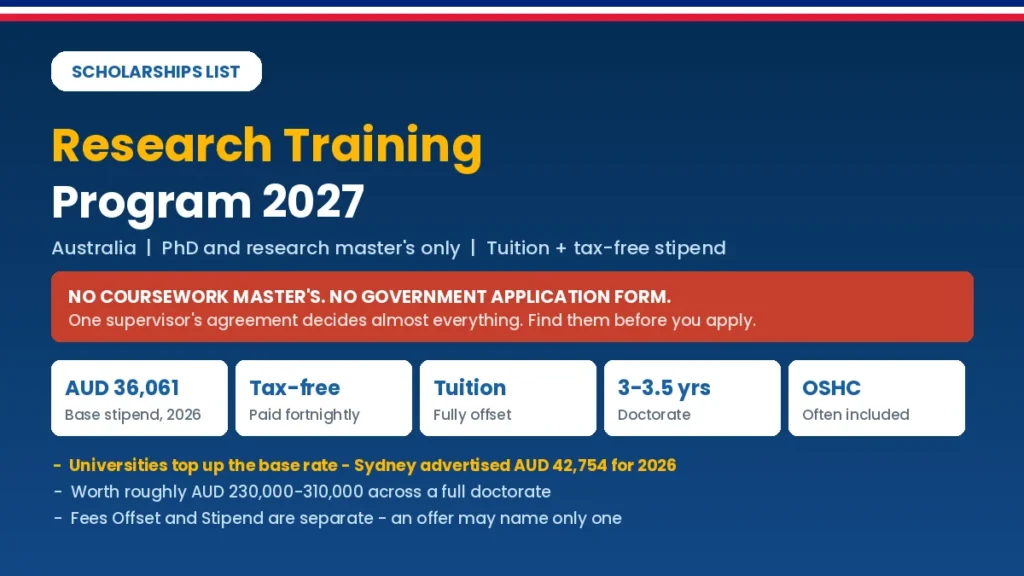
That is not a criticism of the program. RTP funds Australian doctorates and research master’s degrees properly full tuition, a tax-free living stipend of roughly AUD 36,000 a year, and at many universities your health cover and relocation costs as well. Over a four-year PhD, that package runs past AUD 250,000. Nothing else on the Australian scholarship landscape comes close for an international student.
The catch is the one nobody states plainly. RTP funds research degrees only. A coursework Master’s , the MBA, the Master of Data Science, the Master of Public Health that most international applicants want cannot touch it. And there is no application portal, no deadline published by the government, and no selection committee in Canberra. The Australian Government hands the money to universities as a block grant, and the universities decide who gets it.
In practice that means one thing. Your entire chance rests on persuading an academic to supervise you, and almost everything written about RTP skips that part to talk about stipend figures.
This guide covers what RTP actually pays, who qualifies, how the money reaches you, how to find a supervisor who will say yes, and the realistic competition you face.
What RTP Actually Is
The Australian Government funds research in universities through a set of block grants. The Research Training Program is the part aimed at students, and it supports what Australia calls Higher Degree by Research candidates doctorates and research master’s degrees.
The government calculates each university’s share using a formula based on research income, research output and how many research students that university successfully gets through to completion. Universities that bring in more research funding and finish more candidates receive a bigger grant.
Once the money arrives, the university runs its own competition. It decides how many scholarships to offer, how to split them between domestic and international students, what the selection criteria look like, when applications close, and whether to top up the government’s base stipend from its own funds.
So “RTP Scholarship” is not one scholarship. It is around forty different scholarships, one at each Australian university, funded from the same federal pot and operating under the same broad rules.
That is why you will find RTP pages at the University of Melbourne, Monash, UNSW, Queensland, Sydney, Adelaide, Flinders, Curtin, Griffith, Deakin and every other Australian university, each with different numbers and different deadlines.
The Three Things RTP Pays For
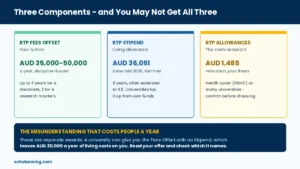
RTP splits into three components, and understanding the split protects you from a painful misunderstanding.
RTP Fees Offset
This covers your tuition. For an international PhD candidate, that alone removes roughly AUD 35,000 to AUD 50,000 a year depending on the discipline, since laboratory-based research costs far more than desk-based research.
A Fees Offset typically runs for up to four years for a doctorate and two years for a research master’s.
RTP Stipend
This is your living allowance, paid fortnightly, and in Australia it arrives tax-free. The 2026 base rate sits at about AUD 36,061 a year for full-time study, indexed upwards each January.
Universities often pay above the base rate from their own funds to compete for strong candidates. The University of Sydney, for instance, has advertised an RTP international stipend of AUD 42,754 for 2026. A difference of nearly AUD 7,000 a year across three or four years is worth paying attention to when you choose where to apply.
Stipend duration usually runs three years for a doctorate, with a possible extension to three and a half, and two years for a research master’s. Universities express this in different units Sydney counts fourteen research periods for a doctorate and seven for a master’s, but the length works out similarly.
RTP Allowances
The third component covers the smaller costs around a research degree. Depending on the university, it can include a relocation or establishment allowance of around AUD 1,485, thesis production costs of roughly AUD 420 for a master’s and AUD 840 for a doctorate, and crucially for international candidates Overseas Student Health Cover.
That last one matters more than its size suggests. OSHC across a four-year PhD for a single student runs well past AUD 2,000, and considerably more for a family. Not every university includes it. Check before you choose.
The misunderstanding to avoid: these three components are separate awards. A university can give you a Fees Offset without a Stipend. Receiving “an RTP scholarship” that covers tuition but pays nothing to live on is a real outcome, and it leaves you funding AUD 30,000 a year of living costs yourself. Read your offer carefully and establish exactly which components it names.
Who Qualifies, and Who Does Not
RTP funds research degrees only. A doctorate, usually a PhD, or a research master’s such as an MPhil or a Master of Research. If your target is a coursework master’s, RTP will not fund it no matter how strong your record is. This single filter removes the large majority of people who search for it.
You need a qualifying prior degree. For a PhD, that normally means a research master’s, or a bachelor’s with honors at first-class or upper second level, or a master’s with a substantial research component. A coursework master’s with no thesis often falls short, and applicants from systems without an honors year are sometimes asked to complete a Master of Research first. Treat that as a route rather than a rejection.
You need English at research level. Most universities ask for IELTS 6.5 overall with no band below 6.0, and many research schools set 7.0 for humanities and social sciences. Check the faculty requirement, not just the university minimum, and note that some universities require your test to remain valid through to enrolment.
You need a supervisor. More on this below, because it decides everything.
International students qualify, and that is worth stating plainly because older guides suggest otherwise. Universities support both domestic and international candidates from the same grant and set their own balance between the two.
The Supervisor Is the Whole Application
Everything else in this guide is detail. This section is the scholarship.
Australian universities will not award an RTP scholarship to a candidate no academic has agreed to supervise. The practical sequence runs: find a supervisor, secure their agreement, apply for admission with their support, then apply for the scholarship. Applicants who start at step four and never do step one receive a polite rejection and never understand why.
A supervisor’s agreement also carries weight inside the selection committee. The academic writes supporting comments, argues for your project in a faculty meeting, and often knows what the panel values. A lukewarm supervisor produces a lukewarm application.
How to find one
Read, then write. Find three or four academics whose recent publications overlap with what you want to do. Read a paper each, properly. The specificity this gives you is what separates your email from the twenty generic ones they received that month.
Send a short email. Around 150 to 200 words. Name the paper, state the question you want to work on, say how it connects, name the scholarship round you intend to apply for, and ask one easy question.
Here is the shape:
Dear Dr Nguyen,
I am completing an MPhil in soil science at the University of Agriculture Faisalabad, working on salinity tolerance in wheat under deficit irrigation.
Your 2025 paper on root-zone salinity mapping used the sensor array I have been trying to replicate on smallholder plots in Punjab, where the readings drift badly in high-clay soils. I think the correction you applied might transfer, and I would like to test it.
I am preparing an application for the RTP round closing in August and would like to ask whether you are taking doctoral candidates for 2027. I can send a two-page proposal if that would help.
Kind regards, Usman Riaz
Attach your CV, nothing else. No transcripts, no certificates, no photograph. Those come later.
Expect silence from most. One reply in four is normal and not a judgment on you. Write to eight academics across three universities rather than to one professor you admire.
Follow up once, after two weeks, in three sentences. Then move on.
Writing the Research Proposal
Most universities ask for a proposal of two to ten pages. It is the document the selection panel actually argues about.
Start with the problem, not the field. One paragraph that states what is unknown and why it matters. A panel member from another discipline should follow it.
Show the gap in the literature precisely. Name four or five papers and say what each one established and where it stopped. This is the paragraph that proves you have read rather than skimmed.
Give a methodology with enough detail to judge. What data, from where, analyzed how. If you need equipment, name it and say whether the host department has it. Panels reject proposals that could not be carried out in the place applying for them.
Include a timeline across three years. Year one for the literature and the first study, year two for data collection, year three for analysis and writing, with a conference and a paper marked in. A realistic timeline signals someone who will finish, and completion rates are exactly what universities earn their RTP grant on.
State the contribution plainly. What will be known at the end that is not known now.
Fit the proposal to the department. The same project rewritten for three universities should read differently each time, because each department has different strengths.
Your Real Odds
The competition is heavy, and the honest numbers help you plan how many applications to send.
RTP scholarships at large research universities number in the dozens to low hundreds each year across all disciplines, and international candidates compete for a portion of those. Smaller universities offer far fewer. Flinders University, for example, has advertised five RTP international scholarships in a single round and described the competition as highly competitive, which it plainly is.
What shifts the odds in your favor:
Publications. Even one peer-reviewed paper as a named author moves you ahead of most applicants. Several universities cap the number they will count, often at five, which tells you they see enough applicants with publications for it to matter.
A supervisor who wants you specifically. An academic with funding, a project and a gap in their team argues harder than one being polite.
Research experience that shows independence. A completed thesis, a research assistantship, fieldwork you organized yourself.
Applying to several universities. Deadlines differ, the competitions are separate, and the effort of a second application is far smaller than the first once the proposal exists.
Applying where your topic is a strength rather than a curiosity. A mining-related proposal is stronger at Curtin or Queensland than at a university with no mining group, however highly ranked.
The Timeline That Works
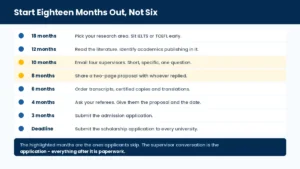
RTP rounds vary between universities, but a common pattern has one major international round closing around August for a start the following year, with a second domestic-heavy round later. Some universities run rolling rounds. Confirm each one individually.
Working backwards from an August deadline:
Eighteen months out. Decide your research area. Sit IELTS or TOEFL early, because a retake later compresses everything.
Twelve months out. Read widely in your target area and identify the academics publishing in it. Draft your proposal’s core question.
Ten months out, around October. Write to your first group of supervisors. This is early by most applicants’ standards, which is why it works.
Eight months out, December. Convert the replies. Share a two-page proposal with anyone who answered, and let them shape it. Their edits are the most valuable feedback you will get.
Six months out, February. Request transcripts and arrange certified copies and translations. This takes longer in most countries than people allow.
Four months out, April. Ask your referees. Give them your proposal, your CV and the deadline, and ask them in person where you can.
Three months out, May. Submit the admission application. Most universities require admission alongside or before the scholarship application.
Deadline month, August. Submit the scholarship application to every university on your list.
After the offer. Expect results in the following months, then apply for the subclass 500 visa. A scholarship letter stating your stipend and tuition cover does most of the financial-capacity work for the visa, which is one more practical advantage of a full RTP package.
What the Package Is Actually Worth
Scholarship pages quote the stipend and stop there, which undersells RTP considerably. Add the components up across a full doctorate and the scale becomes clear.
Take an international PhD candidate in a laboratory discipline at a research-intensive university, starting in 2027 and finishing in three and a half years:
| Component | Over the degree (AUD) |
|---|---|
| Tuition, at roughly 45,000 a year for four years | 180,000 |
| Stipend, at 36,061 a year for three and a half years | 126,200 |
| Overseas Student Health Cover, single | about 2,400 |
| Relocation allowance | 1,485 |
| Thesis production | 840 |
| Total | about 310,900 |
A desk-based discipline with lower tuition lands nearer AUD 230,000. A topped-up stipend at a university paying AUD 42,754 adds roughly AUD 23,000 more across the same period.
Two things are worth drawing out of that table.
The stipend is tax-free. An Australian earning AUD 36,000 as salary keeps noticeably less after income tax. Comparing an RTP stipend against an advertised graduate salary without adjusting for that understates it.
Tuition is the larger half. Applicants fixate on the stipend because it arrives in their account, but the Fees Offset is usually worth more. That is exactly why an offer naming only one component changes your situation so completely.
What the package does not cover: dependents. A partner and child raise your visa evidence requirement and your living costs substantially, and the stipend does not scale. Universities occasionally offer a small dependent allowance, but most do not. Candidates bringing families should budget for a partner working, which Australian student visas generally permit for research candidates on broader terms than for coursework students.
Where to Apply, by Field
Australia has around forty universities, and research strength concentrates unevenly. Applying where your field is a priority improves both your supervision and your odds, because departments argue hardest for candidates in areas they are building.
The Group of Eight:
Melbourne, Sydney, ANU, UNSW, Queensland, Monash, Western Australia and Adelaide hold the largest research grants and therefore the largest RTP allocations. They also attract the most applications. Strong candidates should apply here, but not only here.
Mining, geology and petroleum:
Curtin, Queensland, Western Australia and the University of Adelaide. Curtin’s standing in minerals and mining engineering is genuinely world-leading and far ahead of its overall ranking.
Agriculture, food and water:
Queensland’s Gatton campus, Charles Sturt, Adelaide, Western Australia and La Trobe. For applicants from agricultural economies this is often the strongest fit in the country.
Marine, tropical and environmental science:
James Cook University, which holds a position in tropical marine research that larger universities do not match.
Medical and health research:
Melbourne, Monash, Sydney and Queensland, each tied to major hospital and institute networks. Competition here is heavy and publications matter more than anywhere else.
Engineering and computing:
UNSW, Monash, Melbourne, Queensland, RMIT and the University of Technology Sydney. RMIT and UTS fund well and receive fewer international applications than the Group of Eight.
Education, policy and social sciences:
ANU for policy and political science, Melbourne for education, Deakin and Griffith for applied social research.
Regional universities:
Charles Darwin, University of Southern Queensland, Federation, University of New England run smaller RTP allocations but far smaller applicant pools. For a candidate whose topic suits them, the odds there beat the Group of Eight comfortably, and the degree still carries Australian accreditation.
A practical approach: apply to two Group of Eight universities where your topic genuinely fits, two mid-tier universities with a specific strength in your area, and one regional university where your project matches local research priorities. Five applications built from one proposal is a weekend of work after the first one exists.
Six Mistakes That Cost Applicants an RTP Scholarship
Searching for a government application form. None exists. The money reaches you through a university, and the university’s own deadline is the one that binds.
Applying for a coursework master’s. RTP funds research degrees only. No amount of academic strength changes that.
Emailing supervisors three weeks before the deadline. Academics answer slowly and need time to build a case for you internally. October for an August deadline is the right order of magnitude.
Sending the same proposal everywhere. Panels notice a proposal written for a different department. The core research can stay; the fit paragraphs must change.
Assuming an RTP offer covers everything. Fees Offset and Stipend are separate components. Confirm which ones your offer names, and whether health cover is included.
Ignoring the top-up difference. A base-rate stipend and a topped-up one differ by thousands of dollars a year. The figures sit on each university’s scholarship page.
RTP Compared With the Alternatives
Australia Awards Scholarships are the development-focused Australian government programme, covering tuition, airfares, a living allowance and health cover for applicants from eligible developing countries, with a requirement to return home for two years afterwards. If your country appears on the list, apply for both, they run separately and the deadlines rarely clash.
Destination Australia pays AUD 15,000 a year to students at regional campuses and covers no tuition. For a research candidate, RTP outclasses it by an order of magnitude, though the two can sometimes sit alongside each other.
University-specific PhD scholarships often run on the same application form as RTP. Ticking the box costs nothing and these awards sometimes come with better terms.
European doctorates pay through employment contracts in several countries, which means a salary, pension contributions and labor protections rather than a stipend. The gross figures look similar; the conditions differ considerably.
Industry-funded PhDs in Australia attach to a company partner and often pay a top-up above the RTP base. These rarely appear on scholarship lists because supervisors recruit for them directly, which is one more reason to email academics rather than to scan award pages.
The honest summary: for an international student who wants a funded research degree, RTP is the strongest Australian option and one of the strongest anywhere. For anyone wanting a taught master’s, it does not apply at all.
Doing a PhD in Australia — What to Expect
Australian doctorates run on research from day one. There is little or no coursework, no qualifying examination in the American style, and a thesis examined by external examiners at the end. Candidates from systems built around taught components find the independence demanding in the first six months.
The expected completion time sits around three to three and a half years full-time, and universities take it seriously because their RTP grant depends partly on completions. Expect regular progress reviews.
A tax-free stipend of AUD 36,000 to AUD 43,000 compares reasonably with an entry-level Australian salary once you account for the tax difference, and it stretches considerably further outside Sydney and Melbourne. Many candidates add tutoring or research assistant work, usually capped at a set number of hours a week by the scholarship conditions.
Bringing family is possible on the student visa, and partners of research candidates generally receive broader work rights than partners of coursework students. Budget carefully: the visa requires additional financial evidence for each dependant, and school fees apply for children in several states.
Frequently Asked Questions
Can international students get an RTP scholarship?
Yes. Universities fund both domestic and international candidates from the same government grant and set their own balance.
How much is the RTP stipend?
The 2026 base rate sits at about AUD 36,061 a year, tax-free, indexed each January. Many universities top it up Sydney has advertised AUD 42,754 for 2026.
Does RTP cover tuition?
The Fees Offset component does. It is a separate component from the stipend, and some offers include only one of them.
Can I use RTP for a coursework master’s?
No. It funds research degrees only doctorates and research master’s degrees.
Where do I apply? At the university, not the government. Each institution runs its own round with its own deadline.
Do I need a supervisor before applying?
In nearly every case, yes. Securing one is the first step, not the last.
Does it cover health insurance?
At many universities, yes, through the allowances component. Confirm it for the specific university, because practice varies.
How long does it last?
Usually three years for a doctorate with a possible half-year extension, and two years for a research master’s. The Fees Offset often runs up to four years.
Part of our complete guide to scholarships in Australia for international students — every major award compared.