
Austrian Government Scholarships
Austria funds international students, but almost certainly not in the way you expect.
Search “Austrian Government Scholarship” and you will find dozens of posts promising a fully funded Master’s degree in Vienna. Most of them describe something that does not exist. Austria runs no single national scholarship that pays for a two-year Master’s degree for a general international applicant the way DAAD, Chevening or the Türkiye Burslari do.
What Austria runs instead is a family of grants under one agency, the OeAD, and nearly all of them fund short research stays of one to nine months for PhD students, postdocs and university teachers. A handful reach Master’s-level students. One reaches undergraduates. None of them hands a school-leaver a funded degree.
That sounds like bad news. It is not, and this guide explains why. Austria’s real offer to international students is different and in some ways better: public universities charge non-EU students about €726 a semester, which is roughly what one month of rent costs in Vienna. The money problem in Austria is living costs, not tuition. Once you understand that, the whole picture changes, and so does your strategy.
This guide covers every OeAD programme worth knowing, the exact amounts, the deadlines, who qualifies, and the route most international students actually take to study in Austria. It also tells you plainly where you do not qualify, because a wasted application costs you weeks.
What “Austrian Government Scholarship” Really Means
Austria has no Ministry of Scholarships. Funding flows through the OeAD,Austria’s Agency for Education and Internationalization, a federal agency that administers grants on behalf of the government, individual ministries and a few foundations.
Every OeAD grant lives on one portal: grants.at. You search it, you find the programme that fits, and you apply there. No agent sits between you and that portal, and nobody can file an application on your behalf in a way that improves your chances.
The important thing to grasp early is the shape of the offer. OeAD grants cluster around research mobility. The agency wants a Nigerian PhD student spending six months in a Graz laboratory, a Vietnamese postdoc finishing a paper in Innsbruck, a Georgian lecturer of German literature reading archives in Vienna. Austria funds these stays generously. It does not fund a general Master’s intake.
Three programmes break that pattern slightly, and they matter most to the readers of this site. We will get to them.
The Ernst Mach Grant Family
Ernst Mach was an Austrian physicist, and his name now covers the main OeAD grant line. It is not one scholarship. It is four or five, each with a different target group, and applicants routinely apply to the wrong one.
Ernst Mach Grant — Worldwide
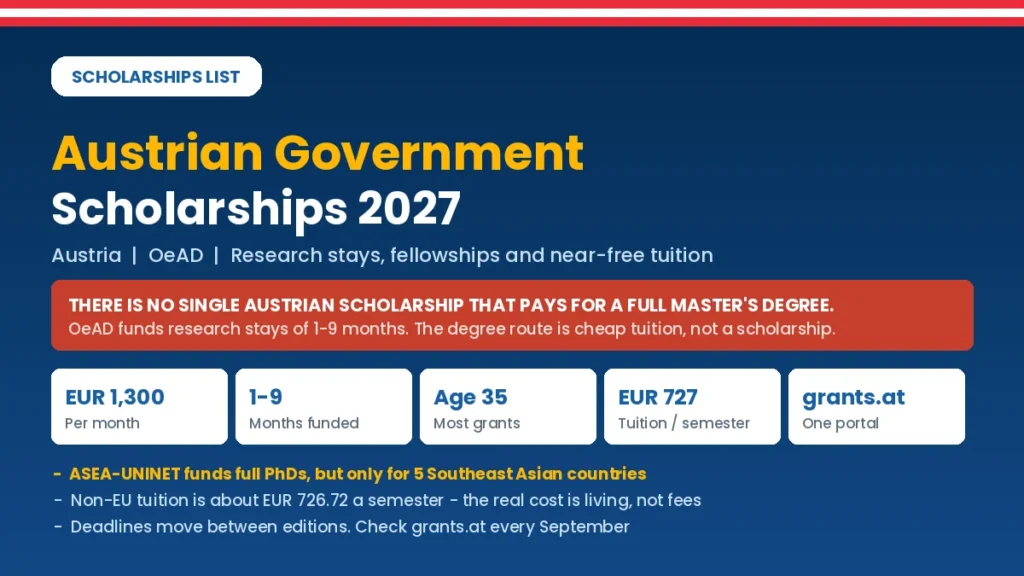
This is the flagship. It funds young researchers from any country except Austria for a research stay of one to nine months at an Austrian university or research institution.
You need a doctorate in progress or already completed, or a comparable research position. The age limit sits at 35. An Austrian supervisor must agree to host you before you apply, and that agreement is the real hurdle, not the paperwork.
The monthly grant runs around €1,300. OeAD also helps arrange accident and health insurance and offers access to its own student housing, where rooms run roughly €330 to €800 a month plus a €24 administration fee.
Note what this grant does not do. It does not fund a degree. You stay enrolled at your home university, you go to Austria for a few months, you do research, you go home. For a PhD student, that is a superb addition to a CV and often the start of a long collaboration. For someone hoping Austria will pay for their Master’s, it is the wrong door.
Ernst Mach Grant for Universities of Applied Sciences
This one reaches further down the academic ladder, and most guides miss it.
It funds undergraduate and graduate students from non-European universities to study for four to ten months at an Austrian Fachhochschule,a university of applied sciences. Bachelor’s students qualify after completing four semesters. The age limit is again 35.
The grant pays about €1,300 a month, and OeAD assists with insurance and housing. You cannot have studied or worked in Austria during the six months before the stay begins.
For a Pakistani, Indian, Nigerian or Indonesian undergraduate, this is one of the very few Austrian routes that opens at Bachelor’s level. It still funds an exchange rather than a degree, so plan it as a semester abroad inside your existing programme.
Ernst Mach Follow-Up Grant
A smaller programme, and a rewarding one if you qualify. It brings back postdocs and lecturers from non-European developing countries who already held an OeAD grant, for a stay of one to three months. At least three years must have passed since your last OeAD-funded visit, and the age limit rises to 45.
Think of it as a return ticket for an alumnus. If you held an Ernst Mach grant in 2022, you can come back.
Ernst Mach Grant — ASEA-UNINET
Austria maintains a university network with Southeast Asia, and this grant sits inside it. It serves students and researchers from Indonesia, Malaysia, the Philippines, Thailand and Vietnam.
The terms differ from the worldwide version in one significant way. Alongside stays of up to nine months, ASEA-UNINET supports full PhD programmes of up to 36 months. That is the closest thing in the entire OeAD catalogue to a fully funded degree, and it is restricted to five countries. A separate short-term research grant covers postdocs from those countries plus Cambodia, Laos and Myanmar, with rolling applications submitted two to nine months before the stay.
If you hold one of those five passports and you want a funded doctorate in Europe, read the ASEA-UNINET terms carefully. Very few people outside those countries can access anything comparable.
Franz Werfel and Richard Plaschka Fellowships
Two programmes serve a narrow and specific audience: young university teachers.
The Franz Werfel Fellowship funds teachers of German language and Austrian literature for four to nine months in Austria. It also builds a long-term network Werfel alumni keep access to follow-up grants and an annual conference, which matters more over a career than the stipend does.
The Richard Plaschka Fellowship does the same for teachers of historical sciences whose work focuses on Austrian history, with stays running four to eighteen months.
Both close twice a year, on 1 March and 15 September.
These fellowships reward a genuine and demonstrable connection to Austria. A scholar of Habsburg administrative history has a strong case. A general European historian who mentions Austria once in a research plan does not.
The Scholarship Foundation of the Republic of Austria
This programme deserves its own section, because its eligibility rule surprises almost everyone who reads it.
The Foundation funds postdoctoral researchers under 35 working at institutions outside Austria, at about €1,050 a month, with health insurance, accommodation support and travel costs for applicants from outside the EU, EFTA and OECD. Applications close on 1 April.
The surprise sits in who may apply. The Foundation prioritizes descendants of people subjected to forced labor under the Nazi regime, and applicants from countries that suffered particularly under Nazi occupation and forced-labor recruitment. Austria set this programme up as a form of historical redress, and the eligibility reflects that purpose rather than an academic ranking.
Read the current call before you assume you qualify or that you do not. The country list and the wording have shifted over the years.
The Deadlines That Actually Matter
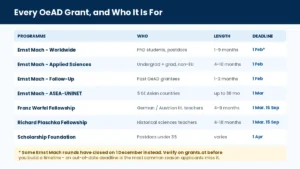
OeAD deadlines move between editions, and several sub-programmes close on different dates in the same year. The pattern below held for the 2026/27 round. Treat it as a planning guide and confirm each date on grants.at before you build a timeline around it.
| Programme | Who it serves | Length | Typical deadline |
|---|---|---|---|
| Ernst Mach Worldwide | PhD students, postdocs, researchers | 1–9 months | 1 February (some rounds open September, close 1 December) |
| Ernst Mach Universities of Applied Sciences | Undergraduates and graduates, non-European universities | 4–10 months | 1 February |
| Ernst Mach Follow-Up | Former OeAD grantees, developing countries | 1–3 months | 1 February |
| Ernst Mach ASEA-UNINET | Five Southeast Asian countries | Up to 9 months, or 36 for a PhD | 1 March |
| Franz Werfel | Teachers of German and Austrian literature | 4–9 months | 1 March and 15 September |
| Richard Plaschka | Teachers of historical sciences | 4–18 months | 1 March and 15 September |
| Scholarship Foundation | Postdocs under 35 | Varies | 1 April |
One date carries a trap. Several Ernst Mach calls have shifted their closing date between February and December in recent cycles, which means an applicant working from a two-year-old blog post misses the window entirely. Check grants.at in September every year, not in January.
The Route Most International Students Actually Take
Here is the part other guides skip, and it is the most useful thing on this page.
If you want a full degree in Austria and no OeAD programme fits you, you have not reached a dead end. You have reached the normal route, and tens of thousands of international students use it.
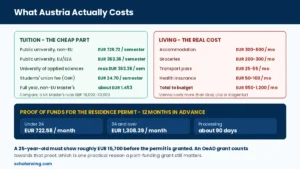
Austrian public universities charge non-EU students about €726.72 per semester. That comes to roughly €1,453 for a full academic year. A university of applied sciences charges at most €363.36 a semester. Every student also pays the Austrian Students’ Union fee, the ÖH-Beitrag, at about €24.70 a semester, which includes basic insurance.
Compare that with the United Kingdom, where a Master’s degree costs £18,000 to £30,000, or the United States, where it costs more. Austria’s tuition is a rounding error by comparison. For many applicants, a self-funded Austrian degree costs less overall than a scholarship application cycle spent chasing funding elsewhere.
So the real question in Austria is not tuition. It is living costs, and the immigration office asks about them before you arrive.
What Austria requires you to prove
For a student residence permit, you must show funds for twelve months in advance:
- Under 24 years old: €722.58 per month
- 24 and over: €1,308.39 per month
For a 25-year-old Master’s applicant, that means demonstrating roughly €15,700 in an accessible account before the permit is granted. A confirmed scholarship counts toward this proof, which is one practical reason an OeAD grant helps even when it covers only part of a stay.
Processing takes about 90 days, and can stretch another 90 if the authority requests documents. Apply three months before you plan to travel at minimum, and six months if your semester start is fixed.
What living actually costs
Budget €850 to €1,200 a month. Accommodation takes €300 to €600 of that, groceries €200 to €300, a transport pass €25 to €55, and health insurance €50 to €100. Vienna costs more than Graz, Linz or Klagenfurt, and the gap is wide enough to influence where you apply.
International students may work alongside their studies within the hours their permit allows, and student jobs in Vienna pay reasonably. Do not build your budget on that income, though. The immigration authority wants the money proven in advance, not earned later.
What Decides an OeAD Application
For the grants that do fit you, selection turns on a small number of things.
The host supervisor comes first. For every Ernst Mach variant, an Austrian academic must agree to host you. This is not a formality. The strength of that letter, and the specificity of what you plan to do in their group, carries more weight than your grades. Write to potential supervisors four to six months before the deadline, with a short email, a clear research question that connects to their published work, and a CV attached.
The research plan comes second. OeAD reviewers want to see why this work needs Austria. A plan that could run anywhere reads as a travel request. A plan that needs a specific instrument, archive, dataset or research group in Graz or Vienna reads as a research proposal. Name the thing.
Your record comes third, and it matters less than applicants assume. These grants reward fit over prestige. A good student from a modest university with a precise plan and an enthusiastic host beats a brilliant student with a vague plan and a lukewarm one.
Language rarely blocks you. Austrian research runs in English at postgraduate level, and most Master’s programmes taught for international students run in English too. Bachelor’s degrees at public universities mostly run in German, which is the single biggest barrier for school-leavers. If German stands between you and a Bachelor’s place, budget a year for it and reach B2 before applying.
The Email That Finds You a Host Supervisor
Everything in an Ernst Mach application depends on one Austrian academic saying yes. Applicants spend weeks polishing a research plan and ten minutes on the email that decides whether anyone reads it.
Austrian professors receive a wave of these messages every autumn, and most of them follow the same template: a long paragraph of admiration, a list of grades, an attached transcript, and no clear request.
Those go unanswered
A good one runs about 150 words and does four things. The message should name the specific person or research that connects to your work. It should also state what you want to do in the lab group concretely. Include the exact dates, and finish with one question that takes thirty seconds to answer.
Here is the shape:
Dear Professor Huber,
I am a second-year PhD student in environmental engineering at the University of Nairobi, working on nitrate transport in shallow aquifers.
Your 2024 paper on isotope tracing in alpine groundwater describes the sampling protocol I have been trying to adapt to tropical conditions, without the instrumentation to validate it. Your group has that instrumentation.
I would like to apply for an OeAD Ernst Mach Grant for a six-month stay between March and August 2027, running isotope validation on twelve field samples I have already collected.
Would you be willing to host me? I can send a two-page plan if that helps you decide.
Kind regards, Grace Mwangi
Send three of these to three different groups. Do not send one message to twelve people with the names swapped, because Austrian departments are small and colleagues talk.
Expect silence from most of them. One reply out of three is a good rate, and one yes is all the application needs.
Which Austrian Universities Do What
Choosing a host institution well strengthens a research plan, and the choice narrows faster than applicants expect once you look at what each place is known for.
University of Vienna is the largest, with real depth in humanities, law, social sciences and theoretical physics. Austrian history, German literature and philosophy run deep here, which matters for Werfel and Plaschka applicants.
TU Wien covers engineering, computer science, architecture and applied mathematics. Its tuition page is the one most non-EU students read first, because its fee structure is typical of the public system.
University of Graz and TU Graz together form a strong second cluster Graz for medicine, pharmacy and plant science, TU Graz for materials, automotive engineering and information security.
University of Innsbruck owns alpine and environmental research, glaciology, atmospheric science and mountain medicine. If your work touches high-altitude or cold-region questions, Innsbruck is the obvious case to make.
BOKU Vienna specializes in agriculture, forestry, water management, biotechnology and natural resources. For applicants from agricultural economies, BOKU often fits better than a general technical university.
Montanuniversität Leoben is small and globally respected in mining, metallurgy, petroleum engineering and materials. It attracts far fewer applications than Vienna.
Medical Universities of Vienna, Graz and Innsbruck run separately from their namesake universities, with their own admission routes.
The universities of applied sciences FH Technikum Wien, FH Joanneum, FH Salzburg and others matter specifically because the Ernst Mach applied-sciences grant targets them. They run practical, industry-linked programmes with smaller classes and lower fees, and they receive fewer international applications than the big universities do.
Your Document Checklist
OeAD applications run through grants.at, and the portal rejects incomplete files rather than chasing you for the missing piece. Assemble these before you open the form.
Always required:
- Passport copy, valid well beyond your intended stay
- Curriculum vitae, including date of birth, because the age limits run on it
- Degree certificates and academic transcripts, with certified English or German translations where the originals use another language
- Letter of acceptance or invitation from your Austrian host supervisor
- Research plan or study plan, usually two to four pages
- List of publications, where you have any
Often required, depending on the programme:
- Two letters of recommendation from academics who taught or supervised you
- Proof of language ability, where the host institution asks for it
- A confirmation letter from your home university stating your current enrolment or employment
- An abstract of your doctoral thesis, for Ernst Mach Worldwide applicants
Worth preparing early, even though the grant application does not ask for it:
- Proof of funds for the residence permit, since the grant alone rarely satisfies the twelve-month requirement
- Birth certificate and, where relevant, marriage certificate, both legalized for use in Austria
- A police clearance certificate, which several residence authorities request and which takes weeks to obtain in many countries
Certified translation and document legalization cause more missed deadlines than any other step. In some countries legalization runs through two ministries and a consulate and takes six weeks. Start that process the same week you decide to apply.
Six Mistakes That Cost Applicants an Austrian Grant
Applying to the wrong Ernst Mach. The worldwide grant, the applied-sciences grant and the ASEA-UNINET grant have different target groups and different deadlines. Applicants submit to the wrong one every year and the application fails on eligibility alone, before anyone reads the research plan.
Working from last year’s deadline. OeAD moves dates. One Ernst Mach call shifted from February to December between editions. Verify on grants.at every time.
Contacting a supervisor three weeks before the deadline. Austrian academics answer in their own time, and an agreement arranged in a rush reads like one. Start in autumn for a spring deadline.
Treating the six-month rule as flexible. Most OeAD grants exclude anyone who studied or worked in Austria during the six months before the stay starts. People discover this after accepting an internship in Vienna.
Assuming the grant covers a degree. It does not, except for ASEA-UNINET PhDs. An applicant who writes a motivation letter about completing a Master’s in Austria has told the reviewer they misread the programme.
Ignoring the proof-of-funds requirement until the permit stage. A grant of €1,300 a month for six months does not satisfy a twelve-month funding proof on its own. Work out the gap early and arrange the rest.
Austria Compared With the Alternatives
If Austria does not fit, these do similar work for similar applicants.
Germany, through DAAD, funds full Master’s degrees for international students, which Austria mostly does not. German public universities also charge almost no tuition. For a general international applicant wanting a funded degree in German-speaking Europe, DAAD is simply the stronger target.
Denmark and the Nordics fund fewer non-EU students than their reputation suggests, and charge real tuition when they do.
Hungary’s Stipendium Hungaricum funds full degrees at Bachelor’s, Master’s and PhD level for dozens of partner countries, with tuition, a stipend and accommodation. For the applicant who wants funded study in Central Europe, it beats Austria on coverage even though it loses on university prestige.
Switzerland’s Government Excellence Scholarships target research stays like Austria’s do, pay considerably more, and compete far harder.
The honest summary: Austria is excellent for a funded research stay, excellent for a cheap self-funded degree, and weak for a fully funded taught Master’s. Match your situation to that.
Living and Studying in Austria
Austrian universities run on independence. Nobody chases you about attendance, nobody reminds you about registration deadlines, and a missed exam registration costs you a semester. Students from closely supervised systems find this bracing in the first term.
Vienna holds one of Europe’s largest student populations and the cost of living to match. Graz, Innsbruck, Linz, Salzburg and Klagenfurt cost less and run excellent departments,Graz for physics and medicine, Leoben for materials and mining, Linz for mechatronics and software.
German helps enormously outside the lecture hall even when your programme runs in English. Administrative offices, rental contracts and part-time work all happen in German. An A2 before arrival and a B1 within a year changes the experience completely.
Winters are long and dark, and the January gap between semesters is quieter than new arrivals expect. Build a social life early, in a sports club or a student association, rather than waiting for it to appear.
INTERNAL LINKING
Do this after the post is live. The first table adds links out of this post. The second table adds links into it, which is what keeps it off the Yoast orphaned-content list.
Related Guides:
- Danish Government Scholarships
- Invest Your Talent in Italy
- Konrad Adenauer Scholarship Germany
- Polish Government NAWA Scholarship
Frequently Asked Questions
Is there a fully funded Austrian Government Scholarship for a Master’s degree?
Not as a general programme. OeAD funds research stays of one to nine months, and the ASEA-UNINET line funds full PhDs for five Southeast Asian countries. For a taught Master’s, the Austrian offer is near-free tuition rather than a scholarship.
Can Pakistani, Indian or Nigerian students apply?
Yes, to the worldwide Ernst Mach grants and to the applied-sciences grant, which are open to applicants from any country outside Austria. The ASEA-UNINET line is not open to them.
Do I need an admission letter before applying?
For Ernst Mach grants you need a host supervisor’s agreement rather than formal admission. For degree study you need admission before the residence permit.
Do I need German?
For most English-taught Master’s programmes and for research stays, no. For a Bachelor’s at a public university, usually yes, at B2 or higher.
How much money must I show for the visa?
€722.58 a month if you are under 24, €1,308.39 a month if you are 24 or over, for twelve months.
Can I work while studying?
Yes, within the limits your residence permit sets. Treat it as supplementary income, not as your funding plan.
What does OeAD student housing cost?
Roughly €330 to €800 a month depending on city and room type, plus a €24 administration fee.
Is there an age limit?
Yes. Most Ernst Mach grants cap at 35, the Follow-Up grant at 45, and the Scholarship Foundation at 35.