
The KAS Scholarship Looks at Your Values Before It Looks at Your Grades
Most international scholarships assess academic excellence first. The Konrad Adenauer Foundation scholarship assesses character first and specifically, it is looking for candidates who align with a particular set of political and civic values.
The Konrad-Adenauer-Stiftung (KAS) is a political foundation, inspired by Christian democratic values, committed to fostering democracy and the rule of law, to implementing social and market-economic structures and to promoting human rights in Europe and worldwide.
This is not a background detail. It is the foundation of every selection decision. Unlike transactional funding schemes that reward test scores alone, the KAS scholarship for international students screens for civic engagement as rigorously as it does academic performance.
If you have strong academics but no record of civic engagement, community service, or commitment to democratic values, the KAS scholarship is not your best fit. Other scholarships (DAAD, GKS Korea, Chevening) will serve you better.
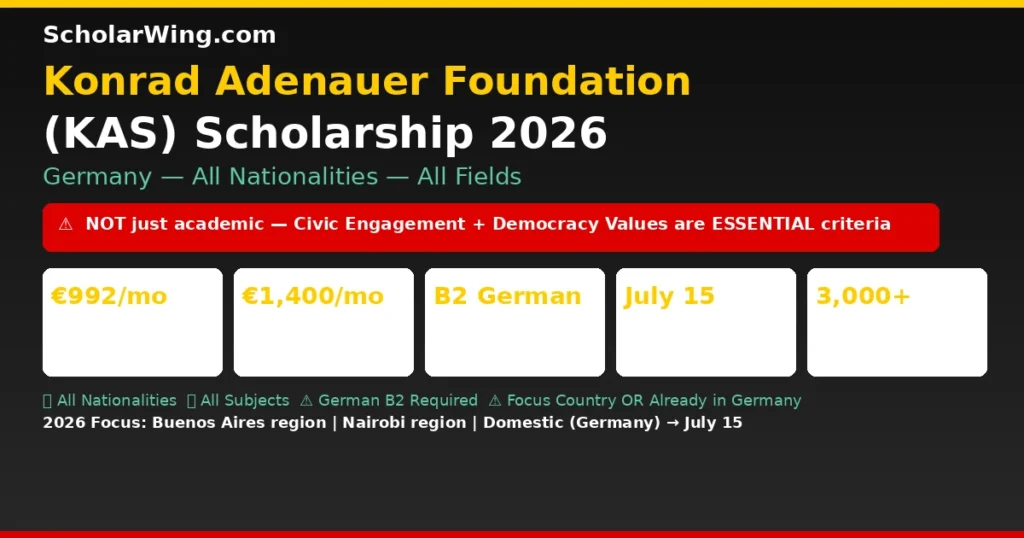
But if you have a history of civic work student leadership, community organizations, advocacy, voluntary service and if you are genuinely committed to democracy, rule of law, and human rights, then KAS offers one of Germany’s most comprehensive scholarship packages:
For Master’s or post-graduate students: monthly stipend of €992 for 2 years. For doctoral or PhD students: monthly stipend of €1,400 for 3 years.
Plus health insurance subsidy, family allowance, children’s allowance, and up to €1,500 per semester in tuition fee reimbursement, alongside access to a worldwide alumni network of over 3,000 international KAS scholars.
Today, more than 3,000 international alumni sit inside its global network, a reach few European scholarships can match.
Who Was Konrad Adenauer — Why the Foundation’s Values Matter
Konrad Adenauer was Germany’s first Federal Chancellor after World War II, serving from 1949 to 1963. He led West Germany’s post-war reconstruction, anchored Germany in Western democratic alliances (NATO, European integration), and built the Christian Democratic Union (CDU) as the dominant centre-right party.
His political legacy rests on four pillars: democracy and rule of law, social market economy, European integration, and transatlantic partnership with the United States.
The Konrad-Adenauer-Stiftung (KAS) is the CDU/CSU’s affiliated political foundation. It operates globally through offices in over 100 countries, funding democracy promotion, civic education, and international partnerships.
When the KAS selects scholarship holders, it is looking for the next generation of leaders who will embody and advance these values in their home countries after studying in Germany.
After finishing their studies in Germany, the Konrad-Adenauer-Stiftung expects its former scholars to contribute actively to the development of their home country’s relations with the Federal Republic of Germany.
Full Financial Package — What KAS Covers
For Master’s / Postgraduate Students:
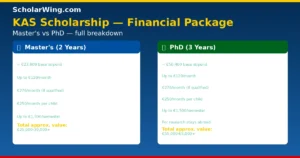
Monthly stipend of €992 for 2 years.
| Benefit | Amount |
|---|---|
| Monthly stipend | €992/month (2 years) |
| Health insurance subsidy | Up to €120/month |
| Family allowance | €276/month (if spouse qualifies) |
| Children’s allowance | €250/month per child in Germany |
| Tuition fee reimbursement | Up to €1,500 per semester |
| Research travel | Funded (for PhD) |
The overall stipend of €23,808 for postgraduate courses is divided into monthly instalments.
For Doctoral / PhD Students:
Monthly stipend of €1,400 for 3 years
| Benefit | Amount |
|---|---|
| Monthly stipend | €1,400/month (3 years) |
| Health insurance subsidy | Up to €120/month |
| Family allowance | €276/month (if spouse qualifies) |
| Children’s allowance | €250/month per child in Germany |
| Tuition fee reimbursement | Up to €1,500 per semester |
| Research travel | Funded for research stays abroad |
The overall stipend of €50,400 for doctoral courses is divided into monthly instalments.
Family Allowance Conditions:
Family allowance of €276 is provided that you and your spouse live together in Germany for three months and his/her income does not exceed the amount of €450 per month.
The German B2 Requirement — The Main Barrier
Applicants must have at least B2 level proficiency in German.
This is the single most significant eligibility barrier for international applicants who have not previously studied German.
B2 German means:
- Can understand the main ideas of complex text on both concrete and abstract topics
- Can interact with a degree of fluency and spontaneity that makes regular interaction with native speakers possible without strain
- Can produce clear, detailed text on a wide range of subjects
B2 is not basic German. It takes approximately 600-750 hours of study from zero to reach B2. For students without any German background, this represents 1-2 years of focused study.
Accepted German language certificates:
- Goethe-Zertifikat B2 (Goethe-Institut — most widely accepted)
- TestDaF (Test Deutsch als Fremdsprache)
- DSH (Deutsche Sprachprüfung für den Hochschulzugang)
- telc Deutsch B2
For students already in Germany: If you are enrolled at a German university and studying in German, your enrollment itself demonstrates language proficiency.
Practical advice: If you want to apply for KAS in 2027, begin German language learning immediately. Goethe-Institut has centers in Pakistan, Bangladesh, India, Nigeria, Kenya, Morocco, Indonesia, and most eligible countries. The B2 certificate is not just for KAS, it also opens applications to a broader range of DAAD programs and German university admissions.
Fields of Study — All Subjects at German Universities
Unlike DAAD EPOS (development-related fields) or ARES Belgium (specific program list), KAS has no field restriction.
Opportunity focus areas: All the available programs at German universities.
Law, medicine, natural sciences, engineering, humanities, social sciences, economics, music, arts, theology, any subject offered at German universities is eligible. This is one of KAS’s distinctive advantages over field-restricted scholarships.
Two Application Routes — The Critical Distinction
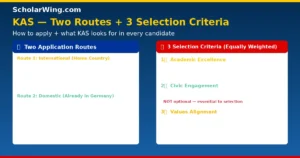
There are two ways to apply for our scholarship program: 1) Application via KAS offices abroad: If you are living in your home country or region, you can apply through your local KAS office. 2) If you already live in Germany, you may apply via the domestic selection process through the KAS Campus Portal.
Route 1: International Selection (Living in Home Country)
Only available if you are in a KAS focus country/region for the current cycle.
Each year, new focus countries or regions are determined for our selection procedures.
2026 confirmed focus regions: Regional selection interviews for 2026 will run through KAS offices in Buenos Aires (covering Argentina, Bolivia, Chile, Uruguay and Paraguay) and Nairobi (covering Kenya, Uganda/South Sudan, Tanzania and Ethiopia).
Previous cycles have included: Central Europe, Southeast Asia, Near East/Jordan, Western Africa, Russia, Ukraine, Turkey.
How international selection works:
- Identify whether your country is in a KAS focus region for the current year
- Contact the responsible KAS office for your region
- Submit written application directly to the KAS office
- KAS office conducts regional interviews
If your country is not in a focus region: Students living in countries that are not listed cannot apply for the international selection procedure.
This means many eligible nationalities must wait until their region becomes a focus region, or study in Germany first and apply domestically.
Route 2: Domestic Selection (Already in Germany)
If you are currently enrolled at a German university or about to begin a program in Germany, you apply directly through the KAS Campus Portal regardless of your nationality.
Deadline: July 15, 2026 at 12:00 noon CET via the KAS Campus Portal.
This is the more universally accessible route, any nationality, already in Germany, can apply domestically.
What “Civic Engagement” Means — The Values Requirement
Committed and gifted international students and doctoral candidates from any subject who can relate to and stand up for the goals of the Konrad Adenauer Foundation.
Character: eligible applicants are driven, open-minded and have a lot of potential to achieve the goals they have set for themselves in their academic studies and life.
KAS evaluates three equally weighted dimensions:
1. Academic Excellence Strong grades — the equivalent of a First Class or Distinction in your undergraduate and postgraduate work. Very good GPA is the baseline.
2. Civic Engagement This is where KAS differs from every other scholarship in this guide. You must have a genuine, documented record of voluntary service, community work, student leadership, or social engagement. Examples:
- Student government or student union leadership
- NGO or community organization work (volunteer, coordinator, founder)
- Religious or cultural community service
- Environmental or social advocacy work
- Youth mentoring or teaching programs
- Political party youth wing (if aligned with democratic values)
3. Values Alignment Commitment to democracy, rule of law, human rights, and the social market economy. You do not need to be Christian or Catholic, the foundation is Christian Democratic but the scholarship is open to all faiths and nationalities. What matters is genuine commitment to democratic values.
Practical test: If you were called to defend democracy against authoritarianism, or speak up for human rights in a context where it was uncomfortable, would you? KAS looks for the answer yes.
Documents Required
Attach a meaningful CV in tabular form, including details about your previous voluntary work or social commitment. Motivation letter. Copies of your examination certificates in German translation if the originals are not in English. Proof of study performance records if you have studied at a German university. Proof of German language skills (B2).
Full document checklist:
| Document | Notes |
|---|---|
| ✅ CV (tabular format) | Must include voluntary/civic engagement history |
| ✅ Motivation letter | Values alignment + study plan + development impact |
| ✅ Academic transcripts | All degrees — translated to German if not in English |
| ✅ Degree certificates | Bachelor’s + Master’s (for PhD applicants) |
| ✅ German B2 certificate | Goethe B2, TestDaF, DSH, or telc B2 |
| ✅ University admission letter | Proof of enrollment/acceptance at German university |
| ✅ Letters of recommendation | Academic references (usually 2) |
| ✅ Research proposal | For PhD applicants — describing research project |
| ✅ Passport copy | Valid identification |
Eligibility Summary
| Criterion | Requirement |
|---|---|
| Nationality | ALL nationalities |
| Study level | Bachelor’s (from 2nd semester) / Master’s / PhD |
| Already has doctorate | ❌ Not eligible |
| German language | B2 level minimum |
| Civic engagement | Essential — documented history required |
| Values | Democracy, rule of law, human rights alignment |
| Study location | German universities only |
| Application route | Focus country → KAS office abroad / In Germany → KAS Campus Portal |
KAS vs Other German Scholarships
| Feature | KAS | DAAD | Heinrich Böll Foundation | Friedrich Ebert Foundation |
|---|---|---|---|---|
| Political alignment | Christian Democratic | None | Green / Environmental | Social Democratic |
| Monthly (Master’s) | €850-992 | €934 | Similar | Similar |
| Monthly (PhD) | €1,200-1,400 | €1,300-1,400 | Similar | Similar |
| German required | ✅ B2 minimum | Often MOI accepted | Sometimes | Sometimes |
| Civic engagement | ✅ Essential | ❌ Not required | ✅ Important | ✅ Important |
| Fields | All fields | All fields | Environmental/gender focus | Social/economic focus |
| Deadline | July 15 | Mid-October | Varies | Varies |
| Network | 3,000+ international | Large | Large | Large |
Which German foundation scholarship suits you?
- KAS → if you are committed to Christian Democratic values, democracy, human rights
- Heinrich Böll → if you focus on environmentalism, gender equality, grassroots democracy
- Friedrich Ebert → if you focus on social democracy, labor rights, economic equity
- DAAD → if you want Germany without political alignment requirements
The KAS Alumni Network — The Non-Financial Benefit
Today, more than 3,000 international alumni sit inside its global network, a reach few European scholarships can match.
The KAS network is arguably more valuable than the monthly stipend for long-term career development. KAS alumni hold positions in:
- Government ministries and parliaments across 100+ countries
- International organizations (EU, UN, World Bank)
- Academic leadership positions
- Civil society and NGO leadership
- Private sector and media
KAS involves its alumni in:
- International conferences and seminars in Germany and globally
- Policy dialogue forums
- Democracy promotion projects
- Alumni associations in each country
For students who want not just a German degree but long-term connection to a global democratic leadership network, KAS offers a unique pathway.
Practical Tips for KAS Applicants
1. Start German — immediately If you do not have B2 German, this is your first priority. Contact the Goethe-Institute in your country. B2 takes 600-750 hours from zero, plan accordingly for the 2027 or 2028 application.
2. Build your civic engagement BEFORE applying Do not apply to KAS hoping your academic record compensates for thin civic engagement. KAS reads CVs in that section first. Join student government, volunteer, lead a community initiative, work with an NGO and document it all.
3. Check focus regions annually Visit kas.de annually in January-February to check which regions are selected for international selection that year. If your region is selected, contact the KAS office in your area immediately.
4. If already in Germany — apply domestically Students at German universities from any nationality can apply via the KAS Campus Portal by July 15. This is the most accessible route for international students already in Germany.
5. Motivation letter must address values — not just study plans The KAS motivation letter is different from a standard SOP. It must articulate your commitment to democracy, human rights, and civic engagement — not just explain why you want to study in Germany. Write two versions and compare.
6. German translation of documents Copies of examination certificates must be in German translation if the originals are not in English. This takes time start translations months before the July 15 deadline.
FAQ
Is the KAS scholarship open to all nationalities?
Yes, international students from all countries are eligible. However, international applicants outside Germany must be in a KAS focus country/region to apply through the international selection route.
What is the monthly stipend?
€992/month for Master’s students and €1,400/month for PhD students, plus health insurance subsidy, family allowance, and tuition fee reimbursement of up to €1,500 per semester.
Is German language required?
Yes, applicants must have at least B2 level proficiency in German. Goethe-Zertifikat B2 is the most commonly accepted proof.
What is the application deadline?
July 15, 2026 at 12:00 noon CET for the domestic application via the KAS Campus Portal.
What are the 2026 focus regions?
Regional selection interviews for 2026 will run through KAS offices in Buenos Aires (covering Argentina, Bolivia, Chile, Uruguay and Paraguay) and Nairobi (covering Kenya, Uganda/South Sudan, Tanzania and Ethiopia).
Do I need to be Christian to apply?
No, KAS is inspired by Christian Democratic values but is open to all faiths and backgrounds. What matters is commitment to democracy, rule of law, and human rights — not religious identity.
Can I apply for any subject?
Yes, all available programs at German universities are eligible.
What if my country is not a KAS focus region?
Students in non-focus regions cannot apply for the international selection. Options: wait until your region is selected, or begin studying in Germany first and then apply domestically through the Campus Portal.
Related Guides:
- 12 Fully Funded Scholarships for Burkina Faso Students 2026-27 — Francophone + OIC Advantage | DAAD | Eiffel
- SCO Digi-Face DAAD Scholarship 2027 — Master of Business Research | Kenya, Tanzania, Ghana
- 12 Fully Funded Scholarships for Côte d’Ivoire Students 2026-27 — Francophone + OIC Advantage | Eiffel | DAAD