
Heinrich Böll Offers Two Application Windows Per Year — And Prioritizes Students Who Haven’t Left Home Yet
The Heinrich Böll Foundation scholarship has two features that most guides fail to highlight:
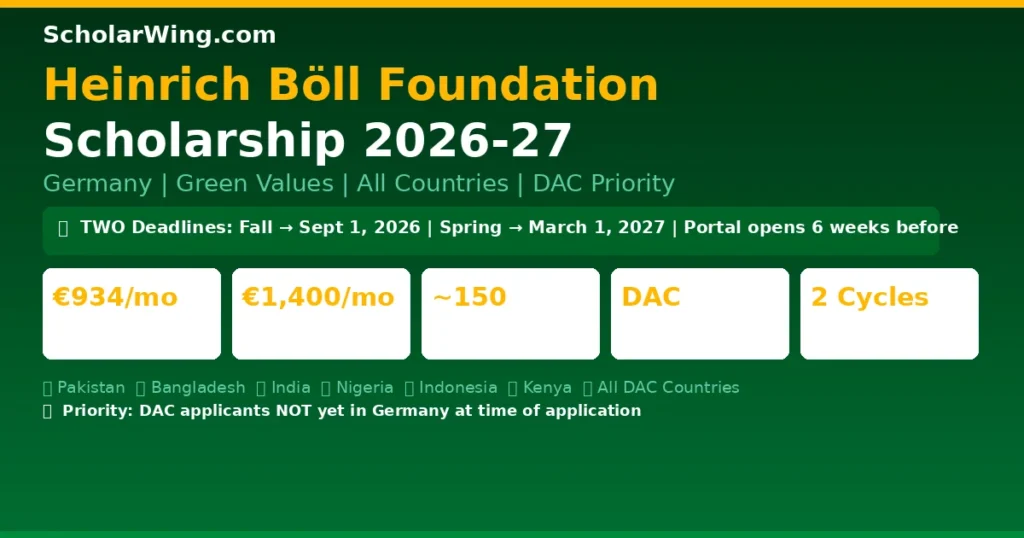
First: Spring 2027: 15 January 2027 until 1 March 2027. Fall 2027: 15 July 2027 until 1 September 2027.
Two application cycles per year, March 1 and September 1. If you miss September, you can apply in March. If you miss March, September follows. This makes the Heinrich Böll Foundation one of the most applicant-friendly major German scholarships in terms of opportunity frequency.
Second: Priority is given to applicants from DAC countries who have not yet taken up residence in Germany at the time of their application.
The Heinrich Böll Foundation explicitly prioritizes students from developing countries (DAC — OECD Development Assistance Committee) who are applying from their home countries before moving to Germany. If you are a student in Pakistan, Bangladesh, India, Nigeria, Indonesia, Morocco, or another developing country who has been admitted to a German Master’s or PhD program, you are in the priority category for this scholarship.
Through its “Tailwind for Talents” scholarship initiative, the foundation seeks to promote equal educational opportunities by supporting talented international students from Development Assistance Committee (DAC) countries who intend to study at German universities.
This is not a scholarship for students who are already in Germany and well-settled. It is a scholarship designed to help talented students from developing countries make the transition to Germany to give them the “tailwind” that removes financial barriers before they even arrive.
Who Was Heinrich Böll — The Foundation’s Values Explained
Heinrich Böll (1917-1985) was Germany’s most prominent post-war author winner of the Nobel Prize in Literature in 1972. His novels and stories confronted German society’s failure to fully reckon with the Nazi past, critiqued consumerism, defended individual conscience against authoritarian institutions, and championed the outsider and the powerless.
His political positions were clear: pacifism, ecology, feminism, civil liberties, and international solidarity. He was involved in peace movements, supported environmental causes before they were mainstream, and wrote with a distinctly humanist, anti-authoritarian perspective.
The Heinrich Böll Foundation (Heinrich-Böll-Stiftung) was established in his name and is affiliated with Germany’s Green Party (Alliance 90/The Greens, Bündnis 90/Die Grünen). Its core values directly reflect Böll’s intellectual legacy:
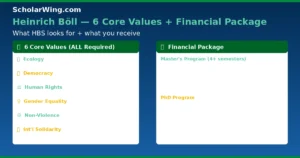
The six core values of the Heinrich Böll Foundation:
- Ecology — environmental protection, sustainability, climate justice
- Democracy — participatory democracy, civil society, transparency
- Human Rights — universal rights, civil liberties, rule of law
- Gender Equality / Feminism — gender justice, women’s rights, LGBTQ+ inclusion
- Non-Violence — peace, conflict prevention, anti-militarism
- International Solidarity — global justice, North-South equity, development
These are not decorative values, they are the lens through which your scholarship application will be evaluated. A student with strong academics but no engagement with any of these areas is unlikely to succeed at Heinrich Böll.
Financial Package — What Heinrich Böll Covers
Heinrich Böll Foundation scholarships: €934/month (Master’s) or €1,350-1,400/month (PhD) for international students in Germany.
For Master’s Students:
| Benefit | Amount |
|---|---|
| Monthly stipend | €934/month |
| Health insurance contribution | Included |
| Child allowance | €160/month per child (if applicable) |
| Book allowance | Included in overall support |
| Program duration funding | Full duration of the Master’s |
For PhD Students:
| Benefit | Amount |
|---|---|
| Monthly stipend | €1,350-1,400/month |
| Health insurance contribution | Included |
| Child allowance | €160/month per child (if applicable) |
| Research travel | Supported |
| Program duration funding | Full duration of PhD |
The Foundation awards complete scholarships to students that cover the entire duration of the program.
Note on Master’s program requirement: We only fund Master’s programmes with a standard duration of four semesters or more.
This means 2-year Master’s programs only. A 1-year (2-semester) Master’s does not qualify. Most German university Master’s programs are 4 semesters but confirm before applying.
Two Application Windows Per Year — Key Dates
First: Spring 2027: 15 January 2027 until 1 March 2027. Fall 2027: 15 July 2027 until 1 September 2027.
Fall 2027 Cycle:
| Event | Date |
|---|---|
| Portal opens | January 15, 2027 |
| Application deadline | March 1, 2027 |
| Studies begin | April/Summer semester 2027 |
Spring 2027 Cycle:
| Event | Date |
|---|---|
| Portal opens | July 15, 2027 |
| Application deadline | September 1, 2027 |
| Studies begin | October/Winter semester 2027 |
Important: The online portal opens approximately 6 weeks before the application deadline. Do not try to access the portal before it opens, it will not be available.
Practical implication of two cycles: If you are admitted to a German Master’s program starting October 2027, apply in the spring 2027 cycle (deadline March 1). If your program starts April 2027, apply in the Fall 2027 cycle (deadline September 1). There is always an appropriate cycle for your intake.
Eligibility — International Students
International students who have completed their first degree abroad can apply prior to starting a Master’s degree program in Germany. Students of all disciplines may apply to study full-time at a state-recognized university.
Full Eligibility Criteria:
1. International student who completed degree outside Germany You must have earned your previous academic qualification (Bachelor’s for Master’s applications; Master’s for PhD applications) from a university OUTSIDE Germany.
2. Applying for Master’s or PhD in Germany You must be enrolled in, or applying to, a state-recognized German university for a Master’s or PhD program.
3. DAC country priority (but all countries eligible) Priority is given to applicants from DAC countries who have not yet taken up residence in Germany at the time of their application.
All countries are eligible. But DAC (developing) countries are explicitly prioritized, especially applicants who haven’t moved to Germany yet.
DAC countries include: Pakistan, Bangladesh, India, Indonesia, Philippines, Vietnam, Nigeria, Kenya, Tanzania, Ghana, Ethiopia, Morocco, Egypt, Senegal, Cambodia, Nepal, Myanmar, Sri Lanka, Zambia, Zimbabwe, Uganda, Rwanda, Mozambique, Bolivia, Peru, Ecuador, Haiti and most other developing countries.
4. All disciplines — no field restriction Engineering, natural sciences, social sciences, humanities, arts, medicine, law, theology, any academic field at a German university is eligible.
5. Strong academic performance Above-average academic record. Heinrich Böll does not specify a minimum GPA but expects demonstrably excellent academic performance.
6. Social/political engagement Commitment to the foundation’s values ecology, democracy, human rights, gender equality, non-violence, expressed through engagement, not just stated in an essay. Documented history of engagement is necessary.
NOT eligible (for international students):
- Bachelor’s programs, international applicants educated abroad are NOT eligible for Bachelor’s funding
- Master’s programs of less than 4 semesters (less than 2 years)
- People who already have a doctorate applying for another doctorate
The “Tailwind for Talents” Initiative
Through its “Tailwind for Talents” scholarship initiative, the foundation seeks to promote equal educational opportunities by supporting talented international students from Development Assistance Committee (DAC) countries who intend to study at German universities.
Funded by the Federal Ministry of Education and Research (BMBF) and the Federal Foreign Office (AA), the scholarship program supports academic excellence while encouraging future leaders committed to social responsibility, sustainability, and international cooperation.
“Tailwind for Talents” (Rückenwind für Talente in German) is the specific initiative within the broader Heinrich Böll scholarship framework that targets international students from developing countries. It reflects the foundation’s commitment to global equity in education, ensuring that financial barriers don’t prevent talented students from the Global South from accessing Germany’s world-class universities.
The name is deliberately chosen: “tailwind” (Rückenwind) means a wind that pushes you forward from behind, giving you assistance without requiring you to fight against the current. This captures the foundation’s philosophy: they are not giving charity; they are removing structural disadvantages that shouldn’t exist.
What Heinrich Böll Looks For — Values in Practice
The Heinrich Böll Foundation’s character criteria are structured around its six core values. Unlike KAS (which primarily looks for democratic values broadly) or the Friedrich Ebert Foundation (social democratic focus), Heinrich Böll specifically looks for engagement in:
Ecology and Sustainability
Active involvement in environmental protection, climate advocacy, sustainable agriculture, conservation, renewable energy, or environmental justice. This can be formal (NGO work, environmental engineering career) or informal (community recycling initiatives, environmental awareness campaigns).
Gender Equality and Feminist Perspectives
Engagement with women’s rights, gender justice, LGBTQ+ advocacy, or research on gender dimensions of development. Heinrich Böll is distinctive in how explicitly it incorporates feminist values into its selection criteria.
Democracy and Human Rights
Participation in democratic processes, civil society, human rights documentation, legal aid, advocacy organizations, or journalism. Similar to KAS in this dimension but without the specifically Christian Democratic frame.
Non-Violence and Peace
Peace education, conflict resolution work, anti-militarism engagement. Particularly relevant for students from conflict-affected countries who have been involved in peace-building.
International Solidarity
Cross-border cooperation, development work, international student exchange, global civil society engagement.
Practical self-assessment: Before applying to Heinrich Böll, honestly list your engagement in these areas with concrete examples, dates, organizations, and outcomes. If you cannot fill at least one area with genuine, documented activity, your application needs development before submission.
Application Process — Step by Step
The Heinrich Böll Foundation only accepts online applications. The online portal opens around six weeks prior to the deadline for applying.
Step 1: Check your eligibility Confirm you are a DAC country national with a degree from outside Germany, applying for a 4+ semester Master’s or PhD at a German state-recognized university.
Step 2: Choose your application cycle Fall (deadline September 1) or Spring (deadline March 1) — based on when your program begins.
3: Prepare documents (start 3 months before deadline)</strong>
Required documents based on official HBS guidance:
- CV (tabular format) including social/political engagement history
- Motivation letter — academic and values alignment
- Academic transcripts — all degrees
- Degree certificate(s)
- Two letters of recommendation (academic)
- German language proficiency certificate (B2 minimum for German-medium programs)
- English language certificate (for English-medium programs)
- University admission letter or proof of enrollment
- Research proposal (for PhD applicants)
- Portfolio of social/civic engagement (strongly recommended)
Step 4: Access portal when it opens The portal opens approximately 6 weeks before the deadline, July 15 for Fall, January 15 for Spring. Do not try to access earlier.
Step 5: Complete online application Access the form from the foundation’s online portal. Fill the form completely and correctly. Attach the required documents in PDF format. Submit before the deadline.
Apply at: boell.de/en/applying-scholarship
German Language Requirement
Must meet German language proficiency requirements (B2 or above in most cases).
For German-medium Master’s programs: B2 German is the standard minimum. Many programs require C1.
For English-medium Master’s programs: English proficiency (IELTS/TOEFL) is required instead. A growing number of German university Master’s programs are fully English-medium, these do not require German B2.
Practical guidance: If you are applying for an English-medium program at a German university, you do not need German B2 for that specific program but learning German will significantly enhance your scholarship application by demonstrating cultural integration commitment.
German language resources: Goethe-Institut offices exist in Pakistan, Bangladesh, India, Indonesia, Nigeria, Kenya, Morocco, and most DAC countries. Begin German preparation early if targeting German-medium programs.
Heinrich Böll vs KAS vs Friedrich Ebert — The Three German Political Foundations
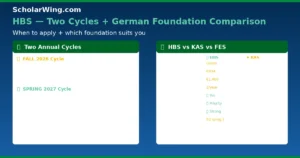
| Feature | Heinrich Böll | KAS | Friedrich Ebert |
|---|---|---|---|
| Political alignment | Green / Ecology | Christian Democratic | Social Democratic |
| Master’s stipend | €934/month | €992/month | ~€861/month |
| PhD stipend | €1,350-1,400/month | €1,400/month | Similar |
| Deadlines | Sept 1 + March 1 | July 15 (once) | Varies |
| Developing country priority | ✅ DAC priority | Focus regions | ✅ Global South |
| Core values focus | Ecology, feminism, peace | Democracy, market economy | Labour, social justice |
| German required | B2 (program-dependent) | B2 minimum | B2+ |
| Can apply from home country | ✅ Priority given | Focus region-dependent | Yes |
| Fields | All fields | All fields | All fields |
| Total scholars/year | ~1,200-1,500 | Selective | ~40 international |
Which foundation suits you?
- You care about environment, climate, gender equality, peace → Heinrich Böll
- You care about democracy, Christian values, social market → KAS
- You care about labour rights, social justice, economic equity → Friedrich Ebert
All three require civic/political engagemen, all three require German (or English-medium program) and all three accept all nationalities.
Country-Specific Notes
🇵🇰 Pakistan
Pakistan is a DAC country — priority category. Pakistani students with admission to a German university’s 4+ semester Master’s or PhD program, combined with documented engagement in environmental/human rights/gender equality areas, are competitive applicants. Contact the Goethe-Institut Pakistan for German language courses.
🇧🇩 Bangladesh
Bangladesh is a DAC country — priority. Bangladesh’s climate change vulnerability and environmental challenges create natural alignment with Heinrich Böll’s ecology focus. Environmental engineering, climate policy, and sustainability students from Bangladesh are particularly well-positioned.
🇮🇳 India
India is a DAC country. Indian students in environmental science, gender studies, human rights, public policy, and related fields have been significant recipients of Heinrich Böll funding. Two cycles per year means more opportunities.
🇮🇩 Indonesia
Indonesia is a DAC country. Environmental science and sustainability are deeply relevant to Indonesia’s biodiversity and deforestation challenges. German-Indonesian academic ties are strong.
🇳🇬 Nigeria
Nigeria is a DAC country. Environmental justice, human rights, and governance are areas where Nigerian applicants can demonstrate strong alignment with HBS values.
🌍 Africa
All sub-Saharan African DAC countries are in the priority category. Environmental issues, gender equality, and democracy themes are directly relevant to African development contexts and Heinrich Böll has particular interest in African civil society.
Practical Tips
1. Apply in the cycle that matches your program start Fall programs (October start) → September 1 deadline. Spring programs (April start) → March 1 deadline. Don’t wait for the “next” cycle if your program starts sooner.
2. Start portal access on July 15 (Fall) or January 15 (Spring) The portal opens 6 weeks before the deadline. Access it immediately when it opens — technical issues are harder to resolve closer to the deadline.
3. Document your engagement in HBS values BEFORE writing the application List every concrete example of engagement in ecology, democracy, human rights, gender equality, non-violence, or international solidarity. For each: organization, dates, specific activities, outcomes. This list becomes the backbone of your CV and motivation letter.
4. For German-medium programs — start German immediately B2 German through Goethe-Institut is the standard requirement. Begin now. The Goethe B2 certificate is also accepted by KAS, Friedrich Ebert, and opens DAAD programs.
5. English-medium programs do NOT need German B2 If you apply to an English-medium Master’s at a German university, you do not need German B2, only English proficiency. This dramatically expands accessibility for non-German speakers.
6. Contact studienwerk@boell.de before applying Telephone office hours: Mon, Tue, Thu, and Fri, 10:00 a.m. – 1:00 p.m. Email: studienwerk@boell.de For specific questions about your eligibility, this is the most reliable source.
FAQ
How many scholarships does Heinrich Böll award?
Every year, the foundation supports around 1,200 students, including approximately 150 international scholars, pursuing Bachelor’s, Master’s, or PhD programs at recognized German universities.
What are the two application deadlines?
First: Spring 2027: 15 January 2027 until 1 March 2027. Fall 2027: 15 July 2027 until 1 September 2027.
Can I apply from my home country before moving to Germany?
Yes, students can apply prior to starting a Master’s degree program in Germany. Priority is given to applicants from DAC countries who have not yet taken up residence in Germany at the time of their application.
Is Pakistan / Bangladesh / India eligible?
Yes, all three are DAC countries and receive priority consideration under the “Tailwind for Talents” initiative.
What is the monthly stipend?
€934/month for Master’s students and €1,350-1,400/month for PhD students, plus health insurance and child allowance.
Do I need German B2?
B2 or above in most case for German-medium programs. English-medium programs require English proficiency instead; German is not required.
What is the minimum duration for Master’s programs?
We only fund Master’s programmes with a standard duration of four semesters or more, i.e., 2-year programs only.
Can I apply for a Bachelor’s degree?
International students educated outside Germany cannot apply for Bachelor’s funding. Bachelor’s applications are only for Germans and EU nationals educated in Germany.
Free Tools for Your Application
- Motivation Letter: Motivation Letter Generator
- CV: Free CV Builder
- SOP / Study Plan: SOP Generator
- Reference Letter: Reference Letter Generator
- Research Proposal (PhD): Research Proposal Generator