
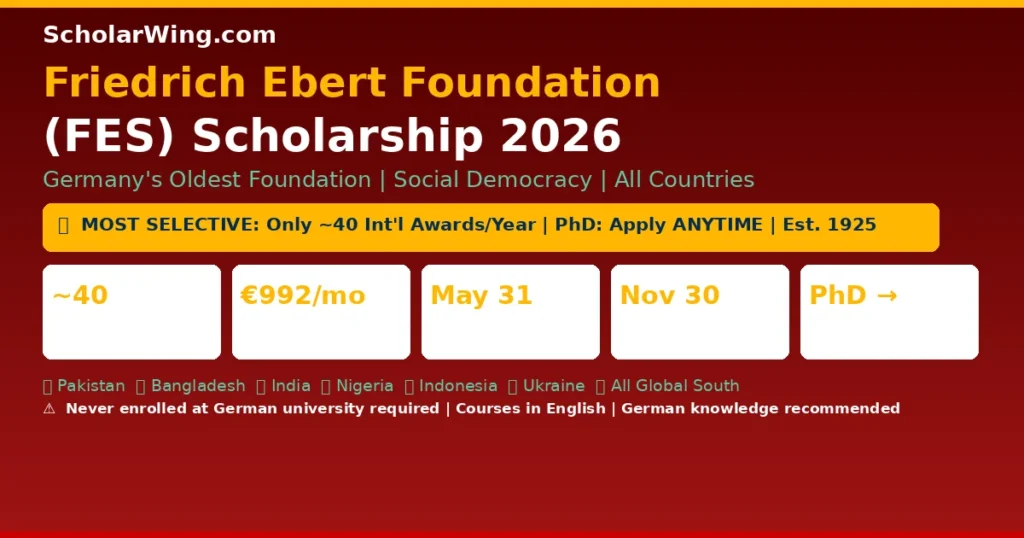
Germany’s Oldest Political Foundation Offers the Most Selective International Scholarship — Only 40 Per Year
The Friedrich Ebert Stiftung (FES) was founded in 1925, making it Germany’s oldest political foundation. It predates the Heinrich Böll Foundation (1987) and the Konrad Adenauer Foundation (1964) by decades.
Its scholarship program for international students is also the most selective among the three: each year up to 40 students are awarded FES sponsorships to study free in Germany.
Forty international scholarships per year. This is not a program where large numbers of students pass through, it is a highly curated selection of exceptional individuals who align closely with the foundation’s values: social democracy, labor rights, trade union traditions, social justice, and international solidarity.
The Friedrich Ebert Foundation Scholarship is awarded to highly performing students and includes a comprehensive seminar program to help enhance candidates’ social competencies and academic skills.
But beyond the scholarship itself, FES offers something that most scholarship programs do not: an active seminar program, a worldwide alumni network connected through the social democratic movement, and direct links to trade union organizations, political parties, civil society groups, and progressive think tanks across the world.
The FES scholarship is not just funding, it is an entry point into the global social democratic ecosystem.
Applicants come from countries in the Global South (Asia, Africa, Latin America), post-Soviet states, as well as eastern and south-eastern European countries.
Pakistan ✅, Bangladesh ✅, India ✅, Nigeria ✅, Indonesia ✅, Kenya ✅, Morocco ✅, Brazil ✅, Colombia ✅, Ukraine ✅, if you are from these regions and committed to social democratic values, FES is one of the most prestigious German scholarship tracks available.
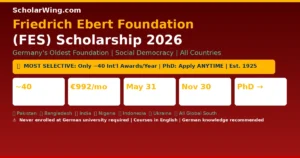
Who Was Friedrich Ebert — The Foundation’s Values Explained
Friedrich Ebert (1871-1925) was Germany’s first democratically elected President, serving from 1919 until his death in 1925 during the tumultuous Weimar Republic period.
Born to a tailor in Heidelberg, Ebert worked as a saddler before becoming involved in trade union organizing and the Social Democratic Party (SPD). He rose to lead the SPD and became the German Republic’s first head of state after the Kaiser’s abdication in 1918. He guided Germany through the immediate post-World War I chaos, suppressed both communist and right-wing putsch attempts, and built the Weimar Constitution’s democratic framework.
His background working class, trade union organizer, social democrat, defines the Friedrich Ebert Stiftung’s core identity:
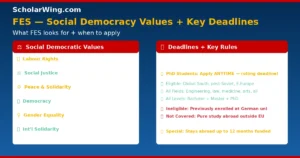
FES core values:
- Social Democracy — democratic governance, social welfare state, progressive taxation
- Labour Rights — trade unions, workers’ rights, decent work, fair wages
- Social Justice — reduction of inequality, poverty alleviation, inclusive growth
- Peace and International Solidarity — multilateralism, conflict prevention, development cooperation
- Democracy and Human Rights — rule of law, civil liberties, free press
- Gender Equality — women’s rights, equal pay, political participation
The FES maintains offices in over 100 countries and funds research, civil society organizations, trade unions, and progressive political parties globally. Its scholarship holders are expected to be future leaders in these areas in government, civil society, trade unions, academia, or journalism.
The 40-Award Figure — Why Selectivity Matters
With a maximum of 40 scholarships available annually for international students, FES offers exceptional students the chance to study in Germany free of charge.
To put this in context:
- Heinrich Böll: ~150 international scholars
- KAS: Several hundred (focus regions annually)
- DAAD: Thousands
- FES: ~40 international per year
Why does this matter for applicants?
Positively: A FES scholarship is highly prestigious, globally recognized as a mark of exceptional academic ability AND social democratic commitment. FES alumni hold senior positions in government, trade unions, international organizations, and civil society globally.
Practically: The 40-award limit means the application process is genuinely competitive. Generic applications, “I have good grades and want to study in Germany” will not work. FES reads for authentic, documented, specific alignment with social democratic values and demonstrated civic engagement.
The selection process can take up to three months. The interview is a genuine values and engagement assessment, not just an academic conversation.
Financial Package — What FES Covers
Scholars receive up to €992 per month.
| Benefit | Amount |
|---|---|
| Monthly stipend | Up to €992/month |
| Health insurance | Covered |
| Child allowance | €160/month per child |
| Family allowance | Applicable cases |
| Stays abroad support | Travel + tuition + international health insurance |
| Seminar program | Fully funded participation |
Stays Abroad — A Unique Benefit:
The Foundation supports stays abroad during the funding period — through subsidies for travel expenses, tuition fees and international health insurance, especially for study or research stays, language courses and internships of up to 12 months.
This means FES does not just fund your study in Germany, it actively supports you in spending up to 12 months during your scholarship period in another country for research, language study, or internships. For PhD students researching topics with fieldwork components in their home countries or third countries, this is a significant additional benefit.
Seminar Program:
A comprehensive seminar program to help enhance the candidates’ social competencies and academic skills.
FES organizes regular seminars, workshops, and network events for its scholarship holders. These include political education seminars aligned with social democratic values, academic skill-building workshops, and networking events connecting scholars with FES’s global network of trade unionists, politicians, civil society leaders, and researchers.
Application Deadlines — Two Per Year + PhD Open Anytime
The last date to apply for Friedrich Ebert Foundation Scholarship 2026 is 30 November 2026 for the Winter semester and 31 May 2027 for the Summer semester. PhD candidates can apply at any time.
Summer Semester Deadline:
| Event | Date |
|---|---|
| Application deadline | May 31 |
| Studies begin | April/Summer semester |
Winter Semester Deadline:
| Event | Date |
|---|---|
| Application deadline | November 30 |
| Studies begin | October/Winter semester |
PhD — No Fixed Deadline:
PhD candidates can apply at any time.
This is a unique and important feature. Unlike most scholarships (including HBS and KAS) which have fixed deadline cycles, FES accepts PhD applications on a rolling basis throughout the year. PhD researchers can submit when ready rather than waiting for a specific window.
Selection timeline: The selection process can take up to three months.
Eligibility — Who Can Apply
Geographic Eligibility:
Students and doctoral candidates from countries of the Global South (Asia, Africa, Latin America), the former CIS states, and Eastern and Southeastern European (EU) countries are eligible.
Global South includes: Pakistan, Bangladesh, India, Indonesia, Philippines, Vietnam, Sri Lanka, Nepal, Nigeria, Kenya, Ghana, Tanzania, Ethiopia, Morocco, Egypt, Senegal, South Africa, Bolivia, Peru, Brazil, Colombia, Mexico, Haiti, Ecuador and most other developing countries in Asia, Africa, and Latin America.
Post-Soviet/CIS states: Ukraine, Russia, Kazakhstan, Uzbekistan, Georgia, Armenia, Azerbaijan, Belarus, Moldova, Kyrgyzstan, Tajikistan, Turkmenistan.
Eastern/SE European EU: Poland, Bulgaria, Romania, Czech Republic, Slovakia, Hungary, Slovenia, Croatia, Baltic states, etc.
Academic Levels:
Bachelor’s, Master’s, PhD degrees in any subject, except for those mentioned on the official website.
- Bachelor’s / Diploma / State Examination
- Master’s degree
- PhD / Doctoral research
All academic subjects at German universities and technical colleges are eligible. There is no field restriction engineering, medicine, social sciences, humanities, arts, law, natural sciences are all eligible.
Key Eligibility Rules:
1. Not previously enrolled at a German university Those who previously have been enrolled at a German university are ineligible.
This is the most distinctive eligibility restriction of FES compared to KAS and HBS. If you have ever been enrolled at a German university before even briefly, you cannot apply. FES wants to bring new international talent to Germany, not fund students who are already established there.
2. Strong academic performance Excellent academic record expected. FES does not specify a minimum GPA but selects from the top of the academic range.
3. Sociopolitical engagement Applicants should be individuals committed to society, for example, in active participation in the student council, youth work, participation in associations and NGOs or in political organizations that are appropriate to the tenets of the Friedrich Ebert Stiftung.
4. Social democratic values alignment Applicants should possess sociopolitical engagement and identification with the values of social democracy, labour rights, social justice, peace, international solidarity, democracy.
5. German language knowledge Sufficient knowledge of German, although the courses are held in English.
FES courses and seminars are conducted in English, making the language barrier lower than KAS or HBS programs requiring German B2. However, knowledge of German is still valued and recommended.
FES Values in Practice — What “Social Democratic Engagement” Means
The FES is looking for people who have lived these values, not just stated them. Practical examples of relevant civic engagement:
Trade Union and Labor Work: Membership and active involvement in trade unions, workers’ rights organizations, labor advocacy, fair wage campaigns, anti-child labor work, labor journalism.
Social Justice Activism: Work with NGOs addressing poverty, inequality, social exclusion, disability rights, indigenous rights, migrant and refugee rights, food security, healthcare access.
Peace and Anti-War Work: Peace organizations, conflict resolution initiatives, disarmament advocacy, post-conflict reconciliation, anti-violence community work.
Democratic Participation: Student government leadership, political party involvement (specifically social democratic or progressive parties aligned with FES values), civic education, election monitoring, voter rights work.
Gender Equality: Women’s rights organizations, gender-based violence prevention, female political representation campaigns, feminist media, girls’ education advocacy.
International Solidarity: Development organizations, North-South cooperation projects, climate justice activism, debt cancellation campaigns, global health equity work.
The FES self-assessment question: Can you name three specific, documented activities in the last 3-5 years where you acted on social democratic values with real organizations, real outcomes, and real communities? If yes, you have an FES application. If not, build your record before applying.
How to Apply — Step by Step
The FES scholarship application is an online process. You will need to register on the FES website and complete the online application form. You will also need to upload all required documents.
Step 1: Determine your deadline Summer semester start → May 31 deadline. Winter semester start → November 30 deadline. PhD → apply anytime.
Step 2: Confirm eligibility Confirm you are from Global South/post-Soviet/Eastern Europe and have NEVER been enrolled at a German university.
Step 3: Prepare documents (start 3 months before)
Required documents based on FES scholarship requirements:
| Document | Notes |
|---|---|
| CV (tabular) | Must include sociopolitical engagement in detail |
| Motivation letter | Values alignment + study plan + development impact |
| Academic transcripts | All previous degrees |
| Degree certificate(s) | All previous qualifications |
| Language certificates | German and/or English proficiency |
| University enrollment/admission | Enrolled or accepted at German university |
| Letters of recommendation | 2 academic references |
| Sociopolitical engagement proof | Documentation of civic work |
| Research proposal | For PhD applicants |
Step 4: Register and apply online Visit fes.de/en/scholarships/ to access the application portal. Complete all sections of the online form.
Step 5: Await selection (up to 3 months) After submitting your application, you will receive a confirmation email. The selection process can take up to three months.
Step 6: Interview The interview assesses your values alignment, academic trajectory, and social democratic engagement, not just academic performance.
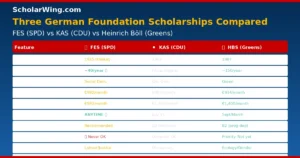
FES vs KAS vs Heinrich Böll — Complete Comparison
| Feature | FES | KAS | Heinrich Böll |
|---|---|---|---|
| Political alignment | Social Democracy (SPD) | Christian Democracy (CDU) | Green Party |
| Founded | 1925 (oldest) | 1964 | 1987 |
| Int’l awards/year | ~40 (most selective) | Several hundred | ~150 |
| Monthly stipend | Up to €992 | €992 (MA) / €1,400 (PhD) | €934 (MA) / €1,400 (PhD) |
| Deadlines | May 31 + Nov 30 | July 15 | Sept 1 + March 1 |
| PhD deadline | Anytime (rolling!) | July 15 | Sept 1 + March 1 |
| German required | Recommended (courses in EN) | B2 minimum | B2 (program-dep.) |
| Previously in Germany | ❌ Ineligible | Domestic route OK | Priority NOT in Germany |
| Core focus | Labour, social justice | Democracy, market econ. | Ecology, feminism |
| Seminar program | ✅ Comprehensive | ✅ Events | ✅ Events |
| Global South priority | ✅ Explicit | By focus regions | ✅ DAC priority |
| Stays abroad | ✅ Up to 12 months | Research travel | Research travel |
Bottom line for applicants:
- FES = if you are deeply committed to labor rights, trade unions, social justice, SPD-style values
- KAS = if you are committed to Christian Democratic, liberal market democracy values
- HBS = if you care about ecology, green politics, feminism, non-violence
Country-Specific Notes
🇵🇰 Pakistan
Pakistan is Global South eligible. Trade union movement, labor rights, workers in textile factories, bonded labor issues, gender-based violence, political party engagement (PPP or PMLN, progressive parties with SPD connections) all provide FES-relevant engagement contexts. Pakistani labor journalism and civil society engagement are particularly competitive.
🇧🇩 Bangladesh
Bangladesh is Global South eligible. Bangladesh’s garment industry and labor rights context is directly relevant to FES’s trade union values. Labor rights organizations, workers’ health and safety NGOs, and fair trade engagement are competitive profiles.
🇮🇳 India
India is Global South eligible. India’s strong trade union movement (INTUC, AITUC, CITU), labor rights tradition, Dalit rights activism, gender equality work, and progressive political engagement all align directly with FES values.
🇳🇬 Nigeria
Nigeria is Global South eligible. Labor union movement (NLC, Nigeria Labor Congress has historical ties to FES), social justice work, anti-corruption activism, and progressive civil society engagement.
🌍 Africa broadly
FES has been active in African labor rights and social democratic party building for decades. FES offices in Lagos, Dar es Salaam, Nairobi, Pretoria, and many other African capitals make this scholarship particularly well-networked for African applicants. Former African FES scholars often go into trade union leadership, government, and civil society.
🇺🇦 Ukraine + Post-Soviet
Ukraine and post-Soviet applicants are eligible. FES has significant engagement in supporting democratic transitions and labor rights in Eastern Europe and Central Asia.
Practical Tips for FES Applicants
1. Document your social democratic engagement specifically Don’t write a general motivation letter saying you “care about social justice.” Name the organizations, the campaigns, the outcomes. FES reads for specificity. “I volunteered with Pakistan’s Human Rights Commission on the 2024 labor law advocacy campaign and contributed to policy brief X” is strong. “I care deeply about workers’ rights” is not.
2. PhD applicants — apply immediately (rolling deadline) PhD candidates have no deadline restriction. If you are a PhD student at a German university (or applying for one), you can apply to FES at any time of year. Do not wait for May 31 or November 30.
3. Never-enrolled-in-Germany rule is strict Even one semester of enrollment in Germany makes you ineligible. Be honest about your history in the application.
4. Courses are in English — German is helpful but not B2 required Unlike KAS (strict B2) and HBS (B2 for German-medium programs), FES courses are conducted in English. This lowers the language barrier significantly. However, demonstrating German learning shows integration commitment.
5. Apply to all three foundations simultaneously if you qualify KAS deadline (July 15), HBS (September 1 + March 1), and FES (May 31 + November 30) are all different. A student eligible for all three can apply to each, they are separate selection processes. You cannot hold multiple simultaneously, but you can apply to multiple and accept the best outcome.
6. Contact FES offices in your country FES has country offices in over 100 countries. The FES office in your country often provides guidance, hosts information events, and can advise on your application before submission.
FAQ
What is the Friedrich Ebert Foundation?
The Friedrich Ebert Stiftung is Germany’s oldest political foundation, founded in 1925 and affiliated with the Social Democratic Party (SPD). It promotes social democracy, labour rights, social justice, peace, and international solidarity globally.
How many international scholarships does FES award?
A maximum of 40 scholarships are available annually for international students, making FES the most selective of Germany’s three major political foundation scholarships.
What is the monthly amount?
Scholars receive up to €992 per month, plus health insurance, child allowance of €160/month, and support for stays abroad.
What are the deadlines?
May 31 for the Summer semester and November 30 for the Winter semester. PhD candidates can apply at any time.
Can I apply if I have studied at a German university before?
No, you are ineligible.
Is German B2 Compulsory?
Sufficient knowledge of German is expected, although the courses are held in English. German B2 is not a strict requirement, unlike KAS.
Can I apply for a Bachelor’s?
Yes, FES supports Bachelor’s degree programs as well as Master’s and PhD at German universities and technical colleges.
Who from the Global South can apply?
Students from countries in the Global South (Asia, Africa, Latin America), post-Soviet states, and eastern and south-eastern European countries are eligible.
Free Tools for Your Application
- Motivation Letter: Motivation Letter Generator
- CV (with civic engagement detail): Free CV Builder
- SOP / Study Plan: SOP Generator
- Reference Letter: Reference Letter Generator
- Research Proposal (PhD): Research Proposal Generator