
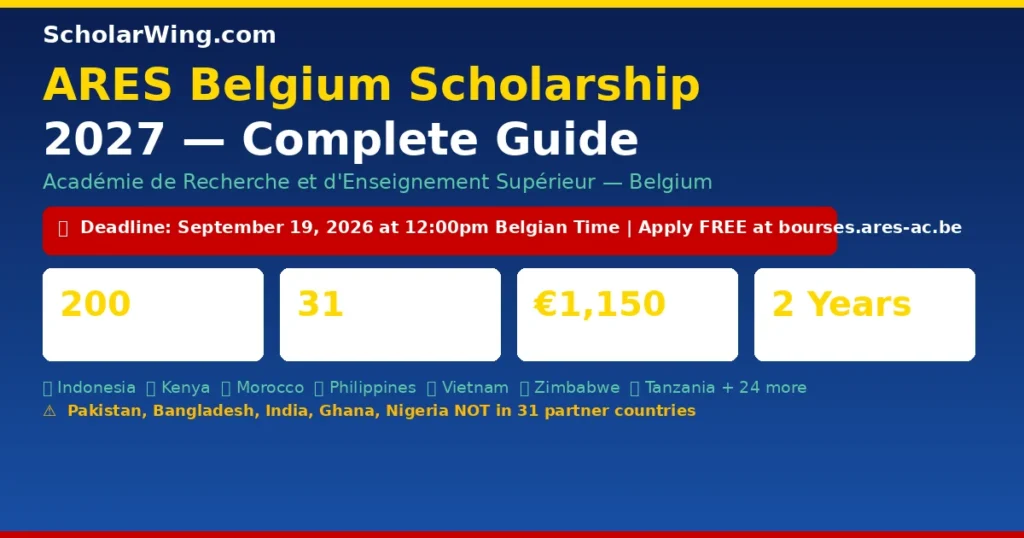
ARES Belgium Is Not Just a Francophone African Scholarship — And Most Guides Present It That Way
The ARES scholarship from Belgium’s Federation of Wallonia-Brussels is consistently described in scholarship guides as a “Francophone Africa” program. This framing is wrong — or at least incomplete.
The Academy of Research and Higher Education (ARES) offers scholarships to citizens from 31 partner countries across Africa, Southeast Asia, Latin America, and the Middle East.
The 31 eligible countries include Indonesia, the Philippines, Vietnam, Cambodia, Nepal (Southeast Asia and South Asia), Bolivia, Cuba, Ecuador, Haiti, Peru (Latin America), Kenya, Uganda, Zimbabwe, Tanzania, South Africa, Ethiopia (Anglophone Africa), Morocco, Tunisia (North Africa), Palestinian Territory (Middle East), alongside the Francophone African countries like Senegal, Mali, Cameroon, and Burkina Faso that most guides focus on.
This is not a regional program. It is a Belgian development cooperation scholarship covering four continents.
The ARES International Training Scholarships offer 200 fully funded awards for specialized bachelor’s degrees, specialized master’s degrees, and continuing training programs within the Federation Wallonia-Brussels.
Two hundred awards. Fully funded, ARES scholarships cover full tuition/registration fees, a monthly living allowance of €1,150, insurance, an international round-trip flight, and visa costs where applicable.
The deadline for the next cycle is confirmed: September 19, 2026.
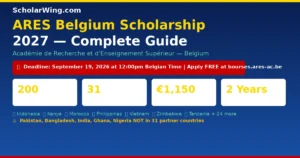
What Is ARES — The Institution Behind the Scholarship
The Académie de Recherche et d’Enseignement Supérieur (ARES) is the official body that coordinates higher education in the Fédération Wallonie-Bruxelles, Belgium. It brings together universities, colleges, and higher art schools to harmonize training, ensure program quality, and promote scientific research.
ARES is the academic coordinating body for the French-speaking part of Belgium, the Wallonia-Brussels Federation. Belgium is linguistically divided into three regions: Flanders (Dutch-speaking), Wallonia-Brussels (French-speaking), and Brussels Capital. ARES administers the scholarship program for universities and institutions within Wallonia-Brussels.
Belgian partner universities in ARES programs include:
- Université Catholique de Louvain (UCLouvain)
- Université Libre de Bruxelles (ULB)
- Université de Liège (ULiège)
- Université de Namur (UNamur)
- Haute École Provinciale de Namur
- And other institutions in the Wallonia-Brussels Federation
Full Funding Package — What ARES Covers
For Specialized Bachelor’s and Master’s Programs (1 year):
Round-trip economy airfare once per academic year. Monthly allowance of €1,150 for 12 months. Indirect mission costs of €250 per stay. Settling-in, didactic, and return allowance totalling €700 per stay. Coverage of tuition/registration fees.
Breaking down the full financial package:
Monthly Living Allowance: €1,150 × 12 = €13,800 total Paid monthly for the full academic year. €1,150 in Belgium covers shared accommodation, food, local transport, and personal expenses adequately in most Belgian cities.
Return Economy Airfare: 1 round-trip per academic year Your international flight from home country to Belgium and return. Economy class, IATA-approved airline.
Arrival/Settling-in + Tuition + Return Fees: €700 (paid once on arrival) A lump sum on arrival combining several one-time costs: registration fees at the university, settling-in expenses, and a departure contribution.
Indirect Mission Fees: €150-250 (paid once on arrival) Administrative and mission-related costs.
Insurance: Covered by ARES Medical and accident insurance during your stay in Belgium.
Visa Costs: Covered Visa application fees — for bachelor’s and specialized master’s degrees.
Total approximate financial value (Master’s, 12 months): €13,800 (living) + €700 (arrival/tuition/return) + €150-250 (indirect) + flight (~€600-1,500) + visa (~€100-200) + insurance = approximately €15,500-17,000 total value
For Short Training Courses (2-6 months):
Stays of 8-17 days: daily allowance of €83, stays of 18 days to 1 month: monthly allowance of €1,400 and stays of 1-6 months: monthly allowance of €1,400. Indirect mission costs: €200 per stay, upon arrival. Insurance: covered by ARES.
Note: Short training courses have a higher monthly rate (€1,400 vs €1,150) because they are shorter and more intensive.
The 31 Eligible Partner Countries — Full List
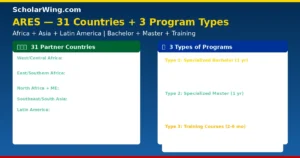
Target group: Open to citizens of the following countries: Benin, Bolivia, Burkina Faso, Burundi, Cambodia, Cameroon, Cuba, Democratic Republic of Congo, Ecuador, Ethiopia, Haiti, Indonesia, Kenya, Madagascar, Mali, Morocco, Mozambique, Nepal, Niger, Palestinian Territory, Peru, Philippines, Republic of Guinea (Conakry), Rwanda, Senegal, South Africa, Tanzania, Tunisia, Uganda, Vietnam, Zimbabwe.
Countries NOT eligible (important for ScholarWing readers):
- ❌ Pakistan — not in the 31 partner countries
- ❌ Bangladesh — not in the 31 partner countries
- ❌ India — not in the 31 partner countries
- ❌ Nigeria — not in the 31 partner countries
- ❌ Ghana — not in the 31 partner countries
- ❌ Algeria — not in the 31 partner countries
Note: Country lists can vary slightly between cycles. Always verify at bourses.ares-ac.be before investing time in your application.
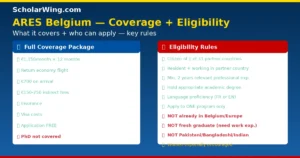
Three Types of Programs — Which One to Apply For
Type 1: Specialized Bachelor’s Degree (1 year)
Level: Bac+3 equivalent Pre-requisite degree: Diploma comparable to a 1st cycle diploma (180 ECTS credits) of Belgian higher education — i.e., an undergraduate degree Duration: 1 academic year in Belgium Example fields from previous cycles: Aquaculture, food technology, agriculture, environmental science
Type 2: Specialized Master’s Degree (1 year)
Level: Bac+5 equivalent Pre-requisite degree: Degree comparable to a 2nd cycle degree (300 ECTS credits, master’s level) from a Belgian university, i.e., you must already have a master’s equivalent degree Duration: 1 academic year in Belgium Example fields from previous cycles: International development, economics, GIS and spatial sciences, public health, information technology, microfinance, human rights
The specialized Bachelor’s and Master’s programs last one year, while training courses are six months in duration. This program aims to deepen skills and knowledge in development-related topics; it is not a full-time degree program.
Type 3: Continuing Training Courses (2-6 months)
Duration: 2 to 6 months Purpose: Professional capacity-building, not a degree program Monthly allowance: €1,400 (higher than Master’s program, shorter, more intensive)
Important: Programs change every year. The specific programs available for the 2027-2028 cycle will be listed on the ARES website when the call opens. Do not assume the same programs from previous years are available, check bourses.ares-ac.be when the 2027 call opens.
Eligibility Requirements — Every Point Matters
1. Citizenship and Residency — The Most Critical Rule
Be a permanent resident and currently working in one of the 31 eligible countries listed below.
No. ARES scholarships are restricted to applicants who are currently residing and working in one of the eligible partner countries. Applicants already resident in Belgium or another European country are not eligible.
This is the single most important eligibility rule: You must be living AND working in one of the 31 partner countries at the time of application. This eliminates:
- Citizens of eligible countries who are currently studying or working in Europe
- Diaspora applicants living in Belgium, France, the Netherlands, or elsewhere in Europe
- Citizens of eligible countries working in non-partner countries
2. Professional Experience — Minimum 2 Years
Demonstrate at least two years’ relevant professional experience in an ARES partner country.
This is a working professionals’ scholarship, not a fresh graduate scholarship. Two years of experience in a field relevant to your chosen program is required.
This distinguishes ARES from most other scholarships in this series: ARES is not for students fresh out of university. It is for mid-career professionals seeking to upskill or specialize.
3. Academic Qualification
For specialized Master’s (Bac+5): A degree equivalent to 300 ECTS credits of Belgian higher education, you need a master’s-level degree already.
For specialized Bachelor’s (Bac+3): A degree equivalent to 180 ECTS credits — an undergraduate degree.
4. Language Proficiency
Most ARES programs are taught in French. However, a small number of programs are available in English.
French proficiency is required for French-medium programs. English proficiency for English-medium programs. Specify which type of program you are applying for and confirm the language requirement.
5. One Application Only
Applicants can only apply for one course. Choose carefully, you cannot submit applications to multiple ARES programs simultaneously.
6. Women Encouraged
Women are highly encouraged to apply for the ARES scholarship. ARES explicitly prioritizes gender equity in its selection process.
7. Palestinian Territory Exception
Palestinian nationals are eligible even if they do not reside in one of the 31 eligible countries. This is the only country-specific exception to the residency requirement.
Application Process — Step by Step
Start by visiting the official ARES scholarships website (bourses.ares-ac.be) and reviewing the list of programs available for the 2027 cycle. Programs vary each year.
Step 1: Check the 2027 program list (when published) Go to bourses.ares-ac.be when the 2027 call opens. Review every available program, Bachelor’s, Master’s, and training courses. Programs change every year.
Step 2: Choose ONE program The selection panel looks for coherence between your background, your chosen program, and your development goals. Don’t apply to a program just because it’s available.
Select the program that aligns with your academic background, professional experience, and career development plan. A coherent fit between your CV and your chosen program is a primary selection criterion.
Step 3: Prepare all documents Begin document preparation early. Translations, certifications, and employer reference letters can take weeks to arrange, especially in contexts where administrative processes are slow.
Key documents (based on ARES requirements):
- Valid passport
- Academic diplomas (Bachelor’s + Master’s as required) with official translations
- Academic transcripts
- CV
- Motivation letter (why this program, how it benefits your country’s development)
- Proof of employment (employer certificate, employment contract)
- Employer reference letter
- Proof of 2 years relevant experience
- Language proficiency proof (French or English as required)
- Proof of residence in partner country
Step 4: Create account on GIRAF platform Applications can be made online through the GIRAF platform at bourses.ares-ac.be. Create your account before the window opens.
Step 5: Submit before September 19, 2026 at 12:00pm Belgian time The application deadline for the ARES Scholarships is September 19, 2026.
Applying for an ARES scholarship is entirely free. No fees are charged at any stage of the application or selection process.
What Makes a Strong ARES Application
1. Coherence Between Background, Program, and Development Goal
The ARES selection panel evaluates whether your academic background + professional experience + chosen program + return plan form a coherent, logical story. A nurse applying for an aquaculture program without explanation will not be competitive. A water engineer applying for an environmental GIS program with a clear community project plan will be.
2. Professional Experience Quality
Two years is the minimum but the relevance and impact of those two years matters more than the duration. A health worker who implemented a community vaccination program has a stronger profile than an administrator with generic experience for a public health program.
3. Development Impact Plan
ARES scholarships exist to build capacity in partner countries. Your application must explain: What specific problem in your home country will you help solve? How does this Belgian training give you skills you currently lack? What will you do when you return?
4. Language Match
If you are applying for a French-medium program but your French is weak, your application will struggle. Be honest about language proficiency and choose a program that matches your actual language level.
5. Women Applicants
ARES explicitly encourages women. Female applicants from partner countries may receive additional consideration in competitive selection.
ARES vs Other Belgian/French Scholarships
| Feature | ARES Belgium | IsDB-France | Eiffel Excellence |
|---|---|---|---|
| Country | Belgium | France | France |
| Monthly amount | €1,150/mo | €700/mo | €1,200-2,100/mo |
| Awards/year | 200 | 200 | ~470 |
| Eligible countries | 31 specific | 42 specific | All (except France) |
| Work exp. required | ✅ Yes (2 years) | ❌ No | ❌ No |
| Students level | Working professionals | Students + pros | Students |
| Application | Via GIRAF (student) | Via isdb.org (student) | Via French uni (not student) |
| Language | French (mostly) + English | French | French + English |
| Deadline | September 19 | June (10-15 days) | January 8 |
| PhD covered | ❌ No | ❌ No | ✅ Yes |
Country-Specific Guidance
🇮🇩 Indonesia
Indonesia is confirmed in the 31 partner countries, making Indonesian professionals one of the largest eligible Southeast Asian pools. French programs require French proficiency; English-medium programs (a small selection) do not. Contact the Alliance Française or French Embassy in Jakarta for ARES guidance.
🇰🇪 Kenya
Kenya is confirmed. As an Anglophone country, Kenyan applicants should specifically seek English-medium ARES programs. Fields in agriculture, environmental science, public health, and development economics align with Kenya’s development context.
🇵🇭 Philippines
Philippines is confirmed. English-medium programs at Belgian universities are accessible for Filipino professionals who may not have French proficiency. Technical and development-related fields are competitive.
🇻🇳 Vietnam
Vietnam is confirmed. Vietnam has active development cooperation ties with Belgium. French is historically present in Vietnam’s academic tradition, French-medium programs may be more accessible than for other Southeast Asian countries.
🇲🇦 Morocco
Morocco is confirmed. As a Francophone country with close French-Belgian academic ties, Moroccan applicants have strong linguistic alignment for ARES programs. Morocco is historically one of the most represented nationalities in Belgian development scholarships.
🇹🇳 Tunisia
Tunisia is confirmed. French-speaking, with strong academic traditions connected to Belgian and French institutions. Tunisian professionals in technical and scientific fields are competitive ARES applicants.
🌍 Francophone Africa
Senegal, Mali, Cameroon, Burkina Faso, Benin, Niger, Guinea, DRC, Madagascar, Burundi, Rwanda, all confirmed. French is the natural language of instruction and these countries have the deepest historical ties to Belgian development cooperation.
🌍 Anglophone Africa
Kenya, Tanzania, Uganda, Zimbabwe, South Africa, Ethiopia all confirmed. Look specifically for English-medium programs in the annual ARES program list. The fields of agriculture, public health, and environmental management typically have English-medium options.
🌎 Latin America
Bolivia, Cuba, Ecuador, Haiti, Peru all confirmed. French proficiency opens the most programs; some English-medium programs are available. Development economics, public health, and agriculture fields are most relevant.
Quick Reference
| Detail | Information |
|---|---|
| Deadline | September 19, 2026 at 12:00pm Belgian time |
| Apply at | bourses.ares-ac.be (GIRAF platform) |
| Monthly allowance | €1,150/month (12 months for MA/Bac) |
| Training allowance | €1,400/month (1-6 month courses) |
| Arrival + tuition + return | €700 (paid once on arrival) |
| Indirect fees | €150-250 (paid once on arrival) |
| Flight | Economy return ticket included |
| Visa costs | Covered by ARES |
| Insurance | Covered by ARES |
| Application fee | FREE |
| Work experience | Minimum 2 years required |
| Programs (language) | Mostly French, some English |
| Can apply to | ONE program only |
| Must be | Resident + working in partner country |
Common Mistakes
1. Applying from Europe Applicants already resident in Belgium or another European country are not eligible. If you are currently in Belgium, France, Germany, or anywhere in Europe, you cannot apply for ARES.
2. Applying to multiple programs Only one application per cycle. Choose carefully.
3. Applying without 2 years’ experience ARES is for working professionals. Fresh graduates are not eligible.
4. Choosing a program for availability, not fit The selection panel rejects applications where there is no clear connection between background, program, and development goal. Apply to what genuinely fits your career trajectory.
5. Not preparing translations early Academic documents, employment certificates, and reference letters may need certified translations into French or English. This takes weeks, start at least 2 months before the September 19 deadline.
6. Assuming the same programs repeat each year The specific programs vary by cycle. Do not assume the program you researched this year will be available next year. Check the official ARES website when the 2027 call opens.
FAQ
What is ARES?
ARES is the Académie de Recherche et d’Enseignement Supérieur, the official body coordinating higher education in the Fédération Wallonie-Bruxelles, Belgium.
What is the monthly allowance?
Living allowance: €1,150/month for 12 months for Bachelor’s and Master’s programs. For short training courses (1 month to 6 months): €1,400/month.
What is the 2027 deadline?
The application deadline for the ARES Scholarships is September 19, 2026 for the 2027-2028 academic year.
Is Pakistan eligible for ARES?
No, Pakistan is not among the 31 confirmed partner countries for ARES scholarships. Check the current cycle’s official country list at bourses.ares-ac.be for any updates.
Is Indonesia eligible?
Yes, Indonesia is listed as one of the 31 partner countries eligible for ARES scholarships.
Can I apply if I am already in Belgium?
No, applicants already resident in Belgium or another European country are not eligible.
Do I need professional experience?
Yes, at least two years’ relevant professional experience in an ARES partner country is required.
Are programs in English?
Most ARES programs are taught in French. However, a small number of programs are available in English. Check the specific program’s language requirement.
Is the application free?
Yes, applying for an ARES scholarship is entirely free. No fees are charged at any stage.
Free Tools for Your Application
- Motivation Letter: Motivation Letter Generator
- CV: Free CV Builder
- Personal Statement: Personal Statement Generator
- Reference Letter (for employer/academic): Reference Letter Generator