
ADB-Japan Scholarship at Auckland
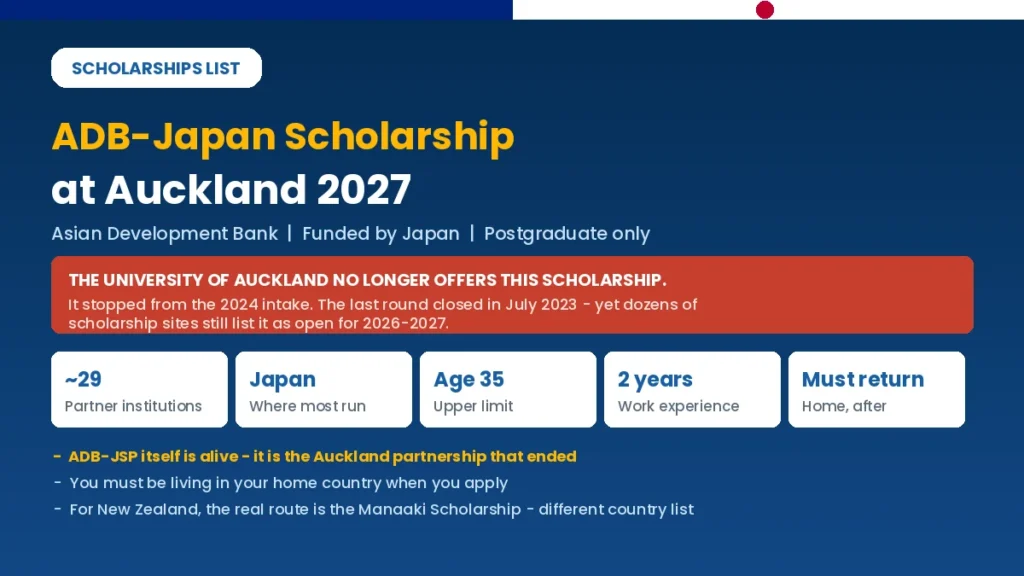
Start with the thing nobody writes: the University of Auckland no longer offers the ADB-Japan Scholarship. It stopped from the 2024 intake, and the last application round closed in July 2023.
Dozens of scholarship sites still carry the Auckland listing. Some label it “2026-2027”. The programmes they name Master of Public Health, Master of Science in Environmental Science, Master of Arts in Development Studies and the engineering master’s degrees were the right ones when Auckland participated. The listing is simply out of date, and the sites reprint each other rather than check.
A student who reads one of those pages spends weeks assembling an application for a scholarship that does not exist. That costs a year, because postgraduate intakes come round once.
So this guide does three things instead. It explains what ADB-JSP actually is and whether you qualify, because the eligibility rules exclude far more people than the listings suggest. It tells you where the programme still runs, since ADB-JSP itself is alive and well across roughly 29 institutions. And it covers New Zealand’s real fully funded route, which is a different programme entirely and which many readers of this page should be applying to instead.
What ADB-JSP Is
The Asian Development Bank–Japan Scholarship Program is funded by the Government of Japan, administered by the Asian Development Bank, and delivered through partner universities across Asia, the Pacific and beyond. Japan pays, ADB runs it, and a university teaches you.
It is genuinely fully funded, which separates it from most of what gets labelled that way. The package covers full tuition fees, a monthly subsistence allowance including housing, an allowance for books and instructional materials, medical insurance and travel expenses. Research students may receive an additional grant towards thesis preparation.
Published figures on scale differ between sources, running from roughly 140 to 300 scholarships a year across all partner institutions. ADB’s own page is the figure to trust; either way, the programme is small relative to the number of people eligible.
The purpose shapes everything about the rules. Japan funds this so that professionals from developing Asian economies gain postgraduate qualifications and take them home. Every eligibility condition follows from that intent, and understanding it explains the rules that otherwise look arbitrary.
Who Actually Qualifies
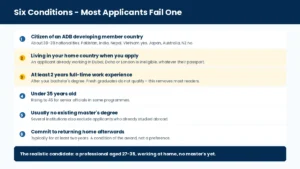
The eligibility rules are stricter than nearly any list conveys. Read them carefully, because failing one ends the application regardless of how strong the rest is.
You must be a citizen of an ADB developing member country. Around 38 to 39 nationalities qualify, covering most of South, Southeast and Central Asia and the Pacific. Pakistan, India, Bangladesh, Nepal, Sri Lanka, Indonesia, Vietnam, the Philippines and the Central Asian republics all appear. Japan, Australia, New Zealand and the high-income members do not.
You must be living in your home country when you apply. This condition removes a large group of otherwise strong candidates. An applicant already working in Dubai, Doha, Riyadh or London does not qualify, however strong their record and whatever passport they hold. ADB funds people who will return, and someone who has already emigrated does not fit the purpose.
Additional:
You need at least two years of full-time professional work experience after your bachelor’s degree. A student applying straight from an undergraduate degree does not qualify. This single rule removes most of the audience that reads scholarship pages.
You does must be under 35, with the limit rising to 45 for senior officials in some programmes.
You does generally cannot already hold a master’s degree, and several partner institutions state that applicants who have already studied abroad are not eligible.
And you does must commit to returning home after your studies, typically for at least two years. This is a condition of the award rather than a preference.
Add those together and the realistic candidate is a professional in their late twenties or early thirties, working in their own country, with two to ten years of experience, a good first degree, no master’s, and a career that connects to development. That profile is far narrower than “international student who wants funding”, which is who most of the listings reach.
Why Auckland Stopped, and What That Tells You
ADB reviews its partner institutions periodically, and universities enter and leave the programme. Auckland left after the 2023 round.
The practical lesson generalizes well beyond this one scholarship. Partner lists change, and scholarship aggregator sites do not update. Several of the pages still advertising Auckland’s ADB-JSP also advertise the University of Sydney’s version, which closed to applications years earlier.
Three habits protect you from this, and they apply to every scholarship you will ever research.
Check the funder’s own page, not a listing site. ADB publishes its current partner institutions. A university that does not appear there does not offer the scholarship, whatever a blog says.
Check the university’s own scholarship page too. If a university offered a scholarship and stopped, its own site usually goes quiet about it rather than announcing the end. Silence on the official page, combined with enthusiasm on aggregator sites, is a reliable signal.
Look at the dates inside the page, not the title. A page titled “2026-2027” with a deadline of July 2023 in the body is describing 2023. This is the most common failure, and it takes ten seconds to catch.
Where ADB-JSP Still Runs
The programme operates through roughly 29 approved institutions. The concentration sits in Japan, which makes sense given who funds it, with further institutions across Asia and the Pacific.
Japan holds the largest cluster, including the International University of Japan, the National Graduate Institute for Policy Studies, Keio University, Ritsumeikan Asia Pacific University, the University of Tokyo and Hitotsubashi, among others. For most ADB-JSP applicants, Japan is where the realistic opportunities sit.
Other participating countries have included China, India, Pakistan, Thailand, the Philippines, Hong Kong and institutions elsewhere in the region, with the list changing between cycles.
Fields funded run across economics, management, public policy, health, education, agriculture, environment, natural resource management, science and technology, and other development-related subjects. The common thread is applicability to a developing economy rather than any particular discipline.
How to apply. There is no ADB application form and no central portal. You apply to the university, for admission to an eligible programme, and indicate that you want ADB-JSP consideration. The university shortlists and ADB confirms. Submit at least six months before your intended start, because the two-stage process takes time.
Before you build a plan around any institution named here, confirm it against ADB’s current partner list. That is the point of the previous section.
New Zealand’s Real Fully Funded Route
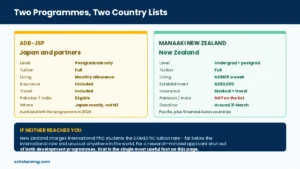
If you came to this page wanting a funded degree in New Zealand specifically, the programme you want is not ADB-JSP. It is the Manaaki New Zealand Scholarship Programme, funded by the New Zealand Government.
What it covers. Full tuition, a living allowance of around NZ$615 a week, an establishment allowance of around NZ$3,000, plus medical and travel insurance and travel costs. That is a genuinely complete package, comparable to ADB-JSP and in some respects more generous.
Levels. Undergraduate and postgraduate study, which is broader than ADB-JSP’s postgraduate focus.
Fields. Development-focused subjects aligned to each country’s priorities renewable energy, agricultural development, disaster risk management, public sector capability, health and education among them.
Conditions. You must have lived in your home country for the two years before applying, meet English requirements, hold relevant work experience for postgraduate study, and commit to returning home for at least two years after graduating. The shape mirrors ADB-JSP, because both programmes exist for the same development reason.
The deadline has fallen around 31 March for study beginning the following year, with the window opening some weeks earlier.
Additional:
And now the part that matters most for many readers of this site. Manaaki’s eligible country list covers the Pacific Fiji, Kiribati, Nauru, Niue, Papua New Guinea, Samoa, Solomon Islands, Tonga, Tuvalu, Vanuatu and the French Pacific territories and a specific set of Asian countries: Cambodia, Indonesia, Lao PDR, Malaysia, Nepal, the Philippines, Thailand, Timor-Leste and Vietnam.
Pakistan, India, Bangladesh and Sri Lanka do not appear on that list. If you hold one of those passports and you wanted a fully funded New Zealand degree, Manaaki does not reach you either, and the honest answer is that New Zealand currently offers you very little at government level.
Country lists change between cycles, so check the current one rather than this paragraph. But plan on what the list says today.
So What Should You Actually Do?
The right answer depends on your passport and your profile, so here it is directly.
If you are a Pakistani, Indian, Bangladeshi or Sri Lankan professional with two or more years of experience, under 35, living at home: ADB-JSP remains open to you, but in Japan and the other current partner countries rather than in New Zealand. Japan’s institutions are the strongest realistic target, several teach entirely in English, and the package is complete. Start there.
If you are from Nepal, Indonesia, Vietnam, the Philippines, Cambodia, Laos, Malaysia, Thailand or Timor-Leste: you can target both. Manaaki gives you a fully funded New Zealand option, ADB-JSP gives you Japan and others. The two have different deadlines and do not compete, so apply to both.
If you are from a Pacific island country: Manaaki is built for you and reaches undergraduate level as well. It should be your first application.
If you are a fresh graduate with no work experience: neither programme accepts you yet. This is worth saying plainly rather than letting you spend months discovering it. Build two years of relevant professional experience, which also strengthens every other scholarship application you will make, and apply then. The two years are not wasted time; they are the entry requirement.
If you already live and work outside your home country: both programmes exclude you. Look instead at university scholarships, which carry no residence condition, or at programmes designed for working professionals wherever you now live.
If You Still Want New Zealand
For students whose passports fall outside Manaaki’s list, New Zealand remains possible, just not free.
Tuition at New Zealand universities runs roughly NZ$30,000 to NZ$45,000 a year for international students, below Australian levels in most fields.
University scholarships exist at Auckland, Otago, Victoria University of Wellington, Canterbury, Massey and Waikato, generally in the NZ$5,000 to NZ$20,000 range, with a smaller number of larger doctoral awards. These carry no residence or nationality conditions of the ADB-JSP kind, which makes them accessible to exactly the people the government programmes exclude.
Doctoral study is the exception worth knowing. New Zealand charges international PhD students the domestic tuition rate, which is dramatically lower than the international rate and unusual anywhere in the world. A funded or self-funded doctorate in New Zealand can cost a fraction of the equivalent in Australia, the United Kingdom or the United States. For a research-minded applicant shut out of the development scholarships, this is the single most useful fact on this page.
Post-study work rights in New Zealand are reasonable, and the pathway from study to residence exists, though it has tightened in recent years.
Applying to ADB-JSP in Japan, Step by Step
Since Japan holds most of the remaining opportunities, this section covers that route in detail. It applies in outline to every partner institution.
Step one: pick two or three institutions, not ten.
ADB-JSP applications run through the university, and each one has its own admission requirements, its own programme structure and its own deadline. Three carefully chosen applications beat ten rushed ones, and the admission application is the harder half of the work.
Step two: match the programme to your job.
The programme assesses development relevance, which means the strongest applications show a straight line from what you do now to what you will study to what you will do when you return. A provincial irrigation engineer applying for a water resources master’s writes that line in one sentence. A generalist applying for an MBA has to work much harder.
Step three: apply for admission first, and early.
ADB-JSP consideration follows admission, and the university cannot nominate someone it has not admitted. Submit at least six months before your intended start, and earlier where the institution allows it.
Step four: tick the ADB-JSP box and submit the separate scholarship documents.
Most partner institutions ask for the ADB-JSP application form, a confirmation of your employment, a statement of purpose addressing development relevance, and evidence that you meet the residence and experience conditions. Each institution publishes its own list.
Step five: get the employer letter right.
This document causes more problems than any other. It needs to confirm your role, your dates of employment and, at many institutions, your employer’s support for your study and your return. Ask for it early, because organizations in every country take weeks to produce a letter on headed paper with a signature.
Step six: prepare for the gap between nomination and confirmation.
The university shortlists, then ADB confirms. Several months can pass between those two steps, and the uncertainty is uncomfortable. Keep your admission application alive and your other options open until the confirmation arrives in writing.
Language note.
Many Japanese partner institutions teach their ADB-JSP programmes entirely in English, which surprises applicants who assume Japanese is required. The International University of Japan, the National Graduate Institute for Policy Studies and Ritsumeikan Asia Pacific University all run English-medium graduate programmes aimed at exactly this audience. Japanese language ability helps you live there; it is usually not an admission requirement.
What the Selection Actually Rewards
ADB-JSP does not select the strongest student. It selects the applicant most likely to produce development impact at home, and the difference shows up in whose applications succeed.
Career trajectory beats grades. An applicant with a modest first degree who has risen through a public works department, an agriculture ministry, a district health office or an NGO reads better than a top-of-class graduate with a thin employment record. The programme funds people who already do the work.
The public sector and development organizations sit at the center. Government officials, public health workers, teachers, agricultural extension officers, engineers in state utilities and NGO staff all fit the programme’s purpose directly. Private-sector applicants succeed too, though they carry a heavier burden of explaining the development link.
Specificity about the return matters more than ambition. “I will contribute to my country’s development” is the sentence every application contains and none should. “I will return to the Punjab Irrigation Department, where I currently manage canal scheduling for 40,000 hectares, and apply remote-sensing methods to the water-loss problem I describe below” is an application.
Women applicants and applicants from disadvantaged backgrounds receive explicit preference at several partner institutions. If either applies to you, the application form usually gives you a place to say so, and you should use it.
Financial need forms part of the assessment, unlike most merit scholarships. This is a development programme, so describing honestly why you could not fund the degree yourself works in your favor rather than against it.
Writing the Statement for a Development Scholarship
The statement these programmes want differs from a university scholarship essay, and applicants who reuse one for the other usually fail.
Open with the problem in your country, not with yourself. One paragraph describing a concrete problem you work on groundwater depletion in a specific district, maternal mortality in a specific province, post-harvest loss in a specific crop. Numbers help.
Show your current role against that problem. What you do, what you can do with your present skills, and precisely where those skills run out. The gap you identify is the argument for the degree.
Name the courses that close the gap. Not the university’s reputation, the specific units, methods or research center that teach what you lack. This paragraph proves you read the programme rather than the ranking.
State what you will do on return, concretely. The role you expect, the organization, the change you intend. If your employer has agreed to hold your position or has written in support, say so here.
Keep the tone professional rather than grateful. These programmes fund colleagues, not supplicants. A statement written as a case reads stronger than one written as a plea.
Finally, cut anything that would appear in a thousand other applications. A development scholarship receives enormous numbers of statements about passion for serving one’s nation. The applications that win contain details nobody else could have written.
Six Mistakes These Listings Cause
Applying to Auckland’s ADB-JSP. It ended from 2024. The listings did not.
Trusting the year in a page title. Check the deadline inside the body. A 2023 date under a “2027” heading tells you everything.
Assuming fresh graduates qualify. Two years of professional experience is a hard requirement, not a preference.
Applying from abroad. Both ADB-JSP and Manaaki require you to be living in your home country. An applicant in the Gulf is ineligible for both.
Assuming Manaaki covers all developing countries. It covers a specific list. Pakistan, India, Bangladesh and Sri Lanka are not on it.
Treating the return-home condition as soft. Both programmes require it, and both mean it. If your plan is migration rather than a career at home, these are the wrong scholarships and a university award is a better fit.
How to Verify Any Scholarship in Five Minutes
This guide exists because a listing was wrong, so here is the method that would have caught it.
One. Find the funder’s own page. Not a blog, not an aggregator,the ADB page, the ministry page, the university’s own scholarship page.
Two. Check the current cycle’s dates on that page. If the most recent cycle named is two years old, treat the programme as dormant until proven otherwise.
Three. Check whether your institution appears on the funder’s current partner list. A university that stopped participating will often leave an old page up, but it will not appear on the funder’s list.
Four. Email the university’s scholarship office with one short question: “Is the X scholarship open for the 2027 intake?” They answer, and the answer is authoritative.
Five. Only then start assembling documents.
Five minutes at the start saves the month that a dead application costs. Use it on every scholarship you find, including the ones on this site.
Frequently Asked Questions
Does the University of Auckland still offer the ADB-Japan Scholarship?
No. Auckland stopped offering it from the 2024 intake, and the final application round closed in July 2023.
Is ADB-JSP still running?
Yes, through roughly 29 partner institutions, with the largest concentration in Japan. It is the Auckland partnership that ended, not the programme.
What does ADB-JSP cover?
Full tuition, a monthly subsistence and housing allowance, a books allowance, medical insurance and travel costs, with a possible thesis grant for research students.
Can I apply straight after my bachelor’s degree?
No. ADB-JSP requires at least two years of full-time professional work experience after your first degree.
Can I apply if I work abroad?
No. You must be living in your home country when you apply.
What is the age limit?
Generally 35, rising to 45 for senior officials in some programmes.
Is there a fully funded New Zealand government scholarship?
Yes, the Manaaki New Zealand Scholarship Programme. Its eligible country list covers the Pacific plus Cambodia, Indonesia, Lao PDR, Malaysia, Nepal, the Philippines, Thailand, Timor-Leste and Vietnam.
Can Pakistani or Indian students get Manaaki?
Those countries have not appeared on the eligible list. Check the current list before assuming either way.
Is a PhD in New Zealand cheaper?
Yes. New Zealand charges international doctoral students the domestic tuition rate, which is far below the international rate.