
Invest Your Talent in Italy
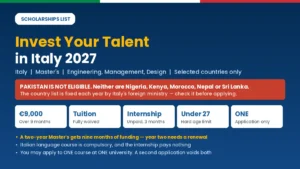
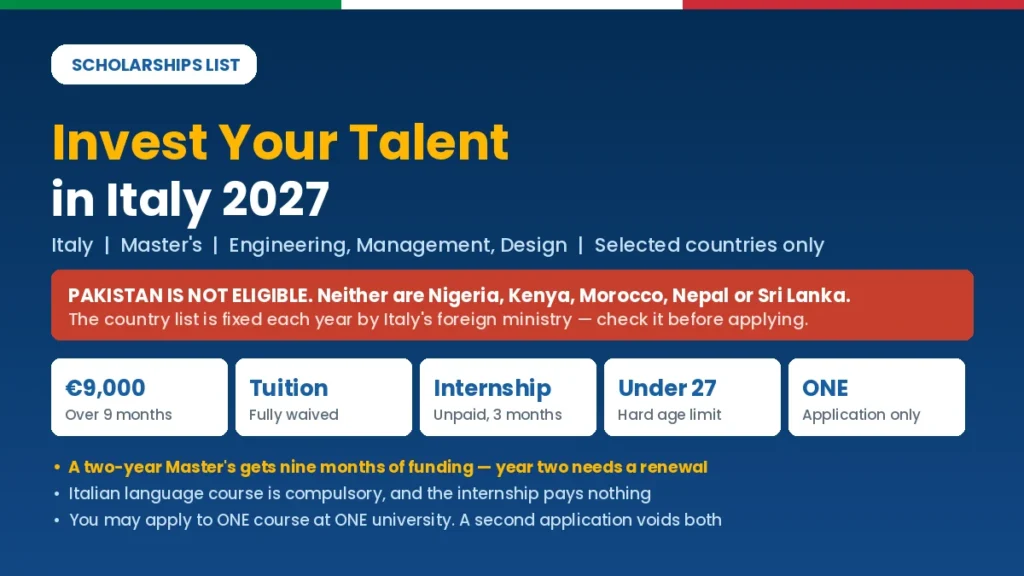
Invest Your Talent in Italy is open to a fixed list of countries, and Pakistan has not been on it.
Neither have Nigeria, Kenya, Morocco, Nepal or Sri Lanka. The list has run between 18 and 23 countries depending on the edition, and the Italian Ministry of Foreign Affairs sets it fresh each year. If your passport is not on the current list, no amount of academic strength changes the outcome, and an application costs you weeks you could spend on something you can actually win.
For the countries that are on it India, Bangladesh, Iran, Turkey, Egypt, Ghana, Ethiopia, Indonesia, Vietnam, China, Kazakhstan, Armenia, Azerbaijan, Tunisia and several in Latin America, this is one of the better-designed programmes in Europe. It pays €9,000, waives tuition, teaches you Italian, and places you in an internship at an Italian company. That last part is genuinely unusual.
This guide covers what it pays and what it quietly does not, the age rule that disqualifies more applicants than any academic criterion, the single application rule that ends careless attempts, the second-year gap nobody mentions, and what Pakistani and Nigerian readers should apply to instead.
Who Can Apply, and Who Cannot
The Italian Ministry of Foreign Affairs and International Cooperation runs this programme, with Uni-Italia administering it, and it is a trade and diplomacy instrument as much as an education one. Italy selects countries where it wants stronger commercial ties. That is why the list exists and why it changes.
The country list
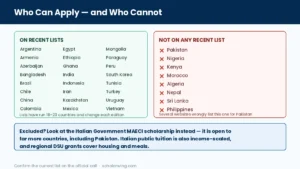
Recent editions have included: Argentina, Armenia, Azerbaijan, Bangladesh, Brazil, Chile, China, Colombia, Egypt, Ethiopia, Ghana, India, Indonesia, Iran, Kazakhstan, Mexico, Mongolia, Paraguay, Peru, Republic of Korea, Tunisia, Turkey, Uruguay and Vietnam.
Not every name appears in every edition. One recent list ran to 18 countries, another to 23. Treat the list above as a guide to the kind of country Italy picks, and confirm the current edition against the official call before you do anything else.
Pakistan has not appeared on any recent list. Nor have Nigeria, Kenya, Morocco, Algeria, Nepal, Sri Lanka or the Philippines. We state this plainly because several large websites list this scholarship under “scholarships for Pakistani students”, and that is simply wrong.
The other requirements
| Requirement | The rule |
|---|---|
| Nationality | Citizen of a country on the current year’s list |
| Degree held | A Bachelor’s degree; you apply for a Master’s or postgraduate course |
| Age | Born on or after 1 January 1999 for the recent edition roughly 27 or under |
| Italian study history | You must never have studied at or graduated from an Italian university |
| English | B2 minimum, with IELTS, TOEFL or TOEIC accepted |
| Residence | You apply from your home country, not from inside Italy |
Two of those catch people out more than the rest.
The age rule is hard. It is a date of birth, not an estimate, and there is no discretion. A candidate born in December 1998 is out of the recent edition, however strong their application. Each edition moves the date forward by one year, so check the current call rather than assuming.
The Italian study history rule is absolute too. If you already hold an Italian degree, or are enrolled at an Italian university now, you cannot apply. This programme exists to bring new people into the Italian system, not to fund people already inside it.
What It Actually Pays
| Item | What you get |
|---|---|
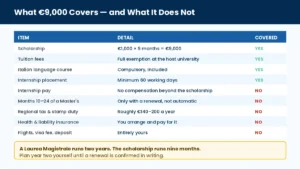
| Scholarship | €9,000 total, €1,000 a month for nine months |
| Tuition fees | Full exemption at the host university |
| Italian language and culture course | Included, and attendance is compulsory |
| Internship | A placement at an Italian company, arranged through the programme |
| Regional taxes, stamp duty | Not covered you pay these yourself |
| Health insurance, liability insurance | Not covered |
| Flights, visa fee, accommodation deposit | Not covered |
| Internship pay | None. The internship carries no compensation beyond the scholarship |
The headline figures are good. Tuition exemption at an Italian public university saves between €1,500 and €4,000 a year depending on the institution, and considerably more at a private one. The €9,000 is real money in most Italian cities outside Milan.
Now the parts that matter and rarely appear in a listicle.
The nine-month problem
The scholarship pays for nine months. An Italian Laurea Magistrale runs two years. The arithmetic does not need explaining.
Renewal exists, and students do get a second year, but renewal is conditional rather than automatic. You must pass your exams, attend the Italian course, and meet the programme’s requirements. Plan on the basis that year two needs its own funding until you hold the renewal in writing, and treat anyone who describes this as “fully funded for two years” as someone who has not read the call.
The unpaid internship
The internship is the distinctive part of this programme and the reason it beats a plain tuition waiver. It runs a minimum of 60 working days,three months, 480 hours,at an Italian company, and you can extend it by a further three months.
It pays nothing. The official FAQ states that there is no economic compensation beyond the scholarship, and travel and accommodation during the placement are yours. If the company sits in a different city from your university, that is a real cost nobody budgets for.
Weigh it anyway. An internship at an Italian firm, on your CV, with Italian language on top, is exactly what makes a graduate employable in Italy afterwards. Few European scholarships build that in.
What You Need Beyond the Scholarship
Italy requires a study visa, and the consulate assesses whether you can support yourself. Requirements vary by consulate, and the figure moves, so check with the Italian mission in your own country rather than relying on a number from a blog.
Living costs give you the shape of it. Outside Milan and Rome, a student lives on roughly €700 to €900 a month including rent. Milan runs considerably higher, often €1,100 or more, because housing there is genuinely difficult. The €1,000 monthly scholarship therefore covers a student in Pisa, Padua, Turin or Bologna reasonably well, and stretches thin in Milan.
Add the costs the scholarship excludes: regional tax of roughly €140 to €200 a year, health insurance of around €150 upwards, the stamp duty, and the flight. None is enormous; together they want planning.
The DSU option worth knowing about
Separately from this programme, Italian regions run need-based grants called DSU or diritto allo studio scholarships, which can include accommodation, meals and a cash grant. Rules on holding a DSU grant alongside an IYT scholarship vary by region and by year, and some combinations are prohibited. Ask the regional authority for your university directly before you count on both.
The Fields, and the Universities
The programme covers three areas only:
- Engineering and advanced technologies
- Economics and management
- Architecture and design
More than 250 Master’s courses sit inside those areas, taught in English at participating universities including Bologna, Padua, Pisa, Turin Polytechnic, Milan Polytechnic, Trento, Brescia and many more. Humanities, law, medicine and pure sciences are outside the programme entirely.
That narrowness is deliberate. Italy is funding the disciplines its industry hires from manufacturing, design, fashion and engineering, which is also why the internship exists.
The Application, Step by Step
The process runs in a fixed order and one mistake early makes the rest pointless.
1. Confirm your country is on the current list. Before anything else. The call published on the official application portal names the countries for that edition.
2. Choose exactly one course. This is the rule that ends the most applications. You may apply to one IYT course at one university. The FAQ states that multiple applications using different email addresses are strictly prohibited and will be rejected. Choose carefully, because there is no second attempt in the same cycle.
3. Obtain pre-admission from that university. Most participating universities run their own admission process with their own deadline, and several close before the IYT deadline. Start here, not with the scholarship form.
4. Prepare the documents. The recent edition asked for an academic transcript, the Bachelor’s degree certificate, a CV, an English certificate, a valid passport, an optional Italian certificate, and a one-minute motivation video in MP4. Every PDF must sit under 1 MB and the video under 10 MB.
5. Apply on the official portal by the deadline. The recent edition closed on 11 May at 18:00 Italian time, for courses starting that September. Confirm the current date on the portal, since it moves by a few days each year.
The one-minute video
Few scholarships ask for this, and most applicants handle it badly. Sixty seconds is roughly 140 spoken words, which means one idea delivered well rather than a summary of your life.
Say who you are in a sentence. Name the specific problem you want to work on and why it needs Italy ,a company, an industry, a design tradition, a research group. Say what you will do with the degree afterwards. Then stop. Speak to the camera in good light with clean audio, in English, without reading from a script you clearly placed beside the lens. Confidence and clarity register; production value does not.
Our free SOP generator and motivation letter generator will help you work out what to say before you record it, and the CV builder handles the academic CV in the European format the programme expects.
What Studying in Italy Is Actually Like
Three things shape the experience for international students, and none of them appears in a scholarship announcement.
The exam system will surprise you.
Italian universities lean heavily on oral examinations. You sit across a desk from the professor, who asks questions and grades you on the spot, in front of whoever is waiting their turn. Students arriving from a written-exam tradition often find the first session unnerving. It rewards genuine understanding over memorised answers, and it rewards speaking up, which is a skill worth practising before you arrive rather than discovering in June.
The grading scale runs to 30, with 18 as a pass and 30 e lode as the top mark. Resitting an exam carries little stigma, and students routinely refuse a grade they dislike and take the exam again. That flexibility surprises people, and it is worth knowing, because the first session rarely goes perfectly for anyone.
Bureaucracy takes real time.
Within eight days of arriving you apply for the permesso di soggiorno, the residence permit, through a post office kit. You also need a codice fiscale, the Italian tax code, before you can sign a lease or open a bank account. Neither is difficult; both move slowly, and both have to happen in a specific order. Budget your first three weeks for paperwork rather than sightseeing, and ask your university’s international office to walk you through it most run a session precisely for this.
Housing varies enormously by city.
Milan is genuinely hard and genuinely expensive. Bologna, Padua, Turin and Pisa are all student cities with real rental markets and prices that a €1,000 scholarship can absorb. Southern cities cost less again. Several universities offer residence places to scholarship holders, so ask before you search privately, and start the search the week you accept rather than the week you fly.
On the language, your course runs in English and the compulsory Italian course gives you the basics. Daily life outside the big universities often does not run in English, though, and the gap between surviving and belonging is almost entirely a language gap. The students who enjoy Italy most are the ones who treat the Italian course as the point rather than an obligation.
After the Degree: Staying in Italy
This is where the programme’s design pays off, and it is the strongest argument for choosing it over a scholarship that simply pays more.
Italy allows graduates to convert a study permit into a job-search permit, giving you a period after graduation to find work while remaining legally in the country. The exact duration and conditions sit with the Interior Ministry and have changed more than once, so confirm the current rule before you plan around it.
What matters is that you arrive at that moment with three things most international graduates lack: an internship already completed at an Italian company, working Italian, and a network inside an industry that hires. A graduate holding a degree alone competes on paper. A graduate who spent three months inside a firm competes on a phone call.
The industries behind this programme are the ones doing the hiring. Italian manufacturing, particularly in the north, runs on mechanical and industrial engineering. Design and fashion concentrate in Milan. Automotive sits around Turin and Modena. Food technology clusters in Emilia-Romagna. If your Master’s and your internship both point at one of those, your odds of staying are materially better than the general graduate average.
The honest caveat: Italian graduate salaries sit below northern European ones, youth unemployment remains high by European standards, and Italian fluency separates candidates far more sharply than it does in the Netherlands or the Nordics. People who go in expecting German or Dutch salary levels leave disappointed. People who want to work in Italian industry, in Italy, find a route here that few other scholarships build.
Choosing Your One Course
With a single application allowed, the choice carries more weight here than in almost any other scholarship. Four questions settle it.
Does your background match the course closely?
A committee comparing a mechanical engineering graduate against an industrial design graduate for a design course will take the obvious fit. Apply where your transcript already argues for you.
Does the university’s own admission deadline let you finish in time?
Several participating universities close admissions months before the scholarship deadline. A course you cannot secure pre-admission for is not a real option, however well it suits you.
Where will you actually live?
A scholarship of €1,000 a month means something different in Milan than in Pisa. The course matters more than the city, yet a student who cannot afford rent cannot finish the degree.
Does the course connect to an industry you want to enter? The internship follows the programme, and the programme sits inside a region with its own industrial character. Choosing a course in a city where your field barely exists wastes the best part of the scholarship.
Seven Mistakes That End Applications
1. Applying from a country not on the list. Check first, always. This single step saves more wasted effort than everything else in this guide.
2. Submitting more than one application. Different email addresses do not hide it, and both applications get rejected.
3. Missing the university’s own deadline. Pre-admission comes first and several universities close earlier than the programme does.
4. Being born a few weeks too early. The age rule is a date, applied mechanically. Check it before you begin.
5. Oversized files. PDFs over 1 MB and videos over 10 MB fail to upload, and applicants discover this at midnight on the deadline.
6. Assuming the second year is funded. Nine months is nine months until a renewal says otherwise.
7. Treating the internship as a paid job. It pays nothing. Budget for the placement months as you would for any other months.
How It Compares With Europe’s Other Options
| Programme | Covers | Duration | Internship | Open to Pakistan? |
|---|---|---|---|---|
| Invest Your Talent in Italy | €9,000 + tuition | 9 months, renewable | Yes, unpaid | No |
| Italian Government MAECI | Monthly grant + tuition | 6 to 9 months | No | Yes |
| Erasmus Mundus | Tuition, living, travel, insurance | Full degree | No | Yes |
| DAAD (Germany) | Living costs + travel | Full degree | No | Yes |
| Swedish Institute SISGP | Tuition, living, travel, insurance | Full degree | No | Yes |
| Hungarian Stipendium | Tuition, monthly grant, housing | Full degree | No | Yes |
Two conclusions follow. For eligible nationalities, IYT’s distinguishing feature is the internship and the Italian language training, not the money, Erasmus Mundus and SISGP both pay better and cover the whole degree. If your goal is to work in Italy afterwards, IYT is built for exactly that, and the others are not.
For Pakistani, Nigerian, Kenyan and other excluded nationalities, the rest of that table is where to look.
If You Are Pakistani, Read This Instead
Italy has not shut you out. This particular programme has, and several better-suited routes remain open.
The Italian Government MAECI scholarship is the one to start with. Administered by the Ministry of Foreign Affairs, it is open to a far wider set of countries including Pakistan, and it pays a monthly grant with tuition exemption. It funds a shorter period than a full degree, so plan the remainder.
Italian universities charge remarkably little by European standards. Public university tuition runs on a sliding scale tied to family income, and students from low-income households often pay a few hundred euros a year rather than thousands. Combined with a regional DSU grant, this is a genuinely affordable route that nobody advertises because there is no agency commission in it.
Regional DSU grants are need-based rather than merit-based and can cover accommodation, meals and a cash stipend. Each region runs its own, and the application usually happens after you are admitted.
And look beyond Italy. Swedish Institute SISGP covers tuition, living costs, travel and insurance. Lund and Uppsala waive tuition. The Danish Government Scholarship does too, at some universities with a living grant attached. All of them accept Pakistani applicants.
Use our eligibility checker to narrow the list to what your passport and your degree actually allow.
Realistic Odds and How to Improve Them
The programme does not publish an application-to-award ratio, and anyone who quotes one is inventing it. What the structure tells you is more useful than a number.
Each participating university offers a limited number of IYT places, and the eligible population is large India, China, Bangladesh, Indonesia and Vietnam alone hold most of the world’s engineering graduates. Competition is therefore heavy, and it concentrates on the best-known universities.
Several things sit within your control. Choose a course that fits your background closely rather than the most famous name, because with one application you cannot hedge. Secure pre-admission early, since a late or incomplete admission file sinks the scholarship application behind it. Put real work into the video, which most applicants treat as an afterthought and which is the only part of the application where a committee hears you. And learn some Italian before you apply, the certificate is optional, but a candidate who has started is a candidate who looks likely to finish the compulsory course and stay.
Frequently Asked Questions
Is Invest Your Talent in Italy open to Pakistani students?
No. Pakistan has not appeared on any recent country list. Check the current call to be certain, and look at the Italian Government MAECI scholarship instead, which is open to Pakistan.
Is it fully funded?
It pays €9,000 over nine months and waives tuition. It does not cover regional taxes, insurance, flights or the second year of a two-year Master’s unless renewed.
Can I apply to more than one university?
No. One course at one university. Multiple applications are rejected.
Is the internship paid?
No. The official FAQ states there is no compensation beyond the scholarship, and travel and accommodation during the placement are yours.
What is the age limit?
The recent edition required a birth date on or after 1 January 1999. The date moves forward each edition, so check the current call.
Do I need to speak Italian?
Not to apply
courses are taught in English and B2 English is the requirement. The Italian language course is compulsory once you arrive, and an Italian certificate strengthens an application.
Can I apply if I already studied in Italy?
No. Applicants must never have studied at or graduated from an Italian university.
What subjects are covered?
Engineering and advanced technologies, economics and management, and architecture and design. Nothing else.
When is the deadline?
The recent edition closed on 11 May at 18:00 Italian time for a September start. Confirm the current date on the official portal.
Read it Also: Lester B. Pearson Scholarship 2027