
Monash International Leadership Scholarship 2027: The Honest Guide
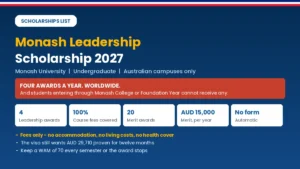
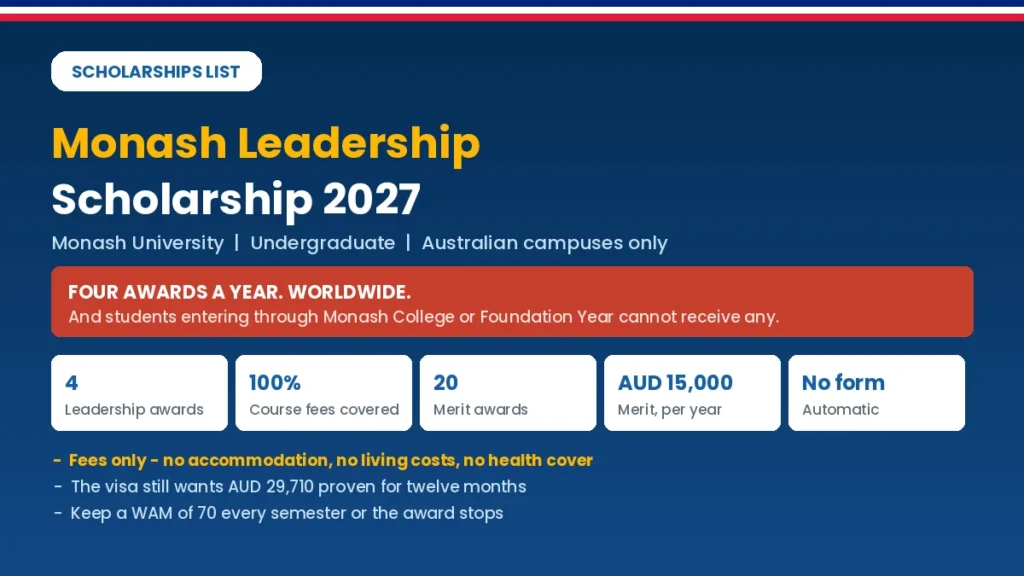
Monash University offers an international undergraduate scholarship called the Monash International Leadership Scholarship that covers 100% of course fees for the entire degree. No application form, no essay, no interview. Every student who receives an undergraduate offer is automatically considered.
It awards four of them a year. Worldwide.
That number appears on Monash’s own page and almost nowhere else, which is why so many applicants build plans around an award with roughly the same odds as a competitive national scholarship, while believing it to be a routine university discount.
Alongside it sits the Monash International Merit Scholarship, which pays AUD 15,000 a year for the duration of the degree and goes to 20 students. Together, the two schemes fund 24 international undergraduates annually out of an applicant pool numbering many thousands.
There is also a rule that disqualifies a large share of Monash’s international students before anything else matters, and it has nothing to do with grades: students entering through Monash College or a Foundation Year cannot receive either award. Since pathway programmes are one of the main routes international students take into Monash, this single line removes a substantial part of the audience reading about these scholarships.
This guide covers what each award actually pays, who the rules quietly exclude, what Monash costs once you add living expenses, and the far stronger funding available to research students that most applicants never look at.
The Two Undergraduate Awards
Monash International Leadership Scholarship
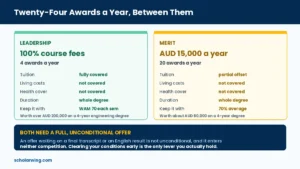
What it pays: 100% of course fees for the duration of your undergraduate degree, until you complete the minimum credit points your course requires.
What it does not pay: accommodation, living costs and Overseas Student Health Cover. Monash states this plainly, and it matters, a student holding full fee cover still needs roughly AUD 30,000 a year to live on, and the Australian visa asks for proof of it before granting the permit.
How many: four a year.
Who can receive it: international students of any nationality who hold a full, unconditional Monash undergraduate course offer and enrol full-time at an Australian Monash campus.
How selection works: primarily on academic achievement.
To keep it: maintain a Weighted Average Mark of at least 70 every semester. Monash may also ask recipients for a student profile for its promotional material.
How to apply: you do not. Every student holding an undergraduate course offer enters automatic consideration.
Monash International Merit Scholarship
What it pays: AUD 15,000 a year for awards from 2026 onwards, paid annually until you complete your degree. Earlier recipients hold AUD 10,000, and older scholarship listings still quote that figure.
How many: 20 a year.
Who can receive it: the same conditions as the Leadership award international student, full unconditional undergraduate offer, full-time enrolment at an Australian Monash campus.
To keep it: a distinction average, 70% or above, each semester.
How to apply: again, you do not. Consideration is automatic on receiving an offer.
The practical difference between the two is large. Full fee cover across a four-year engineering degree at Monash’s rates runs past AUD 200,000. AUD 15,000 a year across the same degree runs to AUD 60,000. Both are worth having. Only one of them removes the tuition problem entirely.
Who These Scholarships Quietly Exclude
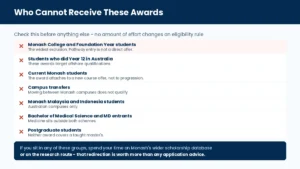
This section matters more than the values, because an ineligible applicant cannot improve their chances by any amount of effort.
Pathway and Foundation students cannot receive either award. Students entering through Monash College or a Monash Foundation Year fall outside both schemes. This is the exclusion with the widest reach, because those pathways bring a large share of Monash’s international undergraduates into the university. A student finishing Monash College and progressing into first year is not a new offer-holder in the sense these scholarships require.
Australian Year 12 students cannot receive them. The awards target students applying from offshore qualifications, so an international student who completed Year 12 in Australia falls outside them though other Monash and state awards may apply instead.
Current Monash students cannot receive them. The awards attach to a new course offer, not to progression. A student moving from one Monash degree to another, or transferring between campuses, does not qualify.
Non-Australian campuses do not qualify. Monash operates in Malaysia, Indonesia and elsewhere, and these scholarships require enrolment at an Australian campus. Students planning to study at Monash Malaysia should look at that campus’s own scholarship schemes instead.
Medicine is excluded. Students commencing the Bachelor of Medical Science and Doctor of Medicine are outside both schemes.
Postgraduate students are outside both. Neither award covers a taught master’s. The research scholarships below cover research degrees, and taught postgraduate students fall between them.
If you sit in any of those groups, stop reading about these two awards and spend the time on Monash’s wider scholarship database or on the research route described further down. That redirection is worth more to you than any application advice.
What Monash Actually Costs
Monash fees span a wide range because the university teaches everything from arts to pharmacy.
Undergraduate international tuition has run roughly AUD 32,860 to AUD 60,600 a year, with arts and education at the lower end and engineering, pharmacy and the sciences at the upper.
Postgraduate tuition runs about AUD 15,100 to AUD 59,900 a year depending on the programme.
Confirm the figure for your specific course on Monash’s own fee page, because a range that wide cannot support a budget.
On top of tuition, the student visa requires proof of AUD 29,710 for twelve months of living costs, plus Overseas Student Health Cover and travel money. Melbourne costs slightly less than Sydney, and Monash’s Clayton campus sits in the suburbs where rents run below the inner city.
Running the numbers on a four-year engineering degree:
| Item | Amount (AUD) |
|---|---|
| Tuition, 4 years at about 55,000 | 220,000 |
| Living costs, 4 years at about 30,000 | 120,000 |
| Total | about 340,000 |
| With the Leadership scholarship | 120,000 |
| With the Merit scholarship | 280,000 |
The Leadership award removes nearly two thirds of the cost. The Merit award removes about 18%. The gap between the two is the difference between a plan that works and one that needs a second source of funding.
Your Real Odds, and What to Do About Them
Four full-fee awards and twenty part-awards from a global applicant pool is competitive in a way that the phrase “automatic consideration” disguises.
Selection runs primarily on academic achievement, which means your final secondary results carry almost all the weight. There is no essay to write, no referee to impress, no interview to prepare. That has one useful consequence and one uncomfortable one.
The useful consequence: your application costs you nothing extra. You apply for admission, and consideration follows. Nobody should skip Monash because the odds look long, since the marginal effort is zero.
The uncomfortable one: you cannot improve your chances through effort once your results are fixed. The levers that exist are narrow, and they are worth using precisely because they are the only ones.
Lever one: get the offer unconditional, early. Both awards require a full, unconditional offer. An offer waiting on a final transcript or an English result is not one. Clear every condition the moment you can.
Lever two: present your results so an assessor reads them correctly. Transcripts from unfamiliar grading systems get read conservatively. Send certified translations, include the grading scale and class rank where your school issues one, and make sure your final results reach Monash complete rather than in pieces.
Lever three: apply to several Australian universities. The applications overlap almost entirely, the awards are separate competitions, and a student applying only to Monash is betting on 24 places.
Lever four: hunt the smaller awards. Monash publishes a large scholarship database covering faculty awards, country-specific awards and donor-funded awards, many in the AUD 5,000 to AUD 20,000 range. These receive a fraction of the applications the headline schemes do, and almost nobody searches them.
The Research Route Nobody Compares
Students fixed on the undergraduate scholarships rarely look at what Monash offers research candidates, and the difference is considerable.
The Monash International Tuition Scholarship covers 100% of tuition fees plus a single Overseas Student Health Cover policy for international students in research doctorates and research master’s degrees. Note the health cover, which the undergraduate Leadership award explicitly excludes.
Alongside it, Monash offers graduate research stipends, funded partly through Australia’s Research Training Program, which pay a tax-free living allowance of roughly AUD 36,000 and upwards a year.
Applications are automatic. Applying for a graduate research degree at Monash places you in consideration for the graduate research scholarships without selecting them individually.
Rounds and deadlines run through the Applicant Portal, with international rounds commonly closing around 31 August for the following year, and a second round running across the earlier part of the year. Confirm the current dates, because Monash adjusts them.
What this means in practice. An international student who completes a research master’s or a PhD at Monash can have fees covered, health cover provided and living costs paid. An international student in a taught undergraduate or master’s degree, in nearly every case, cannot.
If your field admits a research pathway and your longer plan involves research, academia or a technical specialism, the funding argument for the research route is overwhelming. It is not the right choice for everyone, a research degree demands a different temperament and a supervisor’s agreement, but it deserves a serious look before you commit to four self-funded undergraduate years.
The Supervisor Step, If You Take the Research Route
Research funding at Monash, as at every Australian university, runs through a supervisor. No panel awards a research scholarship to a candidate nobody has agreed to supervise.
Find three or four academics whose published work overlaps with what you want to study. Read one recent paper by each, properly.
Write a short email, around 150 to 200 words, that names the paper, states the question you want to work on, explains the connection, names the scholarship round you intend to enter, and asks one easy question.
Dear Dr Rahman,
I completed a Master of Environmental Engineering at NUST Islamabad, where my thesis measured heavy-metal loading in the Ravi river downstream of textile outfalls.
Your 2025 paper on passive sampling in industrial catchments describes a deployment protocol that would solve the sampling-frequency problem my thesis ran into. I would like to test it on the Ravi dataset I already hold.
I am preparing an application for the graduate research round closing in August and would like to ask whether you are taking doctoral candidates for 2027.
Kind regards, Sana Iqbal
Attach your CV and nothing else. Expect roughly one reply in four, and write to more academics rather than to one you admire most.
Start early. A supervisor needs time to assess you, check their funding and support your application internally. Writing in October for an August round is the right order of magnitude; writing in July is not.
The Pathway Question, Answered Properly
The pathway exclusion deserves more than a line, because thousands of students make this decision every year without knowing it affects their scholarship eligibility.
What a pathway is.
Many international students do not meet Monash’s direct entry requirements straight from school the grades fall short, the qualification does not map onto the Australian system, or the English score lands below the threshold. For those students, Monash College runs diploma and foundation programmes that lead into first or second year of a Monash degree. The system works well, and it brings a large number of students into the university every year.
What it costs you in scholarship terms.
A student who enters this way cannot receive the Leadership or the Merit scholarship. The awards attach to a direct undergraduate offer, and progression from a pathway is not that.
What this should change about your planning.
If your results sit close to Monash’s direct entry threshold, the gap between direct entry and a pathway is now worth far more than the few marks that separate them. Direct entry keeps a possible AUD 200,000 award on the table. A pathway removes it.
Three practical responses follow.
Retake or improve where you still can.
If you are a year out, the marks you earn this year decide both your entry route and your scholarship eligibility. Students treat the entry threshold as a pass-fail line and stop pushing once they expect to clear it, which is backwards, the scholarship ranking runs on academic achievement, so every mark above the threshold still works for you.
Fix the English score rather than accepting a pathway for it.
Many pathway placements happen because of English alone. A retake costs a few hundred dollars and a few weeks. A pathway costs a year, extra fees, and these scholarships.
Compare universities on entry route, not only on ranking.
A direct offer from a slightly lower-ranked Australian university, with its scholarship eligibility intact, may leave you better off than a pathway into Monash. That comparison is rarely made and often decisive.
None of this argues against pathways. For a student who genuinely needs the preparation, Monash College does a real job and the degree at the end is the same degree. It argues for making the choice with the scholarship consequence in view rather than discovering it afterwards.
A Timeline That Works
Working backwards from a February 2027 start at an Australian university:
Fourteen months out, December.
Decide your course and check Monash’s direct entry requirements against your predicted results. If the gap is small, plan how to close it this year.
Twelve months out, February.
Book IELTS, TOEFL or PTE. Start the transcript and attestation process, which runs six to eight weeks in many countries and longer where a ministry and a consulate both sign.
Eleven months out, March.
Sit the English test, leaving room for a second attempt. A weak score here is the most common reason students end up on a pathway, and the most fixable.
Ten months out, April.
Shortlist four or five Australian universities. The applications overlap almost entirely, and each one runs a separate scholarship competition.
Nine months out, May.
Submit admission applications as the intakes open. Automatic scholarship consideration follows admission, so earlier applications sit in smaller fields.
Eight months out, June
. Clear every condition on each offer. Upload documents as they arrive rather than waiting for a complete set, and confirm in writing that your offer carries no outstanding conditions.
Seven months out, July.
Search each university’s scholarship database properly, filtered by your course and citizenship, and apply for the smaller faculty and donor awards that need applications.
Six months out, August.
Expect scholarship outcomes alongside or shortly after your offers. If a research round interests you, August is when several Australian graduate research rounds close.
Five months out, September.
Arrange proof of funds in an accessible account with visible history. Moving money the week before you lodge the visa raises questions.
Four months out, October.
Lodge the subclass 500 visa, attaching every scholarship letter you hold.
Two months out, December.
Arrange accommodation. Clayton’s rental market is easier than inner Melbourne but tightens in January as the semester approaches.
Six Mistakes That Cost Applicants These Awards
Assuming “automatic consideration” means generous. Four full-fee awards and twenty part-awards go out each year, worldwide. Apply, and also apply elsewhere.
Not checking the pathway exclusion. Students entering through Monash College or a Foundation Year cannot receive either award. Discovering that after accepting a pathway place is painful and avoidable.
Letting an offer stay conditional. Both awards require a full, unconditional offer. A pending English result keeps you out, and nobody writes to tell you.
Planning around an old AUD 10,000 figure. The Merit award pays AUD 15,000 a year from 2026. Older listings quote the previous rate, which under-states what is available now.
Treating full fee cover as full funding. The Leadership award excludes accommodation, living costs and health cover. The visa still requires AUD 29,710 proven for twelve months.
Forgetting the WAM 70 condition. Both awards continue only while you maintain a distinction average each semester, and the first semester in a new country is where students slip.
Monash Compared With the Alternatives
Melbourne offers 20% fee remission to around 225 undergraduates from 2027, restricted to countries with GDP per capita at or below US$10,000. More students receive less. Monash concentrates more money in far fewer hands. A strong student should apply to both one may hit.
Sydney runs a tiered Vice-Chancellor’s scheme paying AUD 5,000 to AUD 60,000, automatic, one-off and non-renewable. Monash’s awards run for the whole degree, which usually makes them worth more over time.
The Research Training Program at Australian universities funds research degrees with full fees and a tax-free stipend of roughly AUD 36,000 and above. For a research candidate this outclasses every undergraduate award discussed here.
Destination Australia pays AUD 15,000 a year at regional campuses with no fee cover and a regional residence condition. Monash’s main campuses are metropolitan, so the two do not combine.
Australia Awards Scholarships are the fully funded Australian government programme for eligible developing countries, covering tuition, airfares, living costs and health cover. Applicants from Pakistan, Bangladesh, Nepal and much of Africa should check that list before relying on a 1-in-many university award.
The honest summary: Monash’s Leadership scholarship is one of the most valuable undergraduate awards in Australia and one of the hardest to get. Apply, because it costs nothing. Plan as though you will not receive it.
Studying at Monash
Monash is Australia’s largest university by enrolment and a member of the Group of Eight, with real strength in pharmacy and pharmaceutical sciences consistently among the world’s best along with engineering, medicine, business and education.
Its main campus sits at Clayton, in Melbourne’s south-eastern suburbs, with further campuses at Caulfield, Peninsula and Parkville. Clayton runs large and self-contained, with its own residential colleges, research institutes and the Australian Synchrotron next door. Students who want a campus-centered experience generally prefer it to the city-embedded universities; students who want to live in the Centre of Melbourne face a commute.
Rents around Clayton run below inner Melbourne, which makes the living-cost arithmetic easier than it looks on paper. Public transport reaches the campus by bus and train, though the connection is slower than a tram ride to a city campus.
The international community is large and long-established, and Monash’s global campuses mean a genuinely international faculty. Class sizes in popular first-year units run big, and as everywhere, the students who find academic staff early do better than those who wait.
Frequently Asked Questions
How much is the Monash International Leadership Scholarship worth?
It covers 100% of course fees for the duration of your undergraduate degree. It excludes accommodation, living costs and health cover.
How many are available?
Four a year, worldwide.
Do I need to apply?
No. Every student holding a Monash undergraduate course offer enters automatic consideration.
Can Monash College or Foundation Year students receive it?
No. Pathway and Foundation students fall outside both the Leadership and the Merit scholarships.
How much is the Monash International Merit Scholarship?
AUD 15,000 a year from 2026, for the duration of your degree, with 20 awards a year. Earlier recipients hold AUD 10,000.
Are these available at Monash Malaysia?
No. Both require enrolment at an Australian Monash campus.
Is there anything for a taught master’s?
Neither award covers postgraduate coursework. Research degrees have their own, stronger, scholarships.
What do I need to keep the scholarship?
A Weighted Average Mark of at least 70, each semester.
Will a scholarship satisfy my student visa?
Partly. The visa requires AUD 29,710 in living costs plus your first year of tuition, and a scholarship counts only for what it names. The Leadership award covers fees, so it reduces the tuition evidence rather than the living-cost evidence.
Part of our complete guide to scholarships in Australia for international students — every major award compared.