
Sydney Scholars India and Global Scholarships
The University of Sydney offers AUD 40,000 to Indian students through the Sydney Scholars India Scholarship and up to AUD 60,000 to everyone else, which is how most scholarship lists describe these programmes. Both figures are real. Both describe the top tier of a tiered scheme, and most recipients receive something considerably smaller.
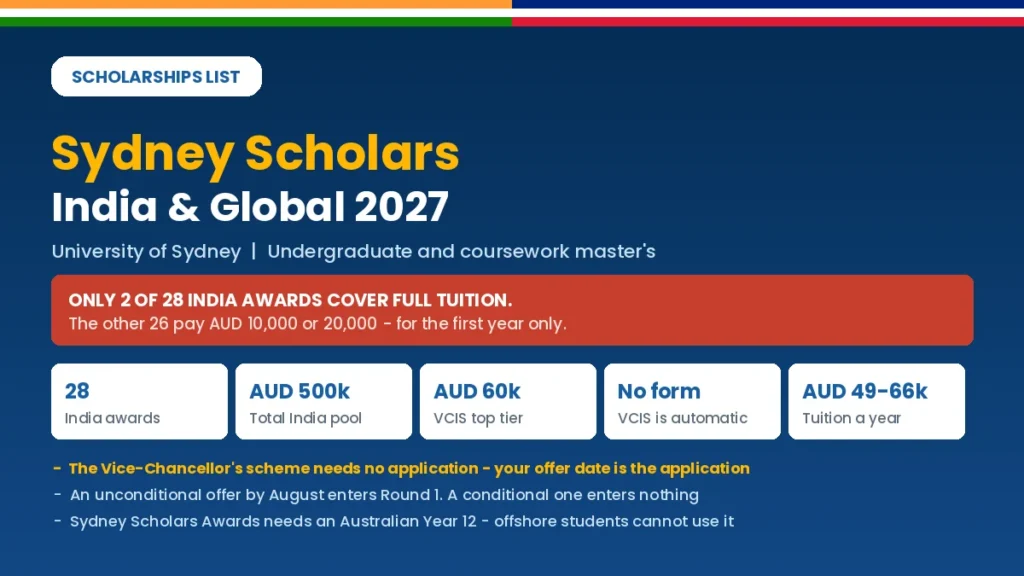
Here is the picture the lists leave out. The Sydney Scholars India programme funds 28 students from a pool of AUD 500,000. Two of them receive full tuition for up to four years. The other 26 receive AUD 10,000 or AUD 20,000 for their first year only. Sydney’s international tuition runs between roughly AUD 49,200 and AUD 65,900 a year, so an AUD 10,000 award covers around a sixth of one year and nothing after it.
That is not a reason to skip these awards. A AUD 20,000 reduction is real money, the application takes an afternoon, and the global scheme requires no application at all, which means thousands of admitted students receive it without ever having searched for a scholarship. It is a reason to understand the numbers before you build a plan around them.
This guide covers both programmes, what each tier pays, the deadlines that matter, how to write the personal statement, and whether Sydney makes financial sense once you add the living costs the visa requires.
The Two Programmes, Side by Side
Sydney runs several awards for international students. Two matter most, and applicants routinely confuse them.
Sydney Scholars India Scholarship Program is the India-specific award. It requires an application, it has a fixed window, and it carries the largest top prize for an undergraduate.
The Vice-Chancellor’s International Scholarships Scheme, usually shortened to VCIS, is the global award. It requires no application at all. Every international student holding an unconditional offer by a round deadline is automatically considered.
There is also the Sydney Scholars Awards, which many international applicants find in search results and cannot actually use. That programme runs at around AUD 6,000 a year and requires applicants to be completing an Australian Year 12 qualification, applying through the Universities Admissions Centre with an ATAR between roughly 95 and 99.85. An offshore student applying from India, Pakistan or Nigeria does not meet that condition. If you are applying from outside Australia, the India programme and VCIS are your routes.
Sydney Scholars India: The Real Numbers
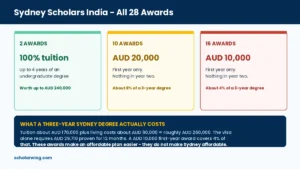
The programme distributes AUD 500,000 a year across 28 awards, in three tiers:
| Tier | Awards | Value | Covers |
|---|---|---|---|
| Full tuition | 2 | 100% of tuition | Up to four years of an undergraduate degree |
| Partial | 10 | AUD 20,000 | First year only |
| Partial | 16 | AUD 10,000 | First year only |
Read the third column carefully, because it carries the whole story. Twenty-six of the 28 awards apply to year one and stop. A student who budgets a three-year degree assuming AUD 20,000 a year receives AUD 20,000 once and faces full fees for years two and three.
The two full-tuition awards are genuinely transformative, covering up to four years of an undergraduate degree, which at Sydney’s engineering or health sciences rates exceeds AUD 240,000. They also represent a 1-in-14 chance within an already competitive applicant pool.
Who can apply: international students holding Indian citizenship and currently resident in India, who hold an unconditional offer of admission and have not yet started studying. Australian citizens, permanent residents and previous holders of the award cannot apply. The programme covers undergraduate and postgraduate coursework degrees across all fields.
To keep it, recipients maintain a minimum average mark of 65. Payments arrive per semester rather than as a lump sum.
The window: the programme has opened on 1 April and closed on 24 May. Confirm the current dates on Sydney’s scholarship page, because the window is short and missing it costs a full year.
The Vice-Chancellor’s Scheme: The Award You Do Not Apply For
VCIS is the most under-explained scholarship in Australia, and the reason is simple: there is nothing to apply for, so nobody writes about the process.
The scheme awards AUD 60,000, AUD 40,000, AUD 20,000, AUD 10,000 or AUD 5,000. The two largest tiers apply across one year; the smaller ones apply to a single semester. The award arrives once, at the start of your degree, and does not renew in later years.
Eligibility covers international students enrolling in a CRICOS-registered bachelor’s or coursework master’s degree who hold an unconditional offer of admission by a round’s closing date and have not previously held the award.
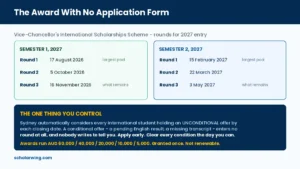
No application exists. Sydney automatically considers every eligible student who holds an unconditional offer by each deadline.
That single fact changes your strategy more than anything else in this guide. Since the award depends on holding an unconditional offer by a round date, the date you secure your offer is the only thing you control. An applicant who submits admission documents in July and clears conditions by mid-August enters Round 1. One who waits until November enters Round 3, competing for whatever remains.
Closing dates for Semester 1, 2027 have run 17 August 2026, 5 October 2026 and 16 November 2026. For Semester 2, 2027, 15 February, 22 March and 3 May 2027. Verify the current dates, because rounds shift between years.
The practical instruction: apply for admission as early as the portal allows, and clear every condition on your offer immediately. A pending English test result or an unsubmitted final transcript keeps your offer conditional, and a conditional offer does not enter the round.
What Sydney Actually Costs
The awards only make sense against the full cost, so here it is.
Undergraduate tuition, per year, 2026 rates:
| Faculty | AUD per year |
|---|---|
| Nursing | 49,200 |
| Arts and Social Sciences | 49,200 – 56,300 |
| Music | 49,200 – 50,300 |
| Architecture, Design and Planning | 52,500 |
| Law | 56,300 |
| Science | 56,300 – 60,600 |
| Business | 56,300 – 60,600 |
| Engineering and Computer Science | 60,600 |
| Health Sciences | 60,600 – 65,900 |
Postgraduate coursework runs similarly, from about AUD 48,100 for architecture to AUD 69,300 for health sciences, with economics and law in the high fifties and sixties.
On top of tuition, the Australian student visa requires proof of AUD 29,710 for twelve months of living costs, plus Overseas Student Health Cover and travel money. Sydney is also among Australia’s most expensive cities, so that figure runs closer to the floor than the average.
A three-year Bachelor of Commerce therefore costs roughly AUD 170,000 in tuition plus around AUD 90,000 in living costs close to AUD 260,000 over the degree.
Against that:
- A full-tuition award removes about AUD 170,000. Transformative.
- A AUD 20,000 first-year award removes about 8% of the degree cost.
- A AUD 10,000 first-year award removes about 4%.
- A AUD 60,000 VCIS award removes about 23%.
None of these makes Sydney affordable to a student who cannot otherwise fund it. They make an already-affordable plan easier, which is a different thing, and the distinction decides whether you should spend your application effort here or on a fully funded programme elsewhere.
Writing the Sydney Scholars India Personal Statement
The India programme assesses academic merit, your personal statement, and your admission application. The statement is the only part you can still improve once your grades are fixed.
Sydney is choosing 28 students from a large pool of academically strong applicants, which means the statement decides more than the transcript does. Most statements fail the same way: a paragraph about childhood ambition, a paragraph praising Sydney’s ranking, a paragraph listing achievements already visible elsewhere in the file, and a closing promise to be a good ambassador.
What works instead:
Open with something specific you have done. The research project, the business you ran, the programme you built, the thing you organized. One concrete paragraph of evidence beats three of aspiration.
Connect it to the degree you chose, at Sydney specifically. Name the unit of study, the research center, the clinic, the lab. A reader who sees the same reasons that could apply to Melbourne or UNSW discounts the statement.
Say what you intend to do with the degree. Selectors fund students with a direction. Vagueness here reads as someone who has not thought it through.
Mention community contribution concretely. What you did, for how long, and what changed because of it. Scholarship committees fund students who do things rather than students who list qualities.
Be brief about financial need unless the form asks. This is a merit programme. Hardship written at length takes space from the case that wins the award.
The test before you submit: delete every sentence that would read identically in an application to a different university. If more than a third survives, the statement is not finished.
How to Get an Unconditional Offer Early
Since the Vice-Chancellor’s scheme runs entirely on who holds an unconditional offer by a round date, this section is worth more to most readers than anything else here.
An offer arrives in one of two states. A conditional offer lists things you still owe ,a final transcript, an English test result, a completed qualification, a certified translation. An unconditional offer lists nothing. Only the second kind enters a VCIS round, and the university does not chase you for the missing pieces.
Apply the week the portal opens.
Sydney processes applications year-round, and an application lodged in June for the following February is unremarkable rather than premature. The students who end up in Round 3 are almost always the ones who applied in October.
Sit your English test before you apply, not after.
This is the single most common condition and the slowest to clear. A test result in hand turns a conditional offer into an unconditional one on the day the offer issues. Book the test four months before you intend to apply so a weak first attempt leaves room for a second.
Order transcripts and certified translations early.
In many countries a sealed, attested transcript takes four to eight weeks and runs through a university office, a ministry and sometimes a consulate. Begin that process before you have any offer at all. It costs little and it removes the condition that most often delays students past a round.
Clear conditions the day you can, not the week you remember.
Upload each document as it arrives rather than waiting to submit a complete set. Each cleared condition moves you closer, and the portal processes them individually.
If your final results arrive after the round closes.
say so and ask. Admissions teams sometimes accept predicted or interim results to issue an unconditional offer where the remaining requirement is already clearly met. A polite email asking what would let them finalize the offer costs nothing.
Watch the round boundary.
If your offer will become unconditional three days after a round closes, a single phone call about an outstanding document can be worth tens of thousands of dollars. Very few applicants realize this, which is exactly why it is worth doing.
Other Sydney Awards Worth Knowing
Beyond the two main programmes, Sydney runs a number of smaller awards that applicants miss because they sit on separate pages.
Faculty-specific scholarships exist across engineering, business, science, architecture and the health faculties, usually in the AUD 5,000 to AUD 20,000 range and sometimes renewable. These attract far fewer applicants than the university-wide schemes because students do not think to look at faculty pages. Check the faculty page for your specific degree, not just the central scholarships search.
Postgraduate coursework awards run separately from undergraduate ones and are frequently less competitive, since fewer master’s applicants search for scholarships at all. If you are applying for a coursework master’s, the central search filtered to your degree is a twenty-minute job that occasionally pays five figures.
Country and region-specific awards appear from time to time, funded by alumni, foundations or partner institutions. These change year to year and rarely feature on scholarship aggregator sites, which is what makes them worth finding. Filter Sydney’s own scholarship search by your citizenship.
Research scholarships, including the Research Training Program and Sydney’s own doctoral awards, sit in a completely separate category and pay far more. Sydney has advertised an RTP international stipend of AUD 42,754 for 2026 alongside full tuition cover. If you are weighing a coursework master’s against a research master’s, that gap deserves serious thought, the research route can be fully funded where the coursework route is not.
The important habit: use the university’s own scholarship search rather than third-party lists. Aggregator sites carry stale figures and closed programmes, and they miss the faculty-level awards entirely.
A Plan That Works, Month by Month
Working backwards from a February 2027 start, with the first Vice-Chancellor’s round closing in August 2026:
Fourteen months out, December. Decide your degree and shortlist Sydney alongside three or four other Australian universities. Look up the exact tuition for your degree and run the full-cost arithmetic.
Twelve months out, February. Book IELTS, TOEFL or PTE. Begin the transcript and attestation process now, before you need it.
Eleven months out, March. Sit the English test. If you are an Indian applicant, draft the Sydney Scholars India personal statement this month so you can leave it alone for a fortnight and reread it with fresh eyes.
Ten months out, April. Submit the admission application the week the intake opens. The India scholarship window also opens around now.
Nine months out, May. Submit the Sydney Scholars India application before the 24 May close. Chase any outstanding admission document.
Eight months out, June. Convert the offer. Upload every remaining document and get the offer to unconditional.
Seven months out, July. Confirm with admissions that your offer carries no conditions. This single check puts you in Round 1.
Six months out, August. Round 1 of the Vice-Chancellor’s scheme closes. If your offer is unconditional, you are automatically in it.
Five months out, September. Arrange proof of funds. The money must sit in an accessible account with a visible history, so moving it the week before you lodge the visa creates questions.
Four months out, October. Lodge the subclass 500 visa. Attach every scholarship letter you hold, since each one reduces the funds you must evidence separately.
Two months out, December. Arrange accommodation. Sydney’s rental market is tight and expensive, and students who leave this to January pay for the delay.
Six Mistakes That Cost Applicants These Awards
Treating the headline as the likely outcome. AUD 40,000 describes two awards out of 28. Plan around AUD 10,000 to AUD 20,000 for one year, and treat anything more as a surprise.
Missing that most India awards fund one year only. Students budget three years at AUD 20,000 and discover the gap in year two, which is when withdrawals happen.
Letting an offer stay conditional. VCIS considers unconditional offers only. A missing transcript or pending English result keeps you out of a round entirely, and nobody writes to tell you.
Applying for admission late. The earliest VCIS round carries the largest unallocated pool. Applicants who apply in November compete for the remainder.
Chasing the Sydney Scholars Awards from offshore. That programme requires an Australian Year 12 qualification and a UAC application. Offshore applicants cannot use it, however often it appears in search results.
Ignoring the 65 average condition. The India award continues only while you maintain it, and first-semester results in a new country catch people out.
Sydney Compared With the Alternatives
Australian National University, UNSW, Melbourne and Monash all run similar tiered international scholarships, generally in the AUD 10,000 to AUD 20,000 range with occasional full-tuition awards. Apply to several. The applications overlap heavily once the first personal statement exists, and the awards are separate competitions.
The Research Training Program funds Australian doctorates and research master’s degrees with full tuition and a tax-free stipend of roughly AUD 36,000 a year. For anyone considering research rather than coursework, RTP outclasses every award on this page by a wide margin.
Destination Australia pays AUD 15,000 a year at regional campuses, covers no tuition, and comes with a residence condition. Sydney does not qualify as regional, so the two cannot combine.
Australia Awards Scholarships are the fully funded Australian government programme for eligible developing countries, covering tuition, airfares, living costs and health cover. India has not generally featured on the eligible list, but applicants from Pakistan, Bangladesh, Nepal and much of Africa should check it before spending effort on partial awards.
Germany and Austria charge little or no tuition to international students, which for a self-funding family often costs less overall than Sydney with a partial scholarship. The honest comparison is not Sydney-with-scholarship against Sydney-without; it is Sydney-with-scholarship against a cheaper country with none.
The summary: Sydney’s awards reward a student who can largely fund the degree and wants a reduction. They do not turn an unaffordable plan into an affordable one.
What Studying at Sydney Is Like
Sydney sits consistently among Australia’s top universities and ranks strongly worldwide, with particular depth in medicine, law, business, engineering and the humanities. The campus sits close to the city center rather than on the outskirts, which shapes student life considerably.
Class sizes in popular undergraduate degrees run large in the early years, and tutorials rather than lectures are where you get attention. Students who seek out research opportunities, lab placements and academic staff early do far better than those who wait to be noticed.
The cost of living is the real difficulty. Sydney rents are among the highest in the country, and a room in a shared house near campus costs well above the national student average. Many international students live further out and commute, which the city’s trains make workable.
Work rights exist within the limits of the student visa, and Sydney’s job market for students is deep. Treat that income as supplementary, since the visa assesses your funds before you arrive rather than after.
Frequently Asked Questions
How much is the Sydney Scholars India Scholarship worth?
Two awards cover full tuition for up to four years. Ten pay AUD 20,000 and sixteen pay AUD 10,000, all for the first year only. Twenty-eight awards in total, from a pool of AUD 500,000.
Who can apply for it?
International students with Indian citizenship, currently resident in India, holding an unconditional offer and not yet started. Both undergraduate and postgraduate coursework degrees qualify.
Do I apply for the Vice-Chancellor’s scheme?
No. Sydney automatically considers every eligible international student holding an unconditional offer by each round’s closing date.
Can non-Indian students get a Sydney scholarship?
Yes, through the Vice-Chancellor’s scheme, which is open to international students of any nationality and requires no application.
Is the Vice-Chancellor’s award renewable?
No. It applies once, at the start of your degree.
Can I use the Sydney Scholars Awards from my home country?
Generally no. That programme requires an Australian Year 12 qualification and a UAC application, so it suits students already studying in Australia.
How much is tuition at Sydney?
Roughly AUD 49,200 to AUD 65,900 a year for undergraduate degrees, depending on faculty, with postgraduate coursework in a similar range.
Will a scholarship satisfy my student visa?
Partly. The visa requires AUD 29,710 in living costs plus your first year of tuition, and a scholarship counts only for the amount it names.
Part of our complete guide to scholarships in Australia for international students — every major award compared.