
Melbourne International Scholarships
The University of Melbourne runs two very different international scholarships, and almost every guide blurs them into one. Understanding exactly what the Melbourne International Scholarship offers is crucial, because the difference decides whether you receive a modest discount or a genuinely funded degree.
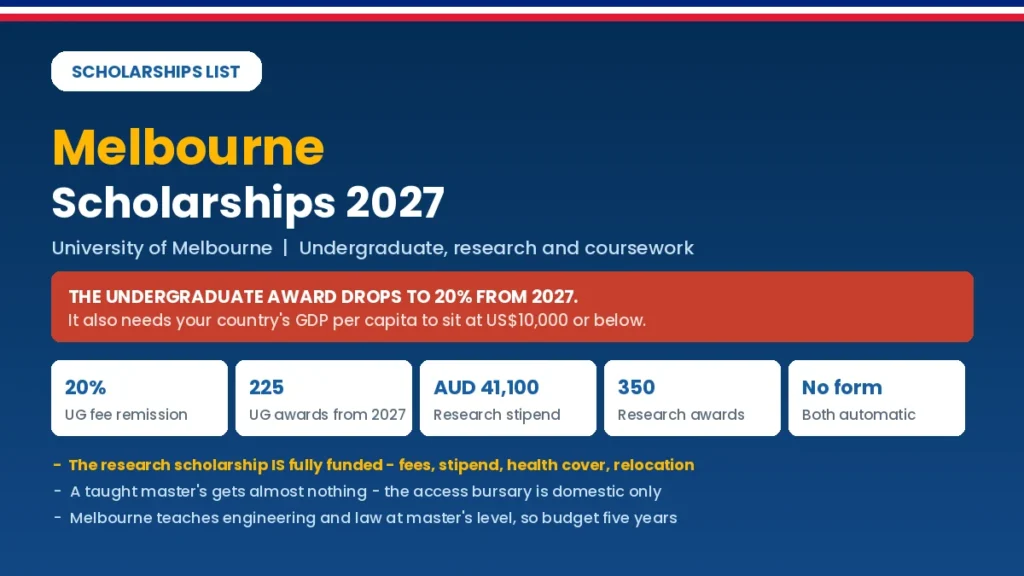
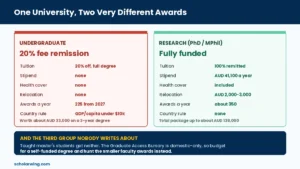
For undergraduates, Melbourne offers the Melbourne International Undergraduate Scholarship. From 2027 it provides 20% fee remission reduced from the 25% that earlier recipients held awarded to around 225 students a year. It also carries an eligibility rule almost nobody mentions: your country’s GDP per capita must sit at US$10,000 or below.
For research students, Melbourne offers the Melbourne Research Scholarship, and this one is a different animal entirely. It covers 100% of fees, pays a stipend of AUD 41,100 a year, includes overseas health cover and adds a relocation allowance of AUD 2,000 to AUD 3,000. Around 350 of these go out each year, and the total package reaches roughly AUD 138,000.
For taught master’s students the MBA, the Master of Data Science, the Master of Public Health, Melbourne offers considerably less than either, and the main access bursary is restricted to domestic students.
This guide covers what each award actually pays, the country rule that decides whether you can apply at all, why neither requires an application form, and whether Melbourne’s numbers work once you add the living costs the visa requires.
The Undergraduate Scholarship: Read the Fine Print
The Melbourne International Undergraduate Scholarship is automatic, which is its best feature, and partial, which is the part people miss.
What it pays. From 2027, 20% fee remission for the full duration of your bachelor’s degree. Students who received the award before 2027 hold a 25% sponsorship, and that older rate does not apply to new entrants. Scholarship lists written two years ago still quote 25%, which is one reason to check the university’s own page rather than an aggregator.
How many. Melbourne has offered at least 110 of these and is increasing the number to 225 from 2027. That expansion is genuine good news, and it is the honest counterweight to the rate reduction more students receive a smaller share.
Who can apply. Three conditions:
- You hold citizenship of a country whose GDP per capita is US$10,000 or less, measured against World Bank data
- You hold an offer for an Overseas Fee place in a bachelor’s degree
- You have not completed previous tertiary study
How selection works. Melbourne ranks candidates on their final secondary school or foundation studies results. Not predicted grades final ones. This matters more than it sounds, because a student whose predicted grades were strong but whose finals dipped falls down the ranking, and a student whose finals exceeded predictions rises.
No application exists. Melbourne considers every eligible applicant from the course application alone, and notifies successful candidates within five working days of the course offer.
One restriction worth noting: the award cannot combine with other fee sponsor ships or discounts. If a government scholarship or a family employer’s education benefit already covers part of your fees, check which one leaves you better off before accepting either.
The Country Rule That Decides Everything
The GDP per capita condition is the single most consequential line in the Melbourne undergraduate scholarship, and it appears in almost no third-party listing.
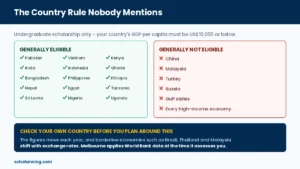
Melbourne restricts the award to citizens of countries whose GDP per capita sits at US$10,000 or below, using World Bank figures. The intent is development-focused: the money goes to students from lower-income economies rather than to every international applicant.
In practice, that generally includes students from Pakistan, India, Bangladesh, Nepal, Sri Lanka, Vietnam, Indonesia, the Philippines, Egypt, Nigeria, Kenya, Ghana, Ethiopia, Tanzania, Uganda and most of South and Southeast Asia and sub-Saharan Africa.
It generally excludes students from China, Malaysia, Thailand in some years, Turkey, Russia, Brazil in some years, and the Gulf states, along with every high-income economy.
Two cautions matter here. First, the figures move. A country sitting just above or just below US$10,000 can change category between years, and borderline economies such as Brazil, Thailand and Malaysia shift with exchange rates and revisions. Second, Melbourne applies the rule against its own reading of World Bank data at the time of assessment, not against whatever figure you found online.
Check your country’s current GDP per capita before you build a plan around this award. For a Pakistani, Indian, Nigerian or Bangladeshi applicant the answer is comfortably yes. For a Chinese or Malaysian applicant it is almost certainly no, and that changes which Australian universities deserve your applications.
The Research Scholarship: Australia’s Strongest Package
The Melbourne Research Scholarship sits in a completely different category, and students who qualify for it should treat everything above as background.
What it pays. One hundred per cent fee remission, plus a living stipend of AUD 41,100 a year at the 2027 full-time rate, paid fortnightly and tax-free. International recipients also receive overseas health cover and a relocation allowance of AUD 2,000 to AUD 3,000. The university puts the total package at up to AUD 138,000.
Duration. Fee offsets run up to four years for a doctorate and two years for a master’s by research. Stipend payments extend to 3.5 years for PhD candidates.
Numbers. Around 350 scholarships a year, which is among the largest allocations at any Australian university.
Eligibility. Both domestic and international students compete. Selection rests on academic merit and research potential, with professional experience, refereed publications and specialist medical qualifications all capable of lifting an application.
No separate application. Applying for a graduate research degree at Melbourne places you in automatic consideration.
That stipend figure is worth pausing on. Australia’s national Research Training Program base rate sits around AUD 36,000, and Melbourne pays AUD 41,100 roughly AUD 5,000 a year above base, tax-free, across three and a half years. Over a doctorate that difference alone exceeds the entire value of many undergraduate scholarships.
The practical conclusion: if you are weighing a taught master’s at Melbourne against a research master’s or a PhD, the funding gap between the two routes is enormous. A research degree can be fully funded here. A coursework degree, for an international student, generally cannot.
The Gap Nobody Talks About: Taught Master’s Students
This section exists because so many readers arrive looking for exactly this and find nothing honest written about it.
If you want a coursework master’s at Melbourne an MBA, a Master of Engineering, a Master of Public Health, a Master of Data Science , your scholarship options as an international student are thin.
The Melbourne Graduate Access Bursary, which appears in search results and pays up to AUD 5,000 across 16 awards, is restricted to Australian citizens, permanent residents and New Zealand citizens. International students cannot receive it.
What remains is a scatter of faculty-specific and donor-funded awards, which vary year to year and usually sit in the AUD 5,000 to AUD 20,000 range. These rarely appear on aggregator sites, which is exactly why they are worth finding. Use Melbourne’s own scholarship search, filter by your specific degree and your citizenship, and read the faculty page for your programme rather than only the central list.
Melbourne also publishes more than a thousand scholarships, bursaries, grants and prizes across the university, and a meaningful number carry no publicity at all because they are small and specific. Twenty minutes in that database is better spent than two hours on a scholarship listing site.
The honest summary for this group: budget for a self-funded taught master’s at Melbourne, treat any scholarship as a reduction rather than a plan, and seriously compare a research master’s if your field allows one.
What Melbourne Actually Costs
Melbourne’s fees run across a wide range because the university teaches everything from arts to dentistry.
Undergraduate international tuition has run roughly AUD 37,884 to AUD 80,984 a year, with arts and science at the lower end and the highest figures attaching to specialized professional programmes.
Postgraduate tuition spans an even wider range, from about AUD 20,992 to AUD 112,000 a year depending on the programme, with the top figures belonging to medicine, dentistry and the MBA.
Confirm the exact number for your specific degree on Melbourne’s own fee tables, because the range above is too wide to budget against.
On top of tuition, the Australian student visa requires proof of AUD 29,710 for twelve months of living costs, plus Overseas Student Health Cover and travel. Melbourne costs slightly less than Sydney to live in, though not by a wide margin.
What the undergraduate award is worth in practice. Take a Bachelor of Commerce at, say, AUD 55,000 a year across three years AUD 165,000 in tuition plus around AUD 90,000 in living costs, so roughly AUD 255,000 over the degree.
A 20% fee remission removes about AUD 33,000 of that. Useful, and worth having, and not the difference between possible and impossible for most families. Plan accordingly.
Why “No Application Required” Changes Your Strategy
Both of Melbourne’s major international scholarships work automatically. That sounds convenient, and it is, but it shifts where your effort should go.
Since you cannot write a personal statement to improve your scholarship chances, the admission application is the scholarship application. Everything that strengthens it strengthens your award chances at the same time.
For the undergraduate award, the ranking runs on final school results, so the leverage sits in how you present them. Make sure your transcript reaches Melbourne complete, certified and correctly translated, with any grading scale explained. A transcript that an assessor has to interpret from an unfamiliar system can be read conservatively.
For the research scholarship, merit and research potential decide the outcome, which means your research proposal, your publications and your supervisor’s support carry the weight. Contact potential supervisors early four to six months before you apply, because Melbourne, like every Australian university, expects a supervisor to back your candidature.
For both, apply early. Automatic consideration happens in rounds against a finite pool, and the students who apply in the first weeks of an intake sit in a smaller field than those who apply at the end.
And for both, clear every condition on your offer immediately. An outstanding English test result or missing final transcript delays the assessment that decides your award.
The Melbourne Model, and What It Costs You
This deserves a section of its own, because it changes the arithmetic of every scholarship on this page and most applicants discover it far too late.
Melbourne does not teach undergraduate engineering, law, medicine, architecture, teaching or physiotherapy the way other Australian universities do. It teaches six broad bachelor’s degrees Arts, Science, Commerce, Design, Bio medicine and Agriculture and places the professional qualification afterwards, at master’s level.
A student who wants to practice engineering in Australia therefore studies a three-year Bachelor of Science, then a two-year or three-year Master of Engineering. A future lawyer studies any bachelor’s degree, then the Juris Doctor. A future doctor studies Biomedicine, then the Doctor of Medicine.
Compare the routes honestly:
| Route | Years | Rough international tuition |
|---|---|---|
| Engineering at UNSW or Monash, direct entry | 4 | about AUD 240,000 |
| Engineering at Melbourne, BSc then MEng | 5 | about AUD 290,000 |
The extra year is not a flaw, the broad first degree genuinely suits students unsure of their direction, and Melbourne’s graduate professional degrees are excellent. But it costs a year of tuition and a year of living expenses, which together run past AUD 80,000.
Now place the scholarship against that. The Melbourne International Undergraduate Scholarship covers the bachelor’s years only. The graduate professional degree that follows attracts far less support for international students, as the taught-master’s section above explains.
So a 20% remission across three bachelor’s years is worth roughly AUD 33,000, set against a five-year pathway costing close to AUD 380,000 including living costs. That is a reduction of under 9% of the total.
None of this argues against Melbourne.
It argues for doing the full-pathway arithmetic rather than the first-degree arithmetic. A student comparing Melbourne against a direct-entry degree elsewhere should compare five years against four, and should weigh Melbourne’s graduate professional qualification against the extra cost. For some careers and some students that trade is clearly worth it. For others it is not, and the honest version of this decision happens before the application rather than in year three.
Finding the Scholarships Melbourne Does Not Advertise
Melbourne publishes more than a thousand scholarships, bursaries, grants and prizes. Two of them attract nearly all the attention, and the rest sit in a database that most applicants never open.
That is the opportunity. Small awards attract few applicants precisely because they are small and hard to find, which means the ratio of effort to reward is often far better than for the headline schemes.
Use the university’s own search, not an aggregator. Melbourne’s scholarship database lets you filter by study level, citizenship, faculty and degree. Aggregator sites carry stale figures ,the 25% undergraduate rate still circulating is a good example and they omit faculty-level awards entirely.
Filter by your exact degree, then by your citizenship. Both filters matter. An award restricted to students from South Asia in the Faculty of Engineering will never appear in a general search, and it may have eight applicants.
Read the faculty page as well. Faculties administer their own awards and do not always push them into the central database promptly. The engineering, business, science and health faculty pages each carry their own scholarship sections.
Look for donor and alumni awards tied to your country or field. These appear, disappear and change value year to year. They rarely reach scholarship listing sites, which is exactly why they remain winnable.
Check again after you receive your offer. Some awards open only to students holding an offer, and a few open only to enrolled students in later years. A scholarship you cannot win in March may be available to you in October.
Twenty minutes in that database beats two hours of reading scholarship blogs, including this one.
A Timeline That Works
Working backwards from a February 2027 start:
Fourteen months out, December. Decide your degree. If it is a professional field, work out whether Melbourne’s graduate route or a direct-entry degree elsewhere suits you better, and price both across the full pathway.
Twelve months out, February. Check your country’s GDP per capita against the US$10,000 threshold. Book IELTS, TOEFL or PTE. Start the transcript and attestation process, which takes six to eight weeks in many countries.
Eleven months out, March. Sit the English test, leaving room for a second attempt. If you are applying for a research degree, begin reading the work of potential supervisors.
Ten months out, April. For research candidates, email four supervisors with a short, specific message naming a paper and a question. For undergraduates, prepare your complete document set.
Nine months out, May. Submit the admission application as soon as the intake opens. Automatic scholarship consideration follows the application, so an early application sits in a smaller field.
Eight months out, June. Clear every condition on your offer. Upload documents as they arrive rather than waiting for a complete set.
Seven months out, July. Search Melbourne’s scholarship database properly, filtered by your degree and citizenship, and apply for every smaller award that fits.
Six months out, August. Expect scholarship outcomes. Melbourne notifies undergraduate recipients within five working days of the course offer, so an early offer means an early answer.
Five months out, September. Arrange proof of funds in an accessible account with a visible history.
Four months out, October. Lodge the subclass 500 visa, attaching every scholarship letter you hold.
Two months out, December. Arrange accommodation. Melbourne’s rental market is easier than Sydney’s but still tight near campus in January.
Six Mistakes That Cost Applicants These Awards
Reading an old 25% figure. The undergraduate rate falls to 20% from 2027. Lists written earlier still quote the higher number, and budgets built on it come up short.
Missing the country-income rule. A Chinese or Malaysian applicant who plans around the undergraduate scholarship has planned around something they cannot receive.
Assuming a taught master’s is funded. It generally is not. This is the single largest gap between what applicants expect from Melbourne and what exists.
Waiting for a scholarship application form. Neither major award has one. Students watch for a form, miss nothing, and conclude they were rejected.
Sending an incomplete transcript. The undergraduate ranking runs on final results. Anything that makes those results harder to read works against you.
Accepting a sponsorship that blocks the award. The undergraduate scholarship cannot combine with other fee discounts. Check the arithmetic before signing anything.
Melbourne Compared With the Alternatives
Sydney runs a tiered Vice-Chancellor’s scheme paying AUD 5,000 to AUD 60,000, also automatic, also one-off and non-renewable. Melbourne’s 20% runs for the full degree, which for a three-year course often exceeds Sydney’s one-year award. Apply to both; the applications do not compete.
The Research Training Program at other Australian universities offers the same shape as Melbourne’s research scholarship, usually at the base rate of around AUD 36,000 rather than Melbourne’s AUD 41,100. Melbourne pays better, and competition reflects that.
Destination Australia pays AUD 15,000 a year at regional campuses with no tuition cover and a residence condition. Melbourne is not regional, so these cannot combine.
Australia Awards Scholarships are the fully funded Australian government programme for eligible developing countries. Applicants from Pakistan, Bangladesh, Nepal and much of Africa should check that list first, because a full package outweighs a 20% discount by an enormous margin.
Germany, Austria and Norway charge little or no tuition. For a self-funding family, a free-tuition country without a scholarship frequently costs less than Melbourne with one. That comparison, rather than Melbourne-with-award against Melbourne-without, is the one worth making.
Studying at Melbourne
Melbourne consistently ranks as Australia’s leading university in most global tables, with particular strength in medicine, law, education, arts and the sciences.
Its undergraduate structure differs from the rest of the country. Melbourne teaches broad bachelor’s degrees Arts, Science, Commerce, Design, Bio medicine and places professional qualifications such as law, medicine, engineering and architecture at graduate level. A student who wants to be an engineer therefore studies a Bachelor of Science then a Master of Engineering, which means more years and more fees than the direct route elsewhere.
That structure interacts with the scholarships in a way worth planning for: a 20% remission covers the bachelor’s years, and the graduate professional degree that follows generally attracts far less support.
The city itself is comfortable, well-served by trams and consistently rated among the world’s most livable. Rents run below Sydney’s, though not dramatically. The international student community is large and well-established.
Frequently Asked Questions
How much is the Melbourne International Undergraduate Scholarship worth?
From 2027, 20% fee remission for the duration of your bachelor’s degree. Students who received it before 2027 hold a 25% rate.
Do I need to apply for it?
No. Melbourne considers every eligible applicant from the course application, and notifies successful candidates within five working days of the course offer.
Who is eligible?
Citizens of countries with GDP per capita of US$10,000 or less, holding an offer for an Overseas Fee place in a bachelor’s degree, with no completed prior tertiary study.
Can Chinese or Malaysian students get it?
Generally no, because those economies sit above the income threshold. Check current World Bank figures for your country.
How much is the Melbourne Research Scholarship?
Full fee remission plus AUD 41,100 a year as a stipend at the 2027 rate, with overseas health cover and a relocation allowance of AUD 2,000 to AUD 3,000. Around 350 awards a year.
Is there a scholarship for a taught master’s?
Nothing large and university-wide for international students. Faculty and donor awards exist in the AUD 5,000 to AUD 20,000 range, and the Graduate Access Bursary is domestic-only.
How many undergraduate scholarships are available?
At least 110 currently, rising to 225 from 2027.
Will a scholarship satisfy my student visa?
Partly. The visa requires AUD 29,710 in living costs plus your first year of tuition, and a scholarship counts only for the amount it names.