
Study in Argentina 2027:
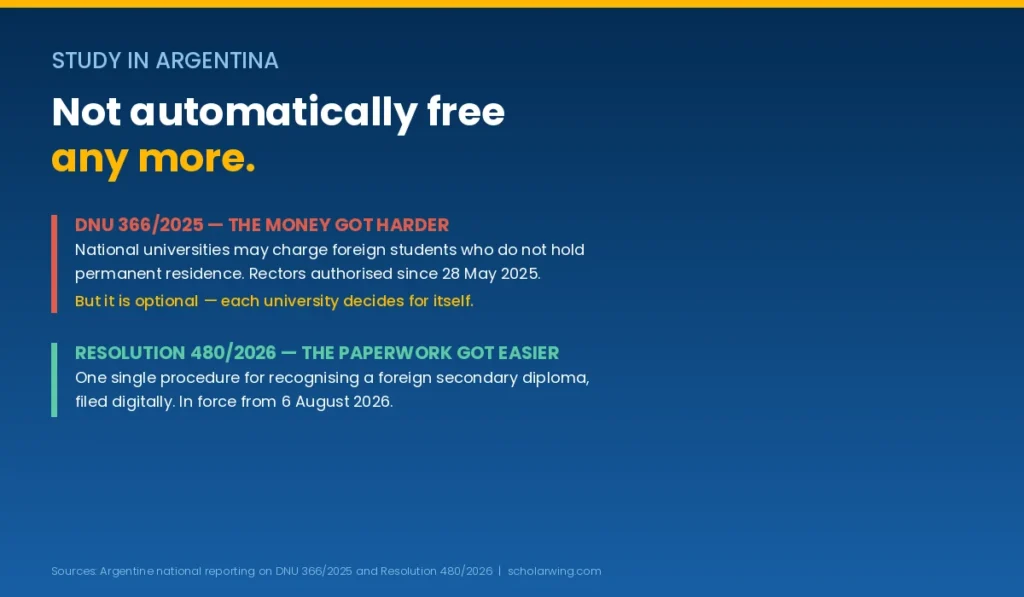
If you have read anywhere that Argentina’s public universities are free for international students, that page was written before the rules changed.
Two things happened in the last eighteen months, and they pull in opposite directions. One made studying there potentially more expensive. The other made getting in administratively easier. Almost nobody writing for Pakistani students has mentioned either.
What changed about the money
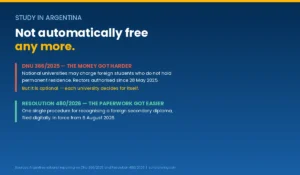
DNU 366/2025 amended Argentina’s Ley de Educación Superior. Under it, national universities may set fees for educational services provided to foreign students who do not hold permanent residence in Argentina.
In July 2026, Alejandro Álvarez, the Sub secretary of University Policies, restated the position publicly after what he described as a flood of questions about its scope. His wording was unambiguous: rectors have been legally authorized since 28 May 2025.
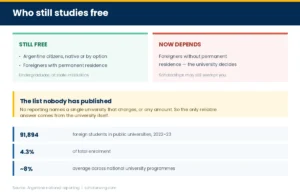
So the sentence “public university in Argentina is free” is now incomplete. It is free for Argentine citizens and for foreigners who hold permanent residence. For everybody else, it depends.
The qualifier that decides your plan
Here is the part that separates this post from the panic headlines.
The decree does not require anybody to charge. It permits it. Each national university decides for itself whether to apply a fee scheme, and we could find no published list of which universities have chosen to and what they charge. Reporting on the debate names no institution and no amount.
Two further points matter. Scholarships can still exempt you, where a university’s own statutes provide for them or where agreements exist with other states, organizations or national and international institutions. And the scale of the thing is worth knowing: Argentine public universities held 91,894 foreign students in 2022-2023, about 4.3% of enrolment, with the Sub secretary putting the figure nearer 8% across national university programmes on average.
This produces one clear instruction, and it is the most useful sentence in this guide. Ask the specific university, in writing, before you commit to anything. The answer is no longer national. It is institutional, and it may differ between two universities in the same city.
What changed about the paperwork, and it is good news
While the fee question opened, a different door got wider.
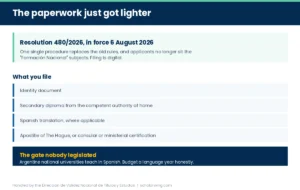
Resolution 480/2026 was published in the Boletín Oficial on 5 August 2026 and took effect on 6 August, applying to procedures started from that date. It replaced two older resolutions with a single regime for recognizing a foreign secondary diploma.
The headline change: applicants no longer have to take the “Formación Nacional” subjects to validate a diploma for entry to a university or an instituto superior. That requirement had been waived in some cases before; now it sits outside the procedure altogether.
The process is also digital, filed through a platform run by the Dirección de Validez Nacional de Títulos y Estudios, under the Secretaría de Educación.
What you file is short by the standards of this series: an identity document, your secondary diploma issued by the competent education authority in your country, a Spanish translation where applicable, and an Apostille of The Hague or the required consular or ministerial certification.
Compare that with the equivalency process we documented in our Egypt guide, where nothing moves without a certificate from the Supreme Council of Universities, or the ministerial authentication step in our Algeria guide. Argentina has just made its version of that step noticeably lighter.
The gate nobody legislated
Neither decree touches the real barrier, which is the same one we met across North Africa.
Argentine universities teach in Spanish. Not as a formality and not with an English escape hatch at the national universities. A Pakistani applicant arriving without Spanish faces a language year before an academic one, and should budget for it honestly rather than hope to absorb it on arrival.
Our guide on studying in Tunisia made the same point about French, and the conclusion carries across continents: in several of the world’s cheapest university systems, language rather than nationality decides who can actually use them.
So who should still consider Argentina
Someone who already speaks Spanish, or who will commit a full year to it, and who wants a large public university system at a cost that may still be zero depending on the institution.
Someone willing to ask before assuming. The whole opportunity now rests on one email to one university, and the people who send it will know something the internet does not.
Someone eligible for a scholarship route, since the decree explicitly preserves exemptions where statutes or inter-state agreements provide them. That is a question for the university and for the Argentine embassy rather than for any blog.
Not someone who needs certainty today, and not someone who needs English. For those readers, our guides on Thailand, where one scholarship lists its nationality as simply Pakistan, and Qatar, where a doctorate carries a full waiver and a monthly stipend, remain the strongest in this series. If a low bill rather than a scholarship is the goal, Türkiye and Latvia are better documented in English.
Eligibility criteria
1. A recognized secondary diploma, validated under Resolution 480/2026 through the Dirección de Validez Nacional de Títulos y Estudios.
2. An Apostille of The Hague, or the required consular or ministerial certification, on that diploma.
3. A Spanish translation of your documents where applicable.
4. Spanish, for study at the national universities.
5. Written confirmation from your chosen university on whether it charges non-resident foreigners, since the decree leaves that to each institution.
6. Permanent residence, if you want the free undergraduate entitlement rather than an institutional decision in your favor.
Step-by-step application process
Step 1, today: write to two or three universities and ask one question plainly: do you charge tuition to a foreign student without permanent residence, and if so, how much for the 2027 intake. Get it in writing. Nothing else in this plan is worth starting until you have that answer.
Step 2, this week: be honest about Spanish. If you have none, your timeline includes a language year. Build the plan around that rather than around the academic start date.
Step 3, November: get the Apostille or consular certification on your secondary diploma. This sits at the front of the validation procedure.
Step 4, November: arrange the Spanish translation of your diploma and supporting documents.
5, December: file the validation digitally with the Dirección de Validez Nacional de Títulos y Estudios under the new single procedure.
Step 6, December: ask the same universities about scholarships for non-resident foreigners, since the decree preserves exemptions where statutes or agreements provide them.
7, January: ask the Argentine embassy which student visa route applies and what proof of funds it requires.
Step 8: budget twice. Once on the assumption your university charges, once on the assumption it does not. Until a rector decides, both are live.
Step 9: recheck before you fly. This is a moving policy area, and a university that charged nothing last year may charge this year.
FAQ
Is university free in Argentina for international students?
Not automatically, not any more. DNU 366/2025 allows national universities to charge foreign students who do not hold permanent residence, and the government confirmed in July 2026 that rectors have been authorized since 28 May 2025.
So does every university charge now?
No. The decree is permissive, not mandatory. Each university decides, and no published list exists of which ones charge or how much.
Who still studies free?
Argentine citizens, whether native or by option, and foreigners who hold permanent residence keep free undergraduate tuition at state institutions.
Can a scholarship still cover me?
Yes. The decree preserves scholarships for students without permanent residence where university statutes provide them or where agreements exist with other states, organizations or institutions.
How many foreign students are there?
Argentine public universities had 91,894 foreign students in 2022-2023, around 4.3% of enrolment, with officials citing roughly 8% across national university programmes on average.
What changed about diploma recognition?
Resolution 480/2026, in force from 6 August 2026, unified the rules into one procedure and removed the requirement to take the “Formación Nacional” subjects. Filing is digital.
What do I need for that validation?
An identity document, your secondary diploma from the competent authority at home, a Spanish translation where applicable, and an Apostille of The Hague or the required consular or ministerial certification.
Do I need Spanish?
For the national universities, yes. Neither change affects the language of instruction.
What is the single most important thing to do first?
Email your chosen university and ask in writing whether it charges non-resident foreign students for 2027. The answer is now institutional rather than national.
Is Argentina still worth considering?
For a Spanish speaker, yes. For a reader who needs certainty and English, the Asian routes in this series are stronger.