
Hidden Pathology Scholarships 2027:
Pathology hides its money better than any other medical field. Search for a pathology scholarship and you will find page after page listing Fulbright and Chevening, neither of which cares what specialty you hold. The real pathology funding sits inside professional societies, and those societies do not advertise to students. They advertise to members.
That single fact explains why these awards stay hidden. A society award asks you to join first and submit an abstract second. Scholarship aggregators cannot handle that shape, so they skip it, and a Pakistani pathology resident never learns the award exists.
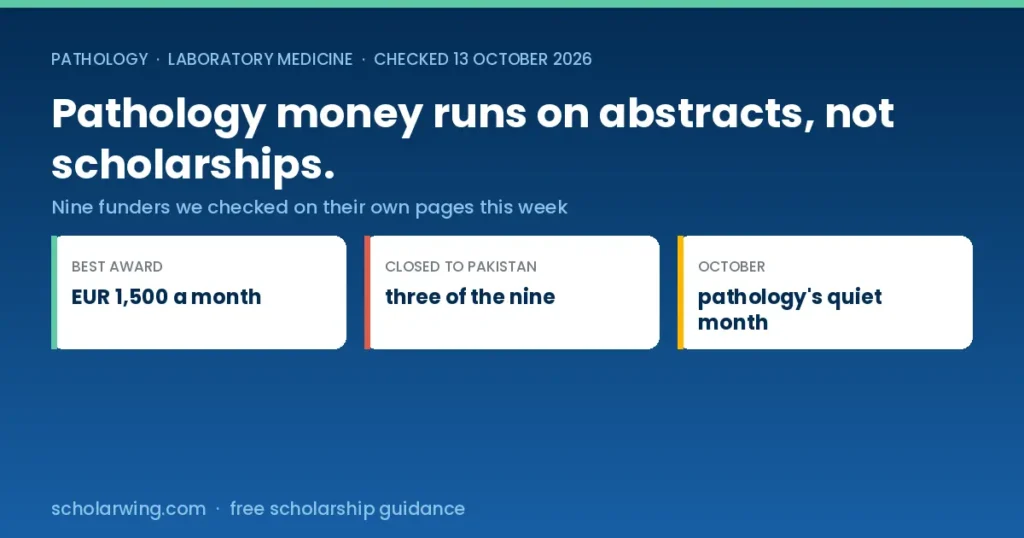
We checked nine funders on their own pages this week. Three turned out closed to anyone outside a short list of rich countries, and we say so plainly below rather than padding the list. The other six accept applicants from Pakistan and from every lower-middle-income country.
First, the honest warning
None of these nine pays for a degree. Not one funds an MD, an FCPS, a master’s or a PhD in pathology. They pay for training visits, congress travel, short placements and published work.
If you want a funded pathology doctorate, the route runs through salaried European PhD positions instead, which our biomedical sciences guide covers in detail. Treat this page as the other half of the picture: the money that moves a working pathologist or a final-year resident abroad for weeks rather than years.
That sounds smaller than a scholarship. In practice it often matters more, because three months inside a European reference laboratory changes what you can do for the rest of your career, and nobody competes for it.
The nine funders
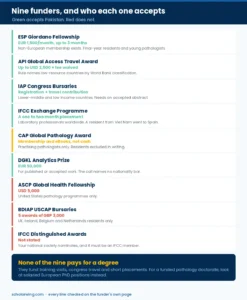
1. ESP Giordano Fellowship — the best one, and almost nobody applies
The European Society of Pathology pays €1,500 per month for up to three months of training at an ESP Advanced Training Centre. ESP sets each award individually and weighs three things: your country of origin, the host center’s cost of living, and your normal income. A Pakistani applicant therefore sits at the favorable end of that calculation rather than the harsh end.
The terms describe the target applicant as young pathologists and residents in the final year of their specialization. Former Giordano Fellows cannot apply twice.
Now the part that surprises people. ESP runs an explicit Non-European Membership category, in its own words “for members residing outside of the EU, including other European countries and global locations.” A pathologist in Karachi or Lahore can join, and membership opens the fellowship. The 2027 edition closed on 3 August 2026, and ESP says applications fall due in mid-summer for training the following year, so watch for the 2028 call around late July 2027. Results follow six to eight weeks later.
2. API Global Access Travel Award — written for your passport
The Association for Pathology Informatics offers up to US$2,500 and waives the US$950 summit registration fee. Its eligibility rule names you directly: “Residents of low-resource countries, as defined by the World Bank country classification for the current year,” practicing outside the United States, early in a pathology informatics career.
The 2026 round closed on 9 February 2026, so expect the next deadline in early February 2027. API will write your invitation letter, though the B1/B2 visa remains your problem.
Additional:
3. IAP Congress Bursaries — the abstract decides everything
The International Academy of Pathology funds trainees and early-career pathologists from lower-middle-income and low-income countries by World Bank ranking. Pakistan qualifies. The bursary covers congress registration plus a contribution toward travel and hotel, and the IAP prefers applicants with fewer than five years of practice.
One condition rules out most people: you must present an accepted abstract as its presenting author. For the 2026 Fukuoka congress, abstracts closed on 10 April and bursary applications on 30 April. Winners submit a short report afterwards and share the congress material with colleagues at home.
Additional:
4. IFCC Professional Scientific Exchange Programme — placements, not prizes
The International Federation of Clinical Chemistry and Laboratory Medicine arranges temporary placements for focused scientific exchange. Its own newsletter describes a third-year resident from Hanoi Medical University who spent 1 December 2025 to 31 January 2026 at a university hospital in Lleida, Spain. That is the shape of it: one to two months inside a working laboratory in another country.
The Fall 2026 call closed on 29 September 2026. IFCC describes a limited number of scholarships each year, so a Spring and a Fall call appear likely, and ifcc@ifcc.org answers eligibility questions directly.
5. CAP Foundation Global Pathology Education Award — worth applying, worth understanding
Read this one carefully before you celebrate. The College of American Pathologists Foundation lists the amount as 0.00, because the award gives access rather than cash: one year of complimentary International Fellow of the CAP membership and a one-year CAP eBook subscription.
It targets practicing pathologists in countries the WHO identifies as medically under-resourced, and it screens against the Research4Life (HINARI) list. The page states one hard exclusion: “Those in a pathology residency training program are not eligible for this award.” Priority goes to applicants who show financial need and who do not already hold IFCAP fellowship. The 2026 deadline fell on 16 June 2026.
6. DGKL Biochemical Analytics Prize — €50,000 for work you already published
The German Society of Clinical Chemistry and Laboratory Medicine awards a prize endowed with €50,000, donated by Sarstedt. Scientists with published or accepted work apply as a single PDF to preise@dgkl.de, and the 2026 round closed on 15 April 2026. The call we read set out no membership requirement and no nationality bar, which makes it unusually open for a European society prize.
The three that shut the door
We would rather tell you now than let you spend a week on an application that cannot succeed.
ASCP Global Health Trainee Fellowship pays US$5,000 for an in-country rotation with international pathology partners, and the requirement reads: “Be a residents or fellows-in-training in a United States pathology program.” A resident in Pakistan cannot apply. The 2026 window ran 1 April to 31 May.
BDIAP USCAP Bursaries offer five awards of £3,000 each toward registration, accommodation and travel. The British Division restricts them to Member Country Resident Members from the UK, Ireland, Belgium and the Netherlands. The 2027 application deadline falls on 25 October 2026, which makes it one of the few pathology awards open as you read this, and one you cannot use. BDIAP also lists an IAP Congress bursary and the Nermin Durakovic Bursary without publishing their terms, so email the division if you hold overseas membership.
IFCC Distinguished Awards, including the Gérard Siest Young Scientist Award for scientists under 40, run on nomination rather than application. Your national society nominates you, and that society “should be a member of the IFCC.” Each country may nominate for two awards at most. Nominations closed on 31 March 2026.
Eligibility criteria: what actually gates these awards
Four gates recur across all nine funders, and they look nothing like the gates on a Fulbright application.
Membership. Giordano needs ESP membership. CAP’s award leads into IFCAP fellowship. Most society money reaches members first, so join before the call opens, not during it. ESP charges membership by calendar year from January to December, so a December joiner pays for a year that is almost over.
An accepted abstract. IAP requires you to present one. API strongly encourages one and views it favorably. BDIAP demands proof of submission. This is the gate that stops most applicants, and it needs a year of planning rather than a week.
Career stage, measured oddly. IAP prefers under five years of practice. Giordano wants final-year residents and young pathologists. CAP excludes residents entirely and wants practicing pathologists. Two of these three rules contradict each other, so your exact stage opens some doors and closes others in the same month.
Country, by World Bank or WHO list rather than by region. API uses the World Bank classification. IAP uses lower-middle and low income. CAP uses the WHO and Research4Life lists. Pakistan sits inside all three, which is a genuine advantage, and a Pakistani applicant should name it in the personal statement rather than apologies for it.
Step-by-step application process
Step 1 — Pick your single target, twelve months out. For a final-year resident, Giordano gives the most value. For a working pathologist, CAP costs nothing and opens a year of literature. And for anyone doing informatics or digital pathology, the API award was written for your situation.
Step 2 — Join the society now. ESP’s non-European category takes a short online form. Choose the category that matches your stage: Ordinary Member, Technical or Scientist Staff, or Trainee / PhD Student / Undergraduate. The form reveals the fee only after you select your country, duration and journal option, so complete it to the fee screen before you budget.
Step 3 — Build the abstract. Pick one case series, one audit or one method comparison from your own laboratory. Congress abstracts for pathology meetings close roughly five months before the meeting, so start writing in the quarter before that.
Step 4 — Line up your referee properly. Giordano asks you to design a personalized programme with the host center, which means you must contact a potential host before you apply. ASCP’s form shows what referees must confirm, including rotation credit and any institutional salary, so ask your head of department for those specifics rather than a generic letter.
Step 5 — Write one personal statement and reuse it. API wants under 500 words on career goals, why informatics management matters and why you need financial support. ASCP asks where you would rotate, what you hope to learn and why global health interests you. The same three paragraphs answer both.
Step 6 — Prepare the documents once. A current CV, a passport copy or government ID, a recent headshot, an income certificate for Giordano’s means assessment, and your abstract number. Keep them in one folder, because every one of these calls asks for a subset of the same six items.
Step 7 — Apply, then submit your report. Both IAP and Giordano require a report afterwards, and Giordano’s falls due one full year after you finish. Funders remember who filed and who vanished, and these communities are small.
The calendar
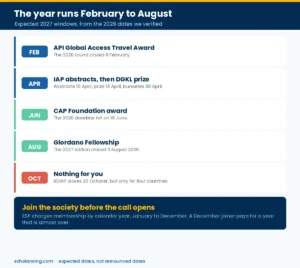
October is pathology’s quiet month, which explains why you found nothing when you searched. The year clusters between February and August. Expected 2027 windows, based on the 2026 dates we verified: early February for the API Global Access Travel Award, mid-April for IAP abstracts and the DGKL prize, late April for IAP bursaries, mid-June for the CAP Foundation award, and late July or early August for the Giordano Fellowship. IFCC runs its own Spring and Fall exchange calls.
Treat these as expected rather than confirmed. Every funder here publishes its real dates on its own page, and we re-check this guide each quarter.
FAQ
Is there any scholarship that pays for an MD or FCPS in pathology abroad?
Not among these nine. Funders in this field pay for training visits and congress travel, not for clinical qualifications. The gap matters so much across medicine that we gave it a whole page: see our medical scholarships hub on why research degrees get funded and clinical ones do not.
Can a laboratory technologist apply, or only doctors?
It depends on the funder. ESP runs a Technical / Scientist Staff membership category, and IFCC’s exchange programme serves laboratory professionals broadly. CAP’s award names practicing pathologists only. Read the category names on each page rather than assuming the award means physicians.
Do I need to publish before applying?
For the DGKL prize, yes, since it rewards published or accepted work. For IAP, you need an accepted abstract rather than a paper. And for Giordano, CAP and the API award, you need neither.
Does IELTS block any of these?
None of the nine calls we read required an English test score. These are professional awards rather than university admissions, so your English shows in the application and the host interview instead. Our medical scholarships without IELTS guide explains the four different things “no IELTS” can mean.
My society in Pakistan is not an IFCC member. Does that end it?
It ends the IFCC Distinguished Awards, which run on nomination through member societies. It does not affect the exchange programme, Giordano, IAP, API or CAP. The Pakistan Association of Pathologists holds a memorandum of understanding with the Royal College of Pathologists, renewed in 2021, and RCPath’s international team answers on international@rcpath.org.