
Hidden Microbiology Scholarships 2027:
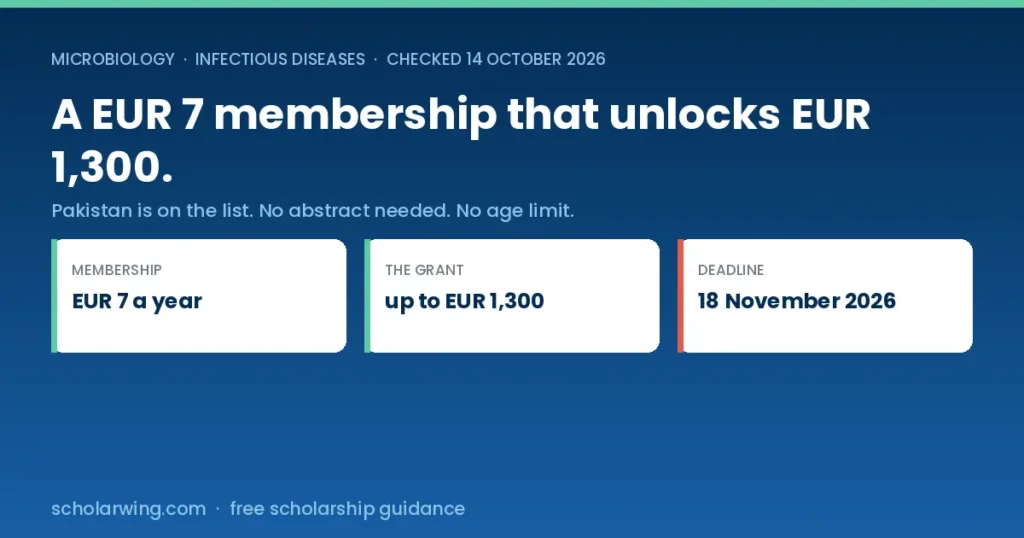
A Pakistani microbiologist can pay €7, and that single payment makes them eligible for a grant worth up to €1,300 plus free congress registration. No abstract. No age limit. And No career stage requirement. The deadline falls on 18 November 2026.
We have written about scholarships for two years and rarely seen a ratio like that. Almost nobody in Pakistan knows it exists, because it hides behind the word “membership” rather than the word “scholarship”, and search engines sort the world by that difference.
This guide covers eight funders in microbiology and infectious diseases. One pays for a whole master’s degree and names Pakistan in writing. One hands out €5,000 with no membership requirement at all. One excludes you completely, and we say so rather than wasting your evening.
Start here: the €7 door
The European Society of Clinical Microbiology and Infectious Diseases runs a membership category for people in low- and middle-income countries. It costs, in its own words, a “Reduced rate of 7 EUR per year”, and it “offers all the benefits of a Full membership”, which explicitly includes eligibility for all awards and grants.
The list runs to 79 countries and follows the World Bank classification of July 2026. Pakistan appears on that list, and not in the temporary transition group that Jordan, Sri Lanka, the Philippines, Viet Nam and Micronesia sit in until mid-2028.
One condition catches people out. You must prove you live and work in an LMIC, and ESCMID states that “copy of the passport is not sufficient.” It accepts an employment or university letter, a rental contract in your name, or a phone or utility bill in your name, each dated within the last year. Arrange that document before you start the form.
The ESCMID ladder
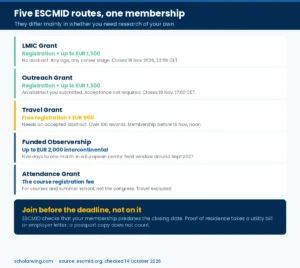
Four separate pots sit behind that membership, and they differ mainly in whether you need research of your own.
The LMIC Grant — the one to apply for now. It covers the registration fee plus up to €1,300 for travel and accommodation at ESCMID Global 2027. Eligibility reads simply: LMIC members who live and work in an LMIC, regardless of age or career stage. It needs no abstract. You submit proof of residence and two short texts of at most 100 words each. The deadline falls on 18 November 2026 at 23:59 CET, and notifications go out in December.
The Outreach Grant. Same money, registration plus up to €1,300, but it asks LMIC members to be the presenting author of a submitted abstract or case study. The generous part sits in the wording: your abstract does not need acceptance. A case study from your own laboratory therefore qualifies. The deadline falls on 18 November 2026 at 17:00 CET, six hours earlier than the LMIC Grant.
The Travel Grant. More than 100 awards of free onsite registration plus a €500 travel allowance, open to Young Scientist Members or to LMIC members who meet the young scientist criteria. This one needs an accepted abstract, and your membership must predate 18 November 2026 at 12:00 CET.
Additional:
The Funded Observer ship. This sends you into a working European laboratory for five days to one month. Active Young Scientist or LMIC members apply, and you must either hold or be enrolled in a postgraduate degree in infectious diseases, clinical microbiology or a related field. Intercontinental visits carry up to €1,300 in travel plus €70 per day for up to ten days, a maximum of €2,000. ESCMID runs more than 100 Collaborative Centers, and applicants from outside Europe may apply to any European center.
The 2026 observer ship round closed on 6 October 2026, days before you read this, with visits running from December 2026 to December 2027. Applications opened on 8 September, so watch early September 2027 for the next window.
The ESCMID Attendance Grant sits slightly apart. It covers the registration fee for ESCMID courses and summer schools rather than the congress, and ESCMID offers it to all Full members, naming Young Scientist and LMIC members among them. Travel and accommodation stay outside it. Each course page carries its own deadline, and successful applicants hear within two weeks.
The TDR route: an actual degree
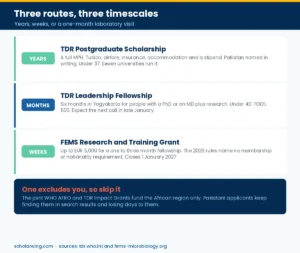
Everything above moves you abroad for days or weeks. The World Health Organization’s TDR programme moves you for years, and it is the rare medical funder that pays for a full taught degree.
The TDR Postgraduate Scholarship in Implementation Research funds an MPH, and its eligible-country list names Pakistan outright alongside Afghanistan, Egypt, Iran, Lebanon, Morocco, Somalia, Sudan, Tunisia and Yemen in the Eastern Mediterranean region, plus eleven South-East Asian countries. You must hold nationality and residence in one of them, work for an academic or research institution, a not-for-profit or a ministry of health, and sit under 37 when you apply.
The package covers tuition and academic fees, one return economy airfare, basic medical and accident insurance, accommodation, a monthly living stipend and thesis data-collection costs. TDR publishes no figures for the stipend, so we print none.
Seven universities run the scheme: BRAC University in Bangladesh, Universidad de Antioquia in Colombia, the University of Ghana, the Indian Institute of Health Management Research, Cheikh Anta Diop University in Senegal, the University of the Witwatersrand in South Africa, and Universitas Gadjah Mada in Indonesia. Each one publishes its own call, which matters more than it sounds: a closed call at one university tells you nothing about the other six.
Academic requirements at BRAC run modestly by scholarship standards — a four-year bachelor’s degree in health, life or social sciences, with a CGPA of 2.5 out of 4.0 or a second division. Selection runs through a written test, a viva and then a TDR interview.
Additional:
The Implementation Research Leadership Fellowship at Universitas Gadjah Mada suits people further along. It takes applicants under 40 from LMICs in the South-East Asia, Western Pacific or Eastern Mediterranean regions, which covers Pakistan, and it demands real credentials: for the academic stream, an MPH or MSc plus a PhD or an MD with three years of research, and at least one peer-reviewed open-access article. English requirements sit lower than most universities ask, at TOEFL PBT 500 for academics and 450 for practitioners.
It runs six months on-site in Yogyakarta and covers airfare, insurance, a stipend matched to Indonesian living costs, an Indonesian language course, and project expenses including travel home for data collection. The 2026 round closed on 30 January 2026, so expect the next call around late January.
FEMS: €5,000, and nobody asks who you are
The Federation of European Microbiological Societies publishes grant regulations each January, and the 2026 edition sets out no requirement that applicants hold membership of a member society, live in Europe, or hold any particular nationality. We read it looking for that gate and did not find one.
The Research and Training Grant pays up to €5,000 for a one to three month fellowship, taken within twelve months of the decision. Two rounds run each year, closing 1 January and 1 July, with decisions on 27 February and 1 September. You may win it once in your life.
The Industry Placement Grant pays up to €5,000 for a placement of up to three months in a company, on the same deadlines. If you have no host company, FEMS says it will try to connect you with one, which is an unusual offer worth taking.
The Meeting Attendance Grant pays €250 to €750 and closes on 1 March and 1 September, twice per person over a career. One trap: FEMS will not consider applications to attend FEMS-sponsored meetings, so apply to the meeting organizer instead for those.
The 1 January 2027 deadline sits eleven weeks away as this publishes, and a one-month training fellowship in a European laboratory is a realistic thing to assemble in that time.
The one that excludes you
The joint WHO AFRO and TDR Impact Grants for Implementation Research fund regional priorities for 2026-2027, and the African regional office runs them for the African region. A Pakistani applicant cannot use them. We mention them because Pakistani students keep finding them in search results and spending days on an application that cannot proceed.
Eligibility criteria: the four real gates
Membership, bought cheaply and early. ESCMID’s LMIC rate removes the usual barrier, but its grants check that your membership predates the deadline, in one case by six days. Join now rather than on the closing day.
Proof of residence, not nationality. ESCMID asks where you live and work, not which passport you hold. A Pakistani doctor already working in the Gulf therefore may not qualify for the LMIC rate, while a non-Pakistani researcher living and working in Lahore may.
An abstract, sometimes. The LMIC Grant needs none. The Outreach Grant needs one submitted, accepted or not. The Travel Grant needs one accepted. These three rules sit on one page and people confuse them constantly.
Age, where it appears. TDR’s MPH scholarship sets under 37, and its leadership fellowship sets under 40. ESCMID’s LMIC Grant sets no age limit whatsoever, which makes it the only route here open to a mid-career laboratory head.
Step-by-step application process
Step 1 — Join ESCMID today, not in November. Gather your proof of residence first: a university or employer letter, or a utility bill in your own name dated within the last year. Pay the €7. Membership runs 365 days from subscription.
Step 2 — Choose your ESCMID grant honestly. No research of your own yet? Apply for the LMIC Grant. Have a case or a small audit? Submit it as an abstract and apply for the Outreach Grant instead, since acceptance does not matter. Both close on 18 November 2026, a few hours apart.
Step 3 — Write the two 100-word texts properly. This is the whole LMIC Grant application. Say what you do, where you do it, and what the congress changes for the patients in front of you. Specific beats grand: one diagnostic problem in your own laboratory carries more weight than a paragraph about global health.
Step 4 — Put 1 January 2027 in your calendar for FEMS. Find a European laboratory doing work close to yours, email the group leader with a one-page plan for a one-month visit, and ask for a host agreement. The grant pays up to €5,000, and the host letter is what takes time.
Step 5 — For TDR, check all seven universities. Each publishes its own call on its own site and on tdr.who.int. Check BRAC in Bangladesh and Gadjah Mada in Indonesia first, since both have run calls open to Eastern Mediterranean applicants.
Step 6 — Build your implementation research story before you apply. TDR prioritizes applicants with implementation research experience and asks you to name a local supervisor or mentor before the programme starts. Both take months, so start the conversation with your department now.
FAQ
Is €7 really the full membership cost?
Yes, for people who live and work in one of the 79 listed countries. ESCMID calls it a reduced rate and grants it the same benefits as full membership, including eligibility for every award and grant. Paying it does not guarantee you a grant; it only makes you eligible to apply.
What counts as an abstract if I have never published?
For the Outreach Grant, ESCMID accepts a submitted abstract or case study. An unusual resistance pattern, an outbreak your laboratory handled, or an audit of your blood culture contamination rate all qualify as case material. Acceptance is not required for that grant, so the risk of trying is low.
Does TDR pay for a PhD?
The postgraduate scholarship funds a master’s, and the leadership fellowship runs six months rather than a doctorate. For a funded PhD in this field you are looking at salaried European positions, which our biomedical sciences guide covers.
Why have I never seen these anywhere?
Because professional societies advertise to members, not to students, and scholarship sites index the word “scholarship”. The same pattern runs through every medical specialty, which is why we now check society pages first. Our hidden pathology scholarships guide found nine funders the same way.
Is paying a membership fee a scam risk?
Paying a recognized society through its own website is normal practice. Paying an individual, an agent or a page that contacted you first is not. No funder here charges a fee to apply for a grant.