
How to Study in Egypt Without a Scholarship:
Our Al-Azhar and Egyptian Government scholarship guide covers the funded routes into Egypt, and most readers should start there.
This post answers the question that arrives next, from the readers those scholarships do not reach: what happens if you pay your own way?
The answer contains one surprise that changes how you plan everything else.
You apply to Egypt, not to a university
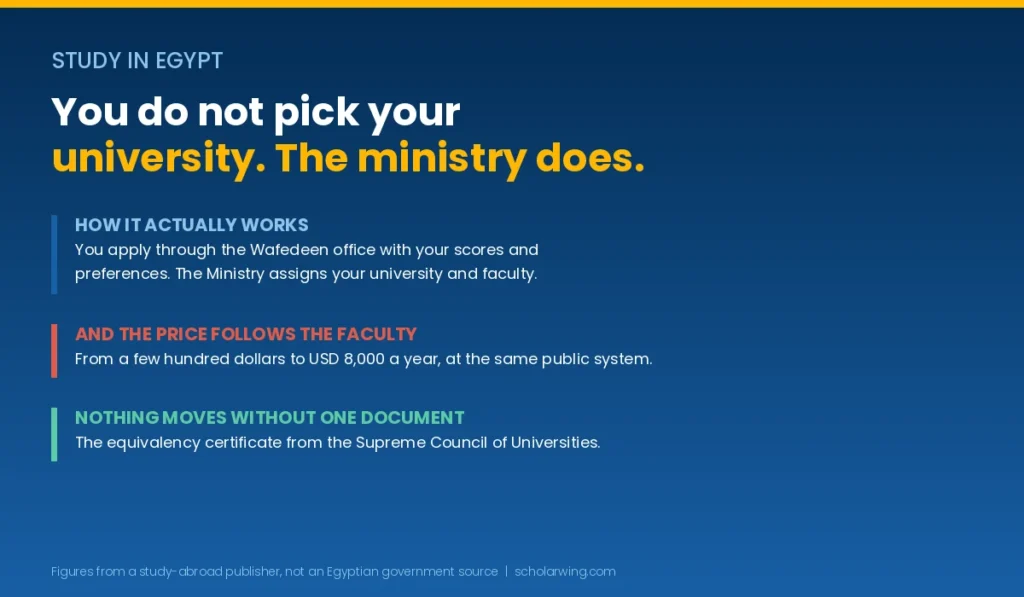
In most countries you choose a university, apply to it, and it decides. Egypt’s public system works differently for foreign students, and almost nobody explains this before people start filling in forms.
You apply through the Wafedeen office, the foreign students department under Egypt’s Bureau for Cultural and Educational Affairs. You submit your scores and your stated preferences. Then the Ministry of Higher Education assigns your university and faculty.
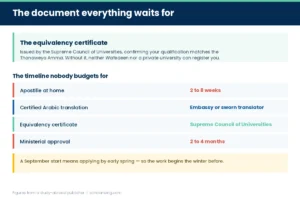
Ministerial approval takes two to four months, and only after it do you receive an acceptance letter and a tuition invoice.
Read that sequence twice if you have been shortlisting Egyptian universities by reputation. Your shortlist is a preference, not a destination, and the thing that decides where you land is your academic record rather than your research into campuses.
Where you apply from also changes the channel. Submission may be online, through the Egyptian embassy in your own country, or in person in Cairo, and the current route differs by nationality. Confirm yours with the embassy or the Wafedeen office before assuming any of the three.
The certificate that everything waits for
Here is the document that decides your timeline, and it is not the one people expect.
The equivalency certificate, شهادة معادلة, confirms that your foreign qualification matches Egypt’s Thanaweya Amma. The Supreme Council of Universities issues it. Without it, neither Wafedeen nor a private university can formally register you — so it is not a formality at the end of the process, it is the hinge the whole process turns on.
Getting there takes two steps that each eat weeks. Your academic transcripts, certificates and birth certificate need an apostille or legalization at home, which takes two to eight weeks, and then a certified Arabic translation. Some Egyptian embassies translate documents; a sworn translator in Egypt is the alternative.
The rest of the file, and the fee before the fee
Alongside the equivalency certificate, the published document list runs: academic transcripts and certificates apostilled and translated into Arabic, a birth certificate the same way, English proficiency evidence for English-medium programmes unless you are exempt, a passport valid for at least 18 months with several blank pages, six to eight passport photographs on a white background, and a health certificate, which may be requested before your residence permit is issued.
There is also an application fee of roughly USD 100 to 200, payable to the Bureau before any decision exists. Our free CV builder and personal statement guide cover the parts of the file you write yourself.
On timing, the main intake is September, and Wafedeen applications close several months ahead of it. The published advice is to apply four to nine months before you intend to start, which means early spring at the latest for a September start. Add the apostille and the ministerial approval window to that and the honest start date is the winter before.
What it actually costs, and why one number misleads
This is where most guides to Egypt, including parts of our own, flatten something that is not flat.
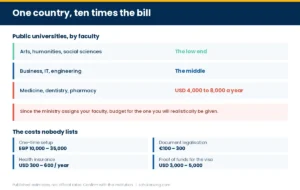
Tuition at public universities for foreign students depends almost entirely on the faculty you are assigned. Published ranges put arts, humanities and social sciences at the low end, business, IT and engineering in the middle, and medicine, dentistry and pharmacy at roughly USD 4,000 to 8,000 a year.
So “Egypt is cheap” is true for a literature student and misleading for a medical one, and since the Ministry assigns your faculty, the figure you should budget for is the one attached to the faculty you are realistically going to be given.
Private universities sit in a different world again. The American University in Cairo runs at USD 25,000 to 40,000 a year, and the German, British and other private universities run well into six figures in Egyptian pounds.
Then come the costs nobody lists. A one-time setup of roughly EGP 10,000 to 35,000 covering visa and residence permit fees, a rental deposit and basics. Document legalization at home of around €100 to 300, plus Arabic translation in Egypt. Residence permit renewal each year. Private health insurance at around USD 300 to 600 a year. And for the visa, proof of funds in the region of USD 3,000 to 5,000 for the year.
One seasonal detail worth knowing before you sign a lease: electricity costs rise sharply from June to September once air conditioning runs, which is exactly the period when a new student arrives.
Who this route actually suits
It suits a student whose faculty sits at the cheap end — arts, humanities, social sciences, Islamic studies — who wants to study in Arabic or alongside it, and who can handle a system that assigns rather than admits.
It suits anyone already pursuing the funded routes as a parallel plan, because the documents overlap almost completely. The equivalency certificate, the apostille and the Arabic translations serve both.
It does not suit a medical applicant assuming Egypt is inexpensive, and it does not suit anyone who needs to know their university before committing.
If funding is what you actually need, read our Al-Azhar and Egyptian Government scholarship guide first. And if Egypt turns out not to fit, our guides on Thailand, Qatar and Brunei cover the countries in this series whose scholarships genuinely reach Pakistani applicants.
Eligibility criteria
1. An equivalency certificate from the Supreme Council of Universities, confirming your qualification matches the Thanaweya Amma.
2. Apostilled and Arabic-translated transcripts, certificates and birth certificate.
3. A passport valid for at least 18 months, with several blank pages.
4. English proficiency evidence for English-medium programmes, unless exempt.
5. The application fee, roughly USD 100 to 200, paid before any decision.
6. Proof of funds for the visa, in the region of USD 3,000 to 5,000 for the year.
Step-by-step application process
Step 1, today: decide which faculty you are realistically aiming at, because that single answer sets your budget anywhere between a few hundred dollars and USD 8,000 a year.
Step 2, this week: contact the Egyptian embassy and ask which submission channel applies to Pakistani applicants this cycle — online, through the embassy, or in person in Cairo.
Step 3, this week: begin the apostille on your transcripts, certificates and birth certificate. Two to eight weeks, and nothing else moves until it finishes.
Step 4, November: arrange certified Arabic translations, either through the embassy or a sworn translator.
Step 5, December: start the equivalency certificate with the Supreme Council of Universities. Without it, no institution can register you.
Step 6, January: assemble the rest — passport with 18 months’ validity, six to eight white-background photographs, English evidence if your programme needs it.
Step 7, by early spring: submit to Wafedeen and pay the application fee. A September start means applying four to nine months ahead.
Step 8: wait two to four months for ministerial approval, then expect your assigned university and faculty with a tuition invoice.
Step 9: budget the setup costs before you travel — residence permit, rental deposit, insurance, and the summer electricity bill nobody warns you about.
FAQ
Can I choose my university in Egypt?
Not on the public route. You submit preferences and scores through Wafedeen, and the Ministry of Higher Education assigns your university and faculty.
How long does approval take?
Two to four months for ministerial approval, which is why applications open four to nine months before a September start.
What is the equivalency certificate?
The شهادة معادلة, issued by the Supreme Council of Universities, confirming your qualification matches the Egyptian Thanaweya Amma. Neither Wafedeen nor a private university can register you without it.
How much is tuition at a public university?
It depends on the faculty. Arts, humanities and social sciences sit at the low end, business, IT and engineering in the middle, and medicine, dentistry and pharmacy at roughly USD 4,000 to 8,000 a year.
Is Egypt cheap to study in?
For some faculties, yes. For medicine, no. Treat any single figure for “Egyptian public universities” with suspicion, including ones you find on scholarship sites.
What do private universities cost?
The American University in Cairo runs USD 25,000 to 40,000 a year, and the other private universities charge in the high tens to low hundreds of thousands of Egyptian pounds.
What other costs should I budget?
A one-time setup of roughly EGP 10,000 to 35,000, document legalization of €100 to 300, annual residence permit renewal, and private health insurance at USD 300 to 600 a year.
Do I need Arabic?
For most public university programmes, yes or eventually yes. English-medium programmes exist and require proficiency evidence.
When is the intake?
September, with Wafedeen applications closing several months earlier.
Should I apply for a scholarship as well?
Yes, if you are eligible, and the documents overlap almost entirely. Our Al-Azhar and Egyptian Government scholarship guide covers those routes.