
ACS-COSECSA Women Scholars Program:
This scholarship serves only senior female surgical trainees in COSECSA’s member countries in East, Central and Southern Africa. If you are a surgeon in Pakistan or elsewhere in Asia, the last section of this post points you to what you can apply for instead.
What the award covers, and why the list matters
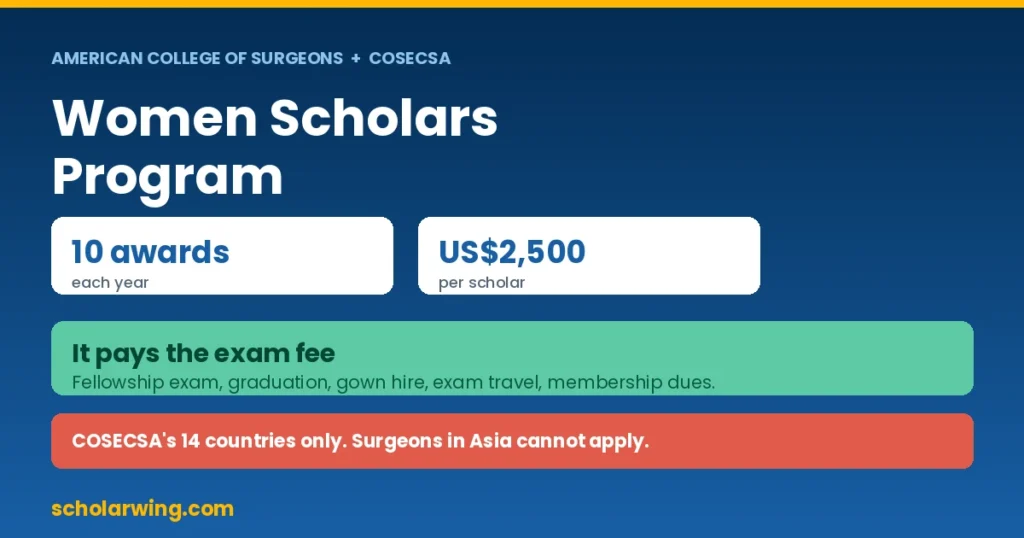
The American College of Surgeons and COSECSA run the ACS-COSECSA Women Scholars Program, funding ten scholarships of US$2,500 each.
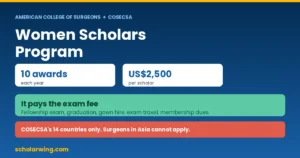
The money covers a very specific list: the COSECSA fellowship-level exam fee, the graduation fee, gown hire, travel to the exam, three years of COSECSA membership dues, and one year of ACS associate membership.
Most surgical funding helps somebody begin. This helps somebody finish. A woman who has completed years of surgical residency and then cannot pay an exam fee loses all of it, and that is the gap the programme closes. The inclusion of gown hire tells you how carefully somebody looked at the real costs of graduation day.
The COSECSA Secretariat administers the scholarship, and funding comes from Dr Pon Satitpunwaycha, FACS, the American College of Surgeons Foundation and the Association of Women Surgeons Foundation.
Who can apply
1. Senior female surgical trainees preparing for the COSECSA fellowship-level exam in 2026.
2. Based in a COSECSA country. COSECSA covers fourteen: Botswana, Burundi, Ethiopia, Kenya, Malawi, Mozambique, Namibia, Rwanda, South Sudan, Sudan, Tanzania, Uganda, Zambia and Zimbabwe.
3. Preference for applicants from surgical departments where women make up fewer than 25% of surgeons and registrars.
That third criterion is unusual and worth understanding. The programme is not only assessing you. It is assessing where you work, and it deliberately favors women training in the most male-dominated departments. If your department is one of those, say so plainly in your personal statement with the actual numbers.
The context you are applying into
COSECSA is not a small body. It accredits around 140 training hospitals, more than 900 trainees have completed its certification, and more than 1,600 surgeons hold its FCS designation. In 2022, of 283 examiners, 95 came from overseas, most of them ACS Fellows.
The ACS sponsors ten women surgeons a year to sit COSECSA’s MCS and FCS exams, which matches the ten scholarships here.
Ten places, across fourteen countries, each year. Treat the application accordingly.
The dates, and a contradiction in the official document
Here the honest answer requires care.
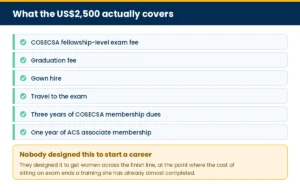
COSECSA’s own 2026 announcement gives two different timelines. In one place it says the window runs from 15 December 2025 to 15 January 2026. In another it lists a deadline of 31 January 2026.
We will not choose one for you. Write to the COSECSA Secretariat and confirm the closing date before you plan around either, and work to the earlier date if you cannot get an answer. A funder’s own document disagreeing with itself is rare, and this is the kind of detail that costs somebody a place through no fault of their own.
The document that costs you nothing to prepare early
The file here holds only three items.
1. A personal statement of one to two pages, under 1,000 words, on your future goals.
2. A current CV.
3. A one-page letter of support from your surgical training programme director.
That is all. No publication requirement, no research proposal, no referee panel.
So the only slow item is the director’s letter, and a one-page letter from a busy surgeon still takes weeks to arrive. Ask early, and give them the programme’s name, the award’s purpose and your own two lines about why you qualify.
For the statement itself, remember what the programme is funding. It is paying for the end of your training, not the start of a research career. Write about finishing, about what you will do as a qualified surgeon in your own hospital, and about the women behind you in a department that has too few.
Step-by-step application process
Step 1, now: confirm the closing date with the COSECSA Secretariat, given the contradiction in the announcement.
Step 2, now: check your department’s numbers. Count the women surgeons and registrars. If the figure sits under 25%, that strengthens your application and belongs in your statement.
Step 3, this week: ask your training programme director for the one-page letter. Give them a fortnight at minimum.
Step 4, this week: do not pay your exam fee yet if you can avoid it. The announcement warns that COSECSA does not refund amounts already paid, so paying before the award puts that money beyond the scholarship’s reach.
Step 5: draft the personal statement, under 1,000 words, on your future goals. Finishing, practicing, teaching.
Step 6: update the CV. Our free CV builder produces the format these applications expect.
Step 7: apply through the COSECSA scholarship application portal, selecting the reference number for the current cycle. For 2026 that was ACS-COSECSA/2026/T2.
Step 8: keep a copy of everything, since the COSECSA Scholarship Committee reviews applications centrally.
If you are reading this from Pakistan or elsewhere in Asia
The geography here will not change, and no email will move it. But the shape of this award is worth copying in your own search.
Look for funding that pays exam and certification costs rather than tuition. Royal college fees, fellowship exam fees and membership dues are among the least discussed costs in medicine and among the most common reasons people stall just short of qualifying. Very few people search for them, which is exactly why they are worth searching for.
For what you can apply to now, our medical and health sciences scholarships page carries degree and fellowship funding, the WFSA Fellowship Programme covers anesthesia placements across 32 centers, and the WHF Salim Yusuf Emerging Leaders Programme selects early and mid-career professionals in cardiovascular health with no national society membership required.
FAQ
What is the ACS-COSECSA Women Scholars Program?
Ten scholarships of US$2,500 for senior female surgical trainees preparing for the COSECSA fellowship-level exam.
What does it cover?
The fellowship exam fee, graduation fee, gown hire, travel to the exam, three years of COSECSA membership dues and one year of ACS associate membership.
Who can apply?
Senior female surgical trainees in COSECSA’s 14 member countries, preparing for the fellowship-level exam.
Which countries are those?
Botswana, Burundi, Ethiopia, Kenya, Malawi, Mozambique, Namibia, Rwanda, South Sudan, Sudan, Tanzania, Uganda, Zambia and Zimbabwe.
Can surgeons from Pakistan or Asia apply?
No. The programme follows COSECSA’s own region.
How many awards are there?
Ten each year.
What is the deadline?
COSECSA’s 2026 announcement gives two dates: applications from 15 December 2025 to 15 January 2026, and separately a deadline of 31 January 2026. Confirm with COSECSA.
Which documents do I need?
A personal statement under 1,000 words, a current CV, and a one-page letter from your surgical training programme director.
Is there a preference?
Yes. Preference goes to applicants from surgical departments where women make up fewer than 25% of surgeons and registrars.
Can I get a refund if I already paid my exam fee?
No. The announcement states that COSECSA does not refund amounts already paid.
Who funds it?
Dr Pon Satitpunwaycha, FACS, the American College of Surgeons Foundation and the Association of Women Surgeons Foundation.
How do I apply?
Through the COSECSA scholarship application portal, selecting the cycle’s reference number.