
How to Study in Brunei Free:
We have now checked eight countries for Pakistani readers, and most of them answered the same way. Poland, Slovenia, Latvia and Lithuania each publish an eligible-country list, and Pakistan is on none of them. India’s scholarship portal lists twenty-one schemes and names Pakistan in none.
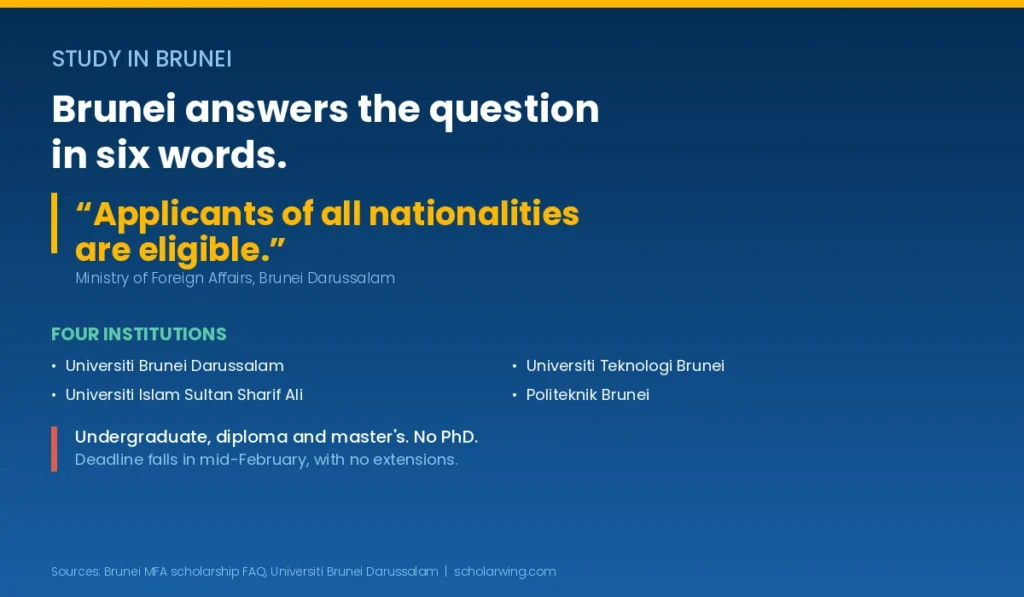
Brunei’s Ministry of Foreign Affairs answers the question in six words.
Applicants of all nationalities are eligible.
What that sentence is actually attached to
The Brunei Darussalam Government Scholarship, usually shortened to BDGS, sends foreign students to four institutions: University Brunei Darussalam, University Technology Brunei, University Islam Sultan Sharif Ali and Politeknik Brunei.
It covers undergraduate, diploma and master’s study. The FAQ is equally direct about what it leaves out: no PhD programmes are offered. If a doctorate is what you want, skip to the last section, because Brunei still has something for you, just not this.
On what you receive, UBD’s own scholarship page describes it in words rather than figures. The government bears the tuition, and the award carries bursaries for accommodation, books, food and personal spending, along with medical treatment at Brunei Government hospitals. The Brunei Darussalam foreign mission in your home country arranges travel, or the nearest mission where there is none.
We are not going to print a monthly allowance figure. Several scholarship sites quote one; no official page we could reach states it, and this guide prints only what funders publish. Ask the ministry directly, and §7 of our research notes carries the address.
The gates, and they are lower than you expect
English. The FAQ accepts any one of four things: a GCE O Level in English at credit 6, an IGCSE English as a second language at grade C, IELTS 6.0 overall, or TOEFL 550. If you hold something equivalent, the FAQ tells you to ask the institution whether it counts.
That is an ordinary bar rather than a punishing one. Compare it with Freiburg’s IELTS 7 in Germany, and with Chulalongkorn in Thailand, which asks only 5.0.
Age. Undergraduate and diploma applicants must be 18 to 25. Master’s applicants must be no older than 35. Brunei’s permanent residents cannot apply at all.
The part that decides your timeline
Here is the detail that separates people who apply from people who meant to.
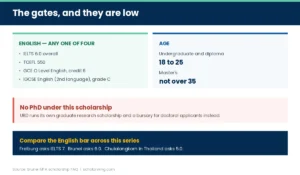
The application goes by email to the ministry, with the completed form and a specific document set. Most of the form you type yourself. But your country’s relevant ministry or focal point must endorse pages 13 and 14 — or your embassy, if you are applying from outside your home country. Signatures may be handwritten; the endorsement itself you cannot skip.
This is not a nomination in the sense that WMO fellowships or Olympic Solidarity require one, where an institution chooses who goes forward. You remain the applicant. But it is an official signature from a government office, and anyone who has asked a Pakistani ministry for a stamped endorsement knows that is a December job, not a February one.
The rest of the file is ordinary: passport photographs, certified copies of your academic records, birth certificate and passport, certified English translations of anything not in English, a statement of purpose, a security clearance statement, and two references completed by your referees on pages 9 to 12. Everything arrives as Word, PDF or JPG, or a zipped folder, and the whole set must stay under 10MB.
Two warnings sit in the FAQ itself. Incomplete applications are not considered, and the deadline carries no extensions. The cycle we could read closed at 1600 hours Brunei time, which is 1300 in Pakistan, so a deadline day is shorter here than it looks.
On timing, a Turkish government notice gives 15 February 2026 as the closing date for the 2026/2027 intake, and the older FAQ gives 14 February for its own cycle. Treat mid-February as the pattern and confirm the exact date on Brunei’s own portal, which is where the current form lives too.
Our guide on asking a professor for a reference letter covers briefing the two referees properly, and our personal statement guide covers the statement of purpose.
If you want a PhD, or if the scholarship does not land
Brunei has a second route, and it is for exactly the people BDGS turns away.
UBD lists a UBD Graduate Research Scholarship, a competitive scheme for PhD students who want a research-intensive environment, and a UBD Bursary offered to doctoral applicants across its programmes. Neither page states a nationality restriction, and neither states its coverage, so both are worth one email rather than one assumption.
And if you would pay your own way, Brunei is unusually affordable by the standards of this series. UBD’s own graduate fees page gives a research master’s at B$3,000 for a non-laboratory programme and B$4,000 for a laboratory one, charged per programme, with research fees running B$750 to B$3,250 a semester depending on the field. A coursework master’s is B$3,000 to B$3,500, though the MBA sits apart at B$22,500. Doctoral research runs B$1,500 to B$2,000 a semester.
After admission come three smaller payments: a B$100 acceptance fee, non-refundable if you do not register, a B$100 registration fee, and a refundable B$500 programme deposit. UBD notes that fees change, so confirm before budgeting.
Set that beside our Latvia guide, where a full European year lands near €7,000, and the self-funded Brunei route reads as a genuine option rather than a consolation.
Eligibility criteria
1. Any nationality, on the ministry’s own FAQ. Brunei’s permanent residents are the single exclusion.
2. Age 18 to 25 for undergraduate and diploma study, or not over 35 for a master’s.
3. English: GCE O Level credit 6, IGCSE English as a second language grade C, IELTS 6.0 or TOEFL 550.
4. An endorsement on pages 13 and 14, which your ministry or focal point signs, or your embassy if applying from abroad.
5. Two completed references on pages 9 to 12 of the form.
6. A complete file under 10MB, since incomplete applications are not considered.
Step-by-step application process
Step 1, today: check your age against the limit. It is the one criterion nothing else rescues. Undergraduate applicants must be under 26, master’s applicants under 36.
Step 2, this week: identify who endorses pages 13 and 14 for you. The relevant ministry or focal point, or your embassy if you are abroad. Ask now, in writing, and ask what they need from you.
Step 3, this week: check your English evidence. IELTS 6.0 or TOEFL 550, or an O Level or IGCSE result you may already hold without realising it counts.
Step 4, November: ask your two referees and give them the form pages rather than a vague request.
5, November: order certified copies of your academic records, birth certificate and passport, plus certified English translations of anything not already in English.
Step 6, December: write the statement of purpose around what you intend to do afterwards, not around how much you admire the country.
7, January: request the security clearance statement. It is a listed document and it is the kind of paper that takes a month.
Step 8, early February: assemble and compress the file. Word, PDF or JPG, or one zipped folder, under 10MB in total.
Step 9, before mid-February: submit. The deadline runs on Brunei time, three hours ahead of Pakistan, and the FAQ rules out extensions.
FAQ
Can Pakistani students apply for the Brunei Government Scholarship?
Yes. The ministry’s own FAQ states that applicants of all nationalities are eligible, with Brunei’s permanent residents the only exclusion.
Which universities does it cover?
Universiti Brunei Darussalam, Universiti Teknologi Brunei, Universiti Islam Sultan Sharif Ali and Politeknik Brunei.
Does it fund a PhD?
No. The FAQ states that no PhD programmes are offered under this scholarship. UBD runs its own graduate research scholarship and a bursary for doctoral applicants, which are separate.
What English score do I need?
IELTS 6.0 or TOEFL 550, or a GCE O Level in English at credit 6, or IGCSE English as a second language at grade C.
Is there an age limit?
Yes. Eighteen to 25 for undergraduate and diploma study, and not over 35 for a master’s.
What does the scholarship cover?
UBD’s page describes government-borne tuition plus bursaries for accommodation, books, food and personal spending, and medical treatment at government hospitals. The Brunei mission in your home country arranges travel, or the nearest one. No official page we reached publishes a monthly figure, so ask the ministry.
Do I need a government nomination?
Not a nomination, but an endorsement. Your ministry or focal point signs off pages 13 and 14 of the form, or your embassy if you apply from abroad.
When is the deadline?
Mid-February. A Turkish government notice gives 15 February 2026 for the 2026/2027 intake, and the earlier FAQ gives 14 February at 1600 hours Brunei time. No extensions are given.
What if my application is incomplete?
It is not considered. The FAQ says so directly.
How much does it cost if I pay myself?
UBD’s own fees page gives a research master’s at B$3,000 to B$4,000 per programme, coursework master’s at B$3,000 to B$3,500, and doctoral research at B$1,500 to B$2,000 a semester, plus small acceptance, registration and deposit payments.