
WMO Fellowships Programme WMO Fellowships:
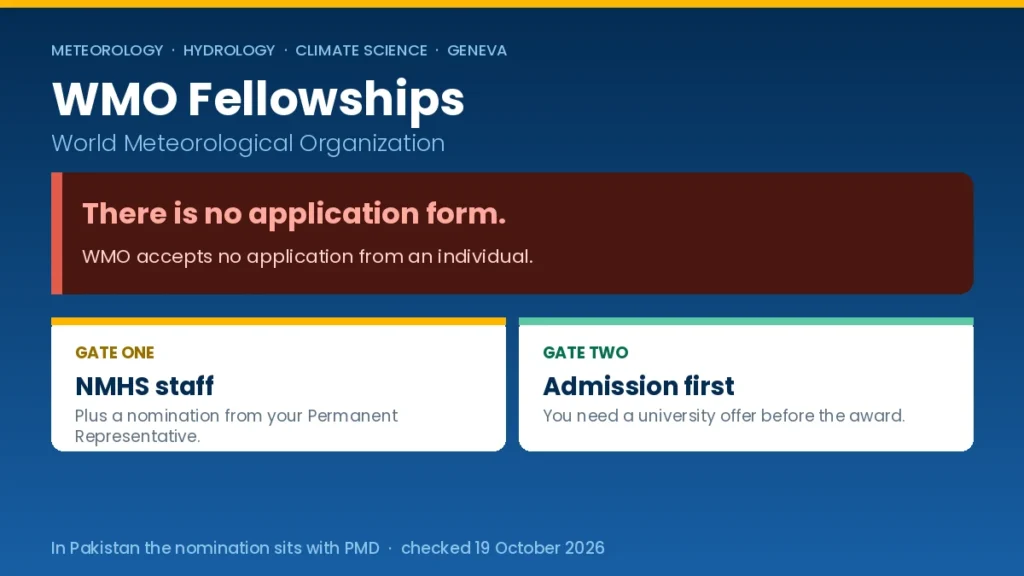
Search for meteorology scholarships and WMO’s name comes up first every time. Then you look for the application form and there isn’t one.
That is not an oversight. WMO takes no application from an individual. Its own eligibility rules say applicants must be staff of a National Meteorological and Hydrological Service or a relevant national institution, and must be nominated by their country’s Permanent Representative with WMO.
In Pakistan the national service is the Pakistan Meteorological Department. So the person who decides whether your name goes to Geneva works in your own building, or in the building you have been trying to get into.
If you work at PMD, this is the strongest funding in your field and the process starts with an internal conversation rather than an online form. If you do not, every WMO-branded fellowship you find listed is shut to you, however the listing is worded.

Two gates, not one
This is the part most summaries miss. The nomination is not the only requirement.
You must also have secured admission to an eligible programme before the fellowship is awarded.
So the order runs: get admitted first, then get nominated. A candidate who waits for the nomination before applying to universities has the sequence backwards and will miss the cycle. Our personal statement guide covers the admission application, which you build exactly as you would for any other master’s.
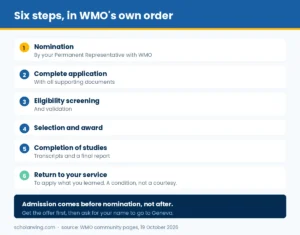
The six steps, in WMO’s own order
1. Nomination by the Permanent Representative.
2. Submission of a complete application with all supporting documents.
3. Eligibility screening and validation.
4. Selection and award of the fellowship.
5. Completion of studies, including transcripts and a final report.
6. Return to the NMHS to apply what you learned.
Step six is a condition, not a courtesy. The programme exists to strengthen national weather services, so the fellowship assumes you go home and work there. Treat it as part of the deal rather than as a suggestion.
What it covers
WMO lists possible support as tuition and academic costs, international travel, a monthly stipend, medical insurance and specialised training, and says plainly that coverage varies by fellowship and partner institution.
That last clause matters. There is no single WMO package. The fellowship routes run through partner universities and training institutions worldwide, and what you receive depends on which one admits you.
What it funds
PhDs, undergraduate and postgraduate programmes, specialized training, and research and technical training, across meteorology, hydrology and climate science — including forecasting, climate services, water resource management and disaster risk reduction.
WMO states that the programme focuses on developing and climate-vulnerable countries, which places Pakistan squarely inside its intended group.
What the selection actually weighs
Beyond the nomination and the admission, WMO names three things: a relevant academic background, alignment with national or NMHS priorities, and meeting language and programme requirements.
The middle one is the one to write for. This is not a scholarship that rewards the most interesting research idea. It rewards the idea your national service needs. A proposal on flood forecasting for the Indus basin or on monsoon prediction speaks directly to PMD’s mandate; a proposal on something fascinating but unrelated does not.
If you work at PMD, start here
Step 1: ask internally who handles WMO nominations, and find out when the department submits them. That timetable, not any published deadline, is your real calendar.
Step 2: identify programmes you could be admitted to, and check which ones WMO partners with. Several routes run through specific universities, and your department will know which ones it has used before.
Step 3: apply for admission. Without an offer the nomination goes nowhere.
Step 4: build your case around departmental priorities, in writing, before you ask for the nomination.
Step 5: ask for the nomination, with the admission and the case already in hand.
If you do not work at a national service
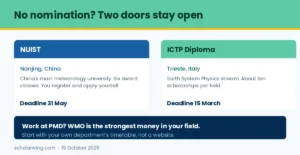
Two routes in this field need nobody’s signature.
NUIST’s own scholarship at China’s main meteorology university, where you register an account and apply yourself. Deadline 31 May, six award classes, and no nomination appears anywhere in the process. NUIST also runs a WMO-branded programme, which tells you how seriously the field takes it.
The ICTP Postgraduate Diploma in Trieste, whose Earth System Physics stream covers this ground, with a 15 March deadline and around ten scholarships per field.
For the broader picture, our Chevening, DAAD and Erasmus Mundus comparison covers the general routes, several of which fund climate and environmental subjects.
FAQ
Can I apply to WMO directly?
No. WMO accepts no individual applications.
Who nominates me?
Your country’s Permanent Representative with WMO. In Pakistan that sits with the Pakistan Meteorological Department.
Do I need to work at a weather service?
Yes, at a National Meteorological and Hydrological Service or a relevant national institution.
Do I need university admission first?
Yes. The fellowship requires admission to an eligible programme.
What does it pay?
Possibly tuition, travel, a monthly stipend, medical insurance and specialized training. Coverage varies by fellowship and partner institution.
What levels does it fund?
PhDs, undergraduate and postgraduate programmes, and specialized or technical training.
Which subjects?
Meteorology, hydrology and climate science, including forecasting, climate services, water resources and disaster risk reduction.
What is the deadline?
WMO publishes none centrally. Your national service’s internal timetable is the date that matters.
Do I have to return home afterwards?
The programme’s final step is returning to your national service to apply what you learned.
What if I do not work at PMD?
Look at NUIST’s own scholarship and the ICTP Postgraduate Diploma, neither of which needs a nomination.