
How to Study in Algeria:
Ten countries into this series, Algeria gives an answer we have not had before: no scholarship for you, and a door that opens anyway.
Both halves of that sentence matter, so take them in order.
Where Algeria’s scholarships actually go
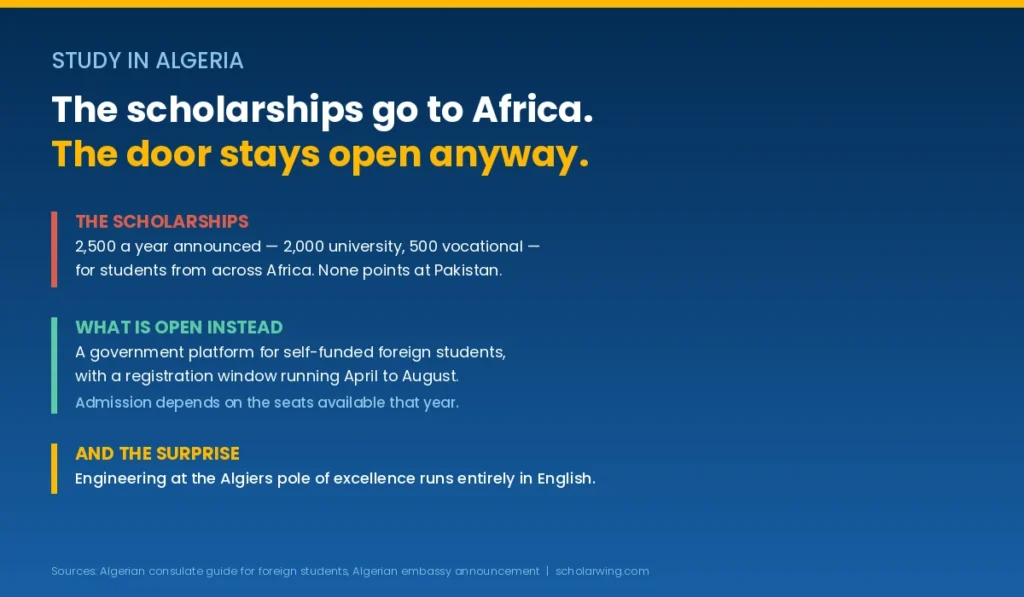
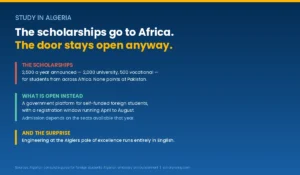
Algeria has been expanding its scholarship programme, and the direction is explicit. The president announced 2,500 scholarships a year, split as 2,000 for higher education and 500 for vocational training, for students from across Africa. Those sit on top of roughly 6,000 African students already studying in the country.
That is a serious commitment, and it is a continental one. Algeria positions itself as a destination for African students, and its scholarship money follows that policy. We found no published Algerian scheme naming Pakistan or South Asia, and nothing suggesting one is planned.
This is the same pattern we have met in Poland, Latvia and Lithuania, where national money follows the government’s own priorities and no amount of merit argues a way in. The difference here is what sits underneath the scholarship.
The route that is genuinely open
Algeria’s Ministry of Higher Education and Scientific Research runs a platform for foreign students who want to study at their own expense, and the Algerian embassy announcement we read describes an open registration rather than a nomination.
The window in the cycle that announcement covered ran from 8 April to 10 August. Treat April to August as the pattern and take the exact dates from the ministry’s platform each year.
Admission works the way it does in most countries with low fees: your host institution admits you based on the seats available that year, and you pay the required tuition. There is no agreement between governments to wait for and no embassy to nominate you.
The language question, and the surprise inside it
Here is where most readers decide Algeria is not for them, and here is why some of them are wrong.
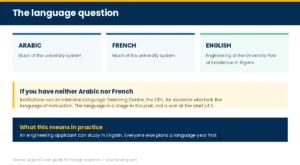
Algeria’s own guide states that instruction runs in Arabic, French and English, depending on the field. For most programmes, that means Arabic or French, which is a real barrier for a Pakistani applicant who has neither.
But the same guide names an exception worth reading twice. At the University Pole of Excellence in Algiers, engineering programmes run entirely in English.
And for everyone else there is a structured answer rather than a shrug. Institutions run an Intensive Language Teaching Centre, the CEIL, where students who lack the language of instruction take intensive courses. So the language is a stage in the plan rather than a wall at the start of it.
What the application actually asks for
The document list runs shorter than Europe’s.
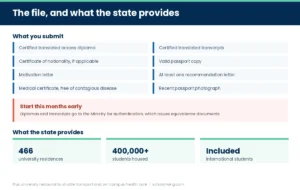
You need a certified translated copy of your access diploma, certified translated academic transcripts, a certificate of nationality where applicable, a copy of your valid passport, a motivation letter, at least one recommendation letter, a medical certificate confirming freedom from contagious diseases, and a recent passport-sized photograph.
One step sits behind that list and it is the one to start early. Your diplomas and transcripts go to the Ministry of Higher Education and Scientific Research for authentication, and the ministry issues equivalence documents. Anyone who has watched a Pakistani transcript travel through an attestation process knows that is a months-long errand, not a fortnight’s.
Our personal statement guide covers the motivation letter, and our guide on asking a professor for a reference letter covers the single referee the list requires.
Where you would live, and what the state covers
This is the part that makes self-funded study in Algeria realistic rather than theoretical.
The National Office for University Services runs 466 university residences housing more than 400,000 students, and the guide counts international students among them. Alongside the residences sit university restaurants, shuttle transport and on-campus health care.
The guide describes student life and registration costs as very affordable, and attributes that to state financial support rather than to any scholarship. It gives no figures, and neither do we. Both official documents we could read decline to print a number, and this series does not fill gaps with somebody else’s estimate.
So the honest summary: your bill in Algeria is small and state-subsidized infrastructure carries much of your living, but you should write to a university and get the number in writing before you plan a year.
Who Algeria actually suits
Be realistic about this, because the answer is narrow and it is better to say so.
It suits an engineering applicant willing to study in Algiers in English, on a modest budget, who wants a North African degree and is comfortable in an unfamiliar system.
It suits anyone who already reads French or Arabic, which opens the whole university system rather than one pole of excellence.
And It does not suit a reader who needs funding, because no scholarship here points at Pakistan. For that, our guides on Thailand, where one scholarship lists its nationality as simply Pakistan, Qatar, where a doctorate carries a full waiver and a monthly stipend, and Brunei, whose own FAQ says all nationalities are eligible, are the three to read instead.
And if the attraction is a low bill rather than a scholarship, compare Algeria with Türkiye, where a state university runs from about €100 a year, the programmes are better documented in English, and Pakistani students are already a known quantity on campus.
Eligibility criteria
1. Admission to a host institution, subject to the seats it has that year.
2. The ability to pay the required tuition, since no scholarship route here reaches Pakistan.
3. The language of your programme: Arabic, French or English depending on the field, with English for engineering at the Algiers pole of excellence.
4. Authenticated diplomas and transcripts, with equivalence documents issued by the ministry.
5. A medical certificate confirming freedom from contagious diseases.
6. A motivation letter and at least one recommendation letter.
Step-by-step application process
Step 1, today: decide whether language makes this realistic. If you have no French or Arabic, your route is engineering in English at the Algiers pole of excellence, or a CEIL language year first. Everything else follows from that answer.
Step 2, this week: open the ministry platform and confirm which address resolves, since official Algerian pages give two different ones.
3, this week: write to one or two universities and ask three things in writing: the annual tuition for a Pakistani student on your programme, the language of instruction, and whether seats are available for international applicants this cycle.
Step 4, November: begin the attestation and equivalence process for your diplomas and transcripts. This is the longest item on the list by a wide margin.
Step 5, November: arrange certified translations, since the guide asks for translated copies rather than originals alone.
6, December: obtain the medical certificate confirming freedom from contagious diseases.
Step 7, December: write the motivation letter and ask your one referee.
Step 8, before April: have the file complete. The registration window in the cycle we checked opened on 8 April.
9, April to August: register, and apply for accommodation through the National Office for University Services at the same time rather than afterwards.
FAQ
Does Algeria offer scholarships to Pakistani students?
We found none. Algeria’s announced programme of 2,500 scholarships a year targets students from across Africa, and no published scheme we could find names Pakistan or South Asia.
So can I still study there?
Yes, at your own expense. The Ministry of Higher Education runs a registration platform for foreign students, and admission depends on the seats a host institution has that year.
When do applications open?
The cycle covered by the embassy announcement we read ran from 8 April to 10 August. Confirm current dates on the ministry platform.
What language will I study in?
Arabic, French or English depending on the field. Engineering at the University Pole of Excellence in Algiers runs entirely in English.
What if I speak neither Arabic nor French?
Institutions run an Intensive Language Teaching Centre, the CEIL, offering intensive courses to students who lack the language of instruction.
How much does it cost?
Algeria’s own documents describe costs as affordable and competitive without publishing figures, so ask the university directly. We print no number rather than repeat an unofficial one.
Is accommodation available?
Yes. The National Office for University Services runs 466 residences housing over 400,000 students, and the guide counts international students among them, alongside university restaurants, shuttle transport and on-campus health care.
What documents do I need?
Certified translated diploma and transcripts, a certificate of nationality where applicable, a passport copy, a motivation letter, at least one recommendation letter, a medical certificate and a photograph.
What takes the longest?
Authentication and equivalence of your diplomas through the ministry. Start it months ahead of the April window.
Where should I look if I need funding instead?
Thailand, Qatar and Brunei are the three countries in this series with routes genuinely open to Pakistani applicants, including one scholarship reserved for Pakistan.