
Study in Poland Free:
Most pages about studying in Poland for free get the country exactly backwards, so start with the part that costs people a year.
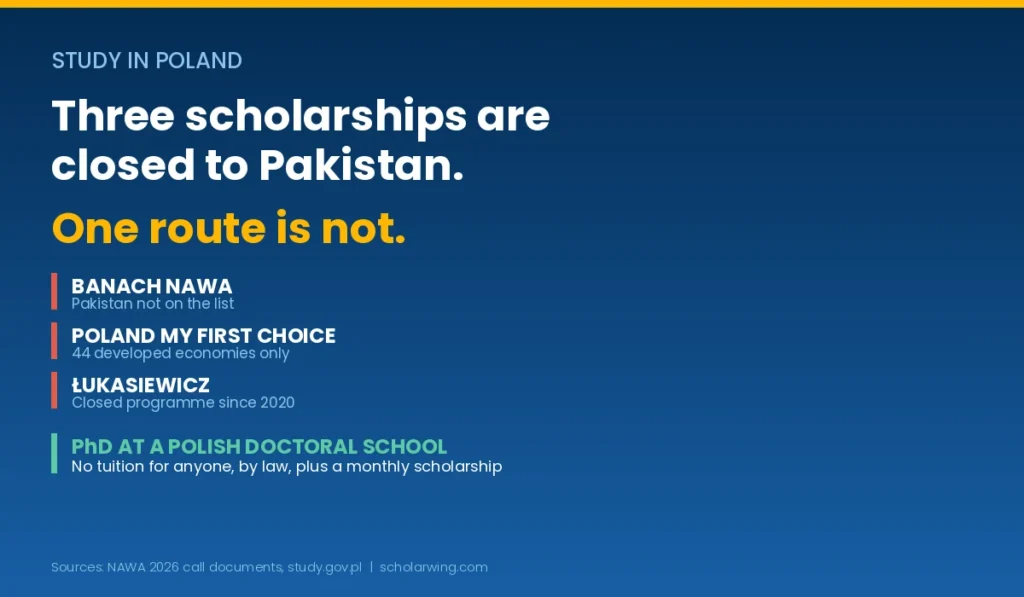
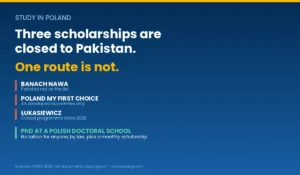
Poland’s three best-known government scholarships do not accept Pakistani applicants. Not “rarely”. Not “it is competitive”. Pakistan does not appear on their eligible-country lists at all.
The three that shut Pakistan out, and what their own documents say
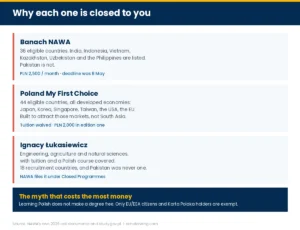
Pakistani sites advertise Banach NAWA more than any other. Its 2026 call names 36 eligible countries, and the Asian entries are India, Indonesia, Iran, Iraq, Jordan, Kazakhstan, Lebanon, Mongolia, the Philippines, Uzbekistan and Vietnam. Pakistan sits on none of the four country groups. The programme itself is excellent — PLN 2,500 a month, a tuition exemption at public universities, a travel lump sum, and a one-year Polish preparatory course if you need it — and the 2026 deadline fell on 8 May at 3pm Warsaw time. None of that helps a Pakistani passport holder.
Poland My First Choice shuts Pakistan out for a different reason. Its 44 eligible countries all rank as developed economies: Japan, South Korea, Singapore, Taiwan, Hong Kong, Australia, Canada, the United States, Israel and the EU states. The programme exists to attract students from those markets, it waives tuition at public universities, and the first edition paid PLN 2,000 a month. It was never aimed at South Asia.
The Ignacy Łukasiewicz Programme is the saddest entry, because it targeted exactly this kind of reader — a master’s in engineering, agricultural or natural sciences, with tuition and a preparatory course covered. It names 18 recruitment countries, Pakistan is not among them, and NAWA now files the whole programme under Closed Programmes, with its last published calls dated 2018, 2019 and 2020.
A fourth name worth clearing up: the General Anders Programme runs 2026 calls for bachelor’s and master’s study, and it exists for the Polish diaspora. If you have no Polish ancestry, it is not a route.
The myth that costs the most money
Here is the sentence repeated on hundreds of pages: study in the Polish language and a public university costs you nothing.
It is false for a Pakistani student. Poland’s own official portal states that full-time Polish-language programmes at state institutions run free for Polish students and for foreigners admitted on the same terms as Polish citizens, then lists who that covers: citizens of the EU and EEA, and holders of the Karta Polaka. It closes the matter in one line — “all other foreigners are required to pay tuition fees.”
So what does a degree actually cost? study.gov.pl publishes EUR 2,000 a year for bachelor’s, master’s and long-cycle programmes, EUR 3,000 a year for postgraduate study and certain internships, and EUR 2,000 a year for the preparatory Polish course. Institutions set their own figures, and the general range runs EUR 2,000 to 6,000 a year, with MBA programmes at EUR 8,000 to 12,000.
Those are not frightening numbers by European standards. They are simply not zero, and a reader who flies to Warsaw expecting zero has a problem.
The route that genuinely is free, for anybody
Now the part that makes Poland worth your attention.
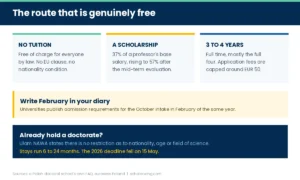
A Polish doctoral school charges no tuition to anyone. One university’s own FAQ puts it plainly: by law it is free of charge for everyone. No EU clause, no Karta Polaka, no nationality condition. And it goes further — every admitted doctoral candidate who stays in Poland legally, on a valid visa or residence permit, receives a subsistence scholarship.
That scholarship is set by law rather than by each university’s generosity. A doctoral candidate receives at least 37% of a professor’s base salary before the mid-term evaluation and 57% after passing it, which works out as roughly a 50% rise partway through. Supervision runs in English at many schools, and a non-Polish speaker taking a Polish-taught course gets individual tutorship.
Full-time Polish doctorates run three to four years, and most take the full four. Application fees sit at no more than EUR 50. The timing detail worth writing in your diary is this: universities must publish their admission requirements for the October intake in February of the same year, so the planning window is short and predictable. Our wider PhD scholarships guide covers how this compares with the funded doctorates elsewhere in Europe.
And one route with no nationality rule at all
If you already hold a doctorate, the Ulam NAWA programme is the most open door in this entire guide. Its own terms state that there is no restriction as to nationality, age or field of science. Holders of a Marie Skłodowska-Curie Seal of Excellence may apply too.
A stay runs 6 to 24 months, and eupraxias Poland’s summary of the 2026 call gives the principal investigator’s remuneration as up to PLN 17,000 a month, on a full-time employment basis with employer costs included, plus up to PLN 1,200 a month for the inviting person at the Polish host. The 2026 deadline was 15 May at 15:00 CET, so a 2027 call around the same point is the sensible assumption rather than a promise.
Eligibility criteria
1. For a funded doctorate: a master’s degree Poland recognizes. Degrees from EU, EFTA and OECD countries count as equivalent automatically. A Pakistani master’s goes through recognition under an international agreement or through notification, and that is the step to start early rather than late.
2. For a doctorate: a supervisor and a project. Doctoral schools admit you to work on something specific with somebody specific, so the conversation with a potential supervisor comes before the application form. Our guide on asking a professor for a reference letter covers how to open that correspondence properly.
3. For a doctorate: legal residence for the scholarship. The tuition exemption is unconditional, but the living scholarship requires that you stay in Poland legally with a valid visa or residence permit.
4. For Ulam: a completed doctorate. Nothing else about your nationality, age or field restricts you.
5. For a bachelor’s or master’s: the money. EUR 2,000 a year upwards at a public university, unless you hold EU or EEA citizenship or the Karta Polaka.
6. English rather than Polish, in most cases. Many doctoral schools teach and supervise in English, which removes the language barrier that the Polish-language myth rests on. Our scholarships without IELTS page covers the institutions that accept a medium-of-instruction certificate instead of a test, and our MOI certificate generator produces one in the format universities expect.
Step-by-step application process
Step 1, this week: decide which of the three routes you are on. A funded doctorate, a paid master’s, or an Ulam fellowship if you already hold a PhD. These three run on completely different calendars and documents, and mixing them wastes months.
Step 2, this week, if you want the doctorate: list five Polish doctoral schools in your field and find their English-language pages. Note which supervise in English.
Step 3, November: write to potential supervisors. One paragraph on your master’s research, one on the problem you want to work on, and a specific question about their group. Attach a CV, and our free CV builder handles the European format Polish institutions expect.
Step 4, November: start degree recognition. Ask each doctoral school how it will treat your Pakistani master’s, under an agreement or by nostrification, and what documents it needs. This is the slowest item in the whole process.
Step 5, December: request transcripts and a grading-scale explanation from your university. Pakistani universities take weeks over the second one and European admissions offices need it to read your marks.
Step 6, February: watch for the admission requirements. Universities must publish them for the October intake in February, so that is when the real deadlines appear.
Step 7: prepare the research proposal, not a personal essay. A doctoral school judges your application on the question you are asking, and our personal statement guide covers building an argument rather than listing enthusiasms.
Step 8, if you hold a PhD: diary mid-May for Ulam. The 2026 call closed on 15 May and you need a Polish host institution agreeing to invite you, which takes months of correspondence rather than days.
Step 9: ignore every page that calls Banach open to Pakistan. Check NAWA’s own call document each year. Lists change, and if Pakistan ever appears on one, that is the day to move.
FAQ
Can Pakistani students apply for the Banach scholarship?
No. The 2026 call lists 36 eligible countries and Pakistan is not among them.
Is Poland My First Choice open to Pakistan?
No. Its 44 eligible countries all lie in Europe, North America, East Asia and Oceania.
Is the Łukasiewicz programme still running?
NAWA lists it under Closed Programmes, with published calls from 2018, 2019 and 2020. Pakistan was not on its recruitment list in any case.
If I learn Polish, can I study free?
No. Poland’s official portal exempts EU and EEA citizens and Karta Polaka holders, and states that all other foreigners pay tuition fees. The language of instruction does not change that.
How much does a master’s in Poland cost?
From EUR 2,000 a year at a public university on the official figures, with the general range running EUR 2,000 to 6,000 depending on the institution.
Is a PhD in Poland really free for Pakistanis?
Yes. Doctoral schools charge no tuition to anyone, and admitted candidates staying legally in Poland receive a living scholarship.
How much does the doctoral scholarship pay?
At least 37% of a professor’s base salary before the mid-term evaluation and 57% afterwards. Ask the specific school for the current figure in złoty.
How long is a Polish doctorate?
Three to four years full time, and most run the full four.
When do Polish universities publish their PhD deadlines?
In February, for the October intake of the same year.
What is open to me if I already have a PhD?
Ulam NAWA, which states there is no restriction as to nationality, age or field of science. Stays run 6 to 24 months.