
Study in Slovenia Free:
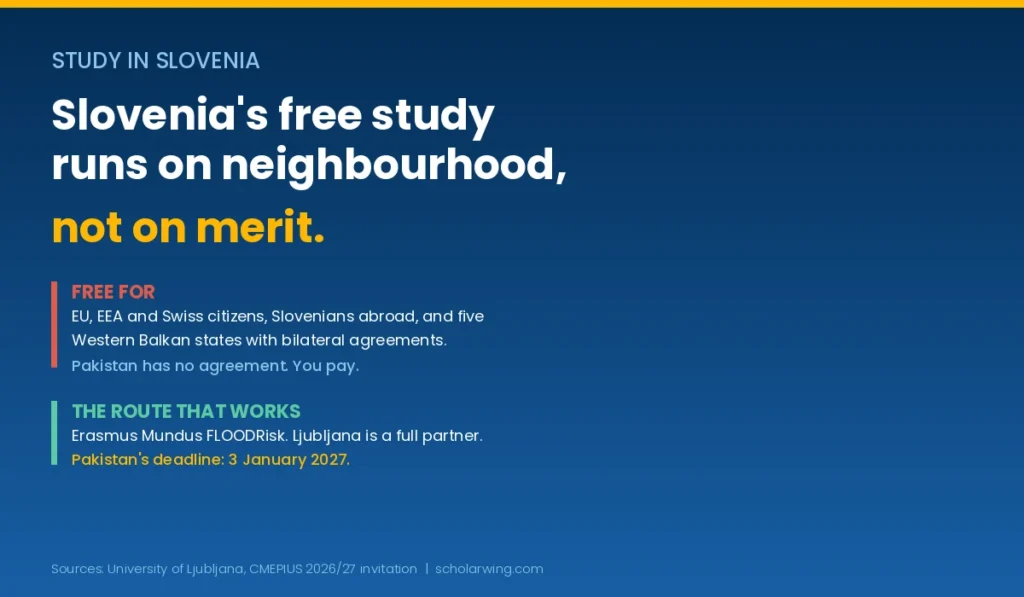
Slovenia looks like the perfect answer. A small, safe EU country, low living costs, English-taught programmes, and a reputation for cheap study. Then you read the tuition rules and discover that the country’s generosity runs along its own borders rather than across the world.
Here is what the University of Ljubljana’s own page actually says, and what it means for a Pakistani passport.
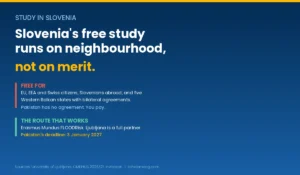
Who studies free, in Slovenia’s own words
The university lists six groups that pay nothing for full-time bachelor’s and master’s study. Slovenians, including those living outside Slovenia’s borders. Citizens of the EU, Switzerland, Iceland, Liechtenstein and Norway. Citizens of countries holding a bilateral agreement with Slovenia, and it names them: Bosnia and Herzegovina, North Macedonia, Montenegro, Kosovo and Serbia. People with permanent residence in Slovenia who pay tax there, or whose parents do. People granted international or temporary protection. And scholarship holders of the Republic of Slovenia, through CMEPIUS or the Public Scholarship Fund.
Then it lists who pays, and the first line settles the question: citizens of non-EU countries with which Slovenia has not signed a bilateral agreement.
Pakistan holds no such agreement. So unless you hold one of Slovenia’s own scholarships, you pay.
The detail that reverses the advice from Poland
Read this line carefully, because it is the single most expensive thing on the page: “all doctoral students” sit in the paying group, subject to a co-funding scheme.
That matters because a doctorate is the cheapest route into several EU countries and a reader naturally assumes it works everywhere. It does not. Our guide on studying in Poland free explains that Polish doctoral schools charge nobody tuition by law and pay every admitted candidate a monthly scholarship. Two EU countries, a few hundred kilometers apart, opposite answers. If a funded doctorate is your goal, Poland takes you and Slovenia bills you.
What it actually costs
One figure comes straight from a university price list rather than a summary site. The University of Ljubljana’s Faculty of Economics charges third-country students €3,400 a year for full-time bachelor’s study in 2026/2027.
Across the sector the published ranges run roughly €2,000 to €11,000 a year for a bachelor’s, €2,000 to €15,000 for a master’s and €2,000 to €6,000 for a doctorate, with private institutions charging more. Treat those ranges as orientation and the €3,400 as a real number, then check the price list of the faculty you actually want, because each one publishes its own.
Living costs soften the picture considerably. Published estimates put a student’s monthly needs at roughly €400 to €700, with a university dormitory around €100 to €250 a month and a transport pass between €10 and €27. By Western European standards that is genuinely cheap, which is why Slovenia keeps appearing on lists of affordable destinations. Affordable and free are different words.
The two Slovenian scholarships, and why neither reaches you
CMEPIUS bilateral scholarships are the ones you will find advertised. The 2026/2027 invitation names sixteen eligible countries: Bulgaria, Bosnia and Herzegovina, Hungary, India, Italy, Japan, Kosovo, Mexico, Montenegro, Poland, China, North Macedonia, Serbia, Slovakia, Switzerland and Turkey. Pakistan appears nowhere on that list, and India’s presence is exactly why Pakistani sites copy the announcement without checking.
Three more things make it a poor fit even for those who qualify. It pays €400 a month, it does not cover tuition, and it does not fund full degree programmes at all — it supports study and research stays of three to ten months. Age limits apply too: 26 for study stays and 30 for research visits. And you cannot apply directly, because your own government’s education ministry nominates you and CMEPIUS refuses individual applications.
Ad Futura, run by Slovenia’s Public Scholarship Fund, is the other name you will see. Its scholarship for foreign nationals studying in Slovenia is for nationals of Western Balkan states, at master’s and doctoral level. Slovenia does occasionally open country-specific calls under development agreements, and Nepal has had one, which shows these doors open by diplomatic arrangement rather than by application. Pakistan has no such arrangement today.
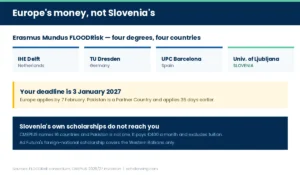
The route that does work
Now the useful part, and it is a real one.
Slovenia sits inside the European Union, which means Slovenian universities join Erasmus Mundus consortia. Those programmes run on European Commission money, and the European Commission does not restrict them to Slovenia’s neighbors.
The clearest example is FLOODRisk, the joint master’s in flood risk management, where the University of Ljubljana is one of four full partners alongside IHE Delft, TU Dresden and UPC Barcelona. A scholarship holder studies in Slovenia as part of the programme, pays nothing, and leaves with four MSc degrees. Our full FLOODRisk guide covers the application in detail, and the date that matters is this: Pakistan’s deadline is 3 January 2027, a month ahead of Europe’s own 7 February.
So the honest answer to “how do I study in Slovenia for free” is that you do not apply to Slovenia. You apply to a European consortium that happens to teach there. Our wider Erasmus Mundus scholarships page lists the others on the same funding model, and our water scholarships page covers the two routes closing on that same January date.
Eligibility criteria
1. For free tuition in Slovenia itself: EU, EEA or Swiss citizenship, Slovenian origin, citizenship of one of the five bilateral Western Balkan states, Slovenian permanent residence with tax status, a protection status, or a Slovenian national scholarship. A Pakistani student arriving on a study visa meets none of these.
2. For the Erasmus Mundus route: a bachelor’s worth 180 ECTS, which a Pakistani three or four-year degree generally clears, plus the consortium’s own subject requirements.
3. English, not Slovene. The Erasmus Mundus programmes teach in English, and our IELTS preparation guide covers reaching a usable band quickly.
4. For CMEPIUS, if you ever become eligible: a government nomination, an acceptance letter from a Slovenian university, and an age under 26 for study stays.
5. For self-funded study: the fee plus living costs. Budget the faculty’s published figure plus €400 to €700 a month.
6. Final-year students may apply to the Erasmus Mundus routes with 120 ECTS completed and a university statement giving your expected graduation date.
Step-by-step application process
Step 1, today: decide whether you want Slovenia or you want Europe. If Slovenia specifically matters to you, budget for a paid degree. If funded study matters more, the consortium route is the one with your name on it.
Step 2, this week: open the FLOODRisk guide and check the January date. Pakistan applies by 3 January 2027, not 7 February, and that single confusion ends more applications than any eligibility rule.
Step 3, this week: request transcripts and a grading-scale explanation from your university. Pakistani universities take weeks over the second one and European admissions offices require it.
Step 4, this week: ask two referees. Letters must usually carry a recent date, so a letter from 2024 helps nobody.
Step 5, November: check your English certificate against the per-module minimum, not just the overall band.
Step 6, December: build the Europass CV and the motivation letter. Our free CV builder handles the format, and our personal statement guide covers writing an argument rather than a list.
Step 7, before 3 January: submit. A 23:59 CET deadline falls in the early hours of 4 January in Pakistan, and nobody should test that at the last minute.
Step 8, if you want Slovenia regardless: email the faculty, not the university. Each faculty publishes its own price list, and the figure you find on a blog will not match the one you pay.
Step 9, once a year: recheck the CMEPIUS country list. It changes, Nepal shows that country-specific calls do open, and the day Pakistan appears is the day this advice changes.
FAQ
Is study free in Slovenia for Pakistani students?
No. Slovenia exempts EU, EEA and Swiss citizens, Slovenians abroad, five Western Balkan countries with bilateral agreements, permanent residents who pay tax, protected persons and holders of Slovenian national scholarships. Pakistan has no bilateral agreement.
Does learning Slovene make it free?
No. The exemption runs on your status, not on your language of study.
Is a PhD free in Slovenia?
No. The University of Ljubljana lists all doctoral students among those who pay, subject to a co-funding scheme. This differs sharply from Poland, where doctoral schools charge nobody.
How much does a degree cost?
The University of Ljubljana’s Faculty of Economics lists €3,400 a year for third-country bachelor’s students in 2026/2027. Published sector ranges run from about €2,000 upwards, and each faculty sets its own.
Can I apply for the CMEPIUS bilateral scholarship?
Not from Pakistan. The 2026/2027 invitation names sixteen countries and Pakistan is not among them. It also pays €400 a month, excludes tuition and does not fund full degrees.
What about Ad Futura?
Its scholarship for foreign nationals covers Western Balkan states at master’s and doctoral level.
So how can I study in Slovenia with full funding?
Through Erasmus Mundus. The University of Ljubljana is a full partner in FLOODRisk, which pays participation costs and asks Pakistani applicants to apply by 3 January 2027.
How expensive is living in Ljubljana?
Published estimates put student costs at roughly €400 to €700 a month, with dormitory accommodation from about €100.
Can final-year students apply?
For the Erasmus Mundus routes, yes, with 120 ECTS completed and a university statement naming your expected graduation date.
Should I wait for Slovenia to sign an agreement with Pakistan?
No. Plan around what exists today and recheck the list once a year.