
UWA Global Excellence Scholarship
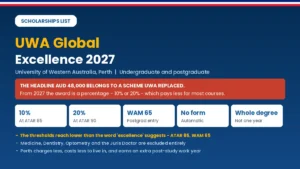
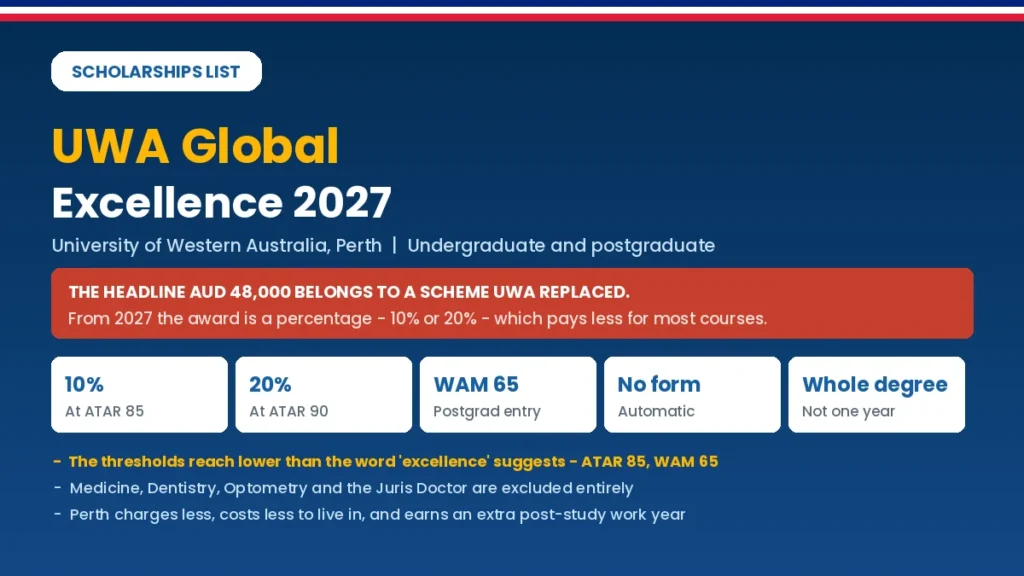
Search for this scholarship and you will find headlines promising up to AUD 48,000, sometimes AUD 60,000 for a five-year combined degree. These offers were part of the UWA Global Excellence Scholarship, a scheme the University of Western Australia has since replaced.
The old award paid fixed dollar amounts AUD 12,000, AUD 10,000 or AUD 6,000 a year depending on your ATAR. Multiply AUD 12,000 by four years and you get the AUD 48,000 that still circulates on scholarship sites.
For intakes from 2027 onwards, UWA pays a percentage of tuition instead: 10% or 20%. That change matters more than it sounds, and it runs in one direction.
UWA’s international tuition runs roughly AUD 30,000 to AUD 50,000 a year. Twenty per cent of AUD 45,000 is AUD 9,000. Twenty per cent of AUD 50,000 is AUD 10,000. To reach the old AUD 12,000 top tier you would need a course costing AUD 60,000 a year and UWA excludes its most expensive degrees, including Medicine, Dental Medicine, Optometry and the Juris Doctor, from the scholarship entirely.
So under the new scheme, essentially no student reaches the figure the headlines still advertise.
None of this makes the award worthless. Ten or twenty per cent off tuition, awarded automatically with no application, for the full duration of your degree, is real money for doing nothing beyond applying. It makes the award smaller and more accessible than the internet describes, and planning on the old numbers leads to a gap you discover after you arrive.
This guide covers the current tiers, the thresholds that are lower than most applicants expect, what the exclusions cost you, and whether Perth makes financial sense once living costs enter the picture.
What Changed, Exactly
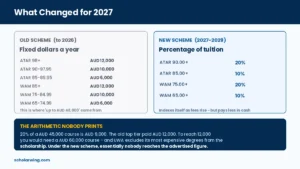
The old scheme, applying to intakes up to 2026, paid fixed annual amounts:
| ATAR or WAM | Annual value |
|---|---|
| ATAR 98.00 and above | AUD 12,000 |
| ATAR 90.00 – 97.95 | AUD 10,000 |
| ATAR 85.00 – 89.95 | AUD 6,000 |
| Postgraduate WAM 85+ | AUD 12,000 |
| Postgraduate WAM 75 – 84.99 | AUD 10,000 |
| Postgraduate WAM 65 – 74.99 | AUD 6,000 |
The new scheme, for intakes across 2027 to 2029, pays percentages:
| Level | Threshold | Discount |
|---|---|---|
| Undergraduate | ATAR equivalent 85.00 | 10% |
| Undergraduate | ATAR equivalent 90.00 | 20% |
| Postgraduate | WAM 65.00 | 10% |
| Postgraduate | WAM 75.00 | 20% |
Three consequences follow, and all three are worth understanding before you plan.
The top end compressed. Under the old scheme, an ATAR of 98 earned more than an ATAR of 90. Under the new one, both earn 20%. An exceptional student and a strong student now receive the same award, which removes the reward for the last eight ATAR points.
The value fell for most courses. A student in a AUD 45,000 engineering degree who would have received AUD 10,000 at ATAR 90 now receives AUD 9,000. At ATAR 98, that student would have received AUD 12,000 and now receives the same AUD 9,000.
The bottom tier improved slightly. A student at ATAR 86 previously received AUD 6,000. Now they receive 10%, which on a AUD 45,000 course is AUD 4,500 lower in cash, though the percentage rises automatically as fees rise each year, where the fixed amount did not.
The honest summary: the new scheme is simpler and indexes itself to fee increases, and for nearly every student it pays less than the old one did. Treat any page quoting AUD 48,000 as describing history.
The Current Tiers, and Why the Thresholds Matter
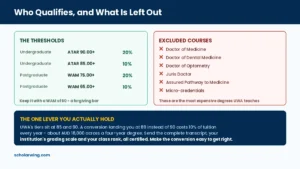
The thresholds are the most useful part of this scheme, and almost nobody highlights them.
Undergraduate entry needs an ATAR equivalent of 85.00 for the 10% tier and 90.00 for the 20% tier. An ATAR of 85 sits well below the “excellence” the name implies. A great many international applicants clear it without realizing the award exists.
Postgraduate entry needs a Weighted Average Mark of 65.00 for 10% and 75.00 for 20%. A WAM of 65 is an ordinary pass-to-credit result in most systems. This is the single most overlooked fact about the scheme: a master’s applicant with middling undergraduate marks still qualifies for something.
Combined degrees qualify. All combined bachelor’s and bachelor’s-master’s degrees sit inside the scheme, which matters at UWA because its structure pushes many professional qualifications into a combined or postgraduate pathway.
It runs for the normal full-time duration of the course, not for one year, which distinguishes it from the one-off awards several Australian universities offer.
No application exists. UWA awards it automatically to applicants who meet the ATAR or WAM thresholds. Your course application is the whole process.
You cannot hold it alongside another UWA tuition reduction. If a partner-institution discount or another UWA award already applies to you, check which leaves you better off before accepting either.
To keep it, recipients maintain a Weighted Average Mark of 60 and satisfactory annual progress. Sixty is a forgiving bar, lower than Monash’s 70 or Adelaide’s thresholds, and students rarely lose the award.
What the Exclusions Cost You
This is where the percentage structure bites, and the logic is worth seeing clearly.
UWA excludes these courses from the scholarship:
- Doctor of Medicine
- Doctor of Dental Medicine
- Doctor of Optometry
- Juris Doctor
- Assured Pathway to Medicine and Dental Medicine at undergraduate level
- Micro-credentials
Notice what those have in common. They are the most expensive degrees UWA teaches, which is exactly where a percentage award would be worth the most. A 20% reduction on a medical degree would run to tens of thousands a year, so the exclusion is not an oversight.
What this means in practice. If your plan runs towards medicine, dentistry, optometry or law at UWA, this scholarship does not reach the professional qualification. It may still cover the bachelor’s degree that precedes it, since combined and standard bachelor’s degrees qualify, but the expensive years sit outside.
A student in that position should price the full pathway undergraduate years with the award, professional years without rather than assuming a scholarship letter covers the whole journey.
What UWA Actually Costs
UWA’s international tuition has run roughly AUD 30,000 to AUD 45,000 a year for undergraduate degrees and AUD 35,000 to AUD 50,000 a year for postgraduate, with arts and humanities at the lower end and engineering, science and commerce at the upper.
Those figures sit below Sydney, Melbourne and Adelaide, which is the quiet advantage in UWA’s favor and rarely appears in scholarship comparisons.
On top of tuition, the Australian student visa requires proof of AUD 29,710 for twelve months of living costs, plus Overseas Student Health Cover and travel money.
A three-year undergraduate degree at AUD 42,000 a year, with the 20% tier:
| Item | Amount (AUD) |
|---|---|
| Tuition, 3 years | 126,000 |
| Less 20% | −25,200 |
| Living costs, 3 years at about 27,000 | 81,000 |
| Total | about 181,800 |
The same degree at the 10% tier:
| Item | Amount (AUD) |
|---|---|
| Tuition after 10% | 113,400 |
| Living costs | 81,000 |
| Total | about 194,400 |
Perth costs less to live in than Sydney and Melbourne frequently AUD 3,000 to AUD 6,000 a year less once rent is counted. Student accommodation near the Crawley campus runs roughly AUD 375 to AUD 710 a week depending on the type, and sharing further out costs considerably less.
The visa’s AUD 29,710 figure runs on a national average rather than on Perth, so a frugal student in Perth genuinely spends below what they had to prove.
The Perth Advantage Nobody Counts
Two benefits of studying in Perth rarely appear in scholarship comparisons, and together they outweigh the difference between UWA’s 10% and 20% tiers.
The extra post-study work year. Australia’s Temporary Graduate visa, subclass 485, lets graduates apply for a second visa adding extra work rights, based on where they studied and lived.
Category 1
Sydney, Melbourne, Brisbane earns nothing.
Category 2
which generally includes Perth, attracts one additional year. For a graduate planning to work in Australia or build towards permanent residence, a full extra year of work rights is worth far more than a few thousand dollars of tuition.
Western Australia’s labor market. Perth’s economy concentrates in mining, resources, energy, engineering, agriculture and marine science, and those sectors hire. Graduate salaries in the resources sector run above national averages, and the state actively works to retain skilled graduates. A mining or petroleum engineering graduate from UWA sits in an unusually favorable position.
The categories run on postcodes, the rules change, and the Department of Home Affairs assesses each case individually, so confirm rather than relying on this paragraph. But when you weigh a UWA offer against one from Sydney or Melbourne, this belongs in the comparison.
Where UWA Is Genuinely Strong
UWA sits among Australia’s Group of Eight and ranks in the global top 100 in most tables. Its strengths concentrate in a handful of fields where it competes internationally rather than nationally.
Mining and minerals engineering. Western Australia produces a substantial share of the world’s iron ore, and UWA’s mining, geology and resources programmes connect directly to that industry. For this field, UWA is among the strongest choices anywhere.
Marine science and oceanography. The Indian Ocean Marine Research Centre sits on campus alongside CSIRO and the Australian Institute of Marine Science. Coral reef, fisheries and ocean engineering research runs at a genuinely international level.
Agriculture and plant science. Western Australian grain and dryland farming research serves one of the world’s major wheat-exporting regions, which suits students from agricultural economies.
Geology and earth sciences. The ancient geology of the state makes it a natural laboratory, and the department reflects that.
Engineering more broadly, particularly civil, mechanical and petroleum, feeding directly into the resources sector.
Medicine and health sciences, though the Doctor of Medicine falls outside this scholarship.
A practical note: UWA places several professional qualifications at postgraduate level, so an aspiring lawyer or doctor studies a bachelor’s degree first. Price the full pathway rather than the first degree alone, especially given the exclusions above.
How to Apply, and the Only Lever You Hold
Step one: apply for admission. The scholarship assessment runs from your course application, so there is nothing else to submit.
Step two: make sure your ATAR equivalence or WAM is calculated correctly. This is the whole of your influence over this award, and it is a real lever.
International qualifications convert into an Australian ATAR equivalent through conversion tables, and the conversion is not always generous to unfamiliar systems. Send your transcript complete and certified, include your institution’s grading scale, and add your class rank where your school issues one. A student sitting at the boundary between 89 and 90 has a genuine reason to make sure every mark reaches the assessor.
Step three: clear every condition on your offer promptly. A pending English result or missing final transcript delays the assessment.
Step four: respond within 30 days. UWA’s scholarship offers have carried a 30-day validity. An offer that lapses is simply gone.
Step five: search UWA’s wider scholarship database. Faculty, donor and country-specific awards exist beyond this scheme and attract far fewer applicants.
Getting Your ATAR Equivalence Right
This section is short on word count and long on value, because the ATAR conversion is the only part of this scholarship you can influence, and a boundary case is worth thousands of dollars a year.
Australian universities convert overseas qualifications into an ATAR equivalent using published tables. A Pakistani Fsc, an Indian CBSE score, a Nigerian WAEC result, a Sri Lankan A-Level and an Indonesian UN all map onto the Australian scale through a conversion that is approximate by nature.
Why boundary cases matter so much here. UWA’s two tiers sit at 85 and 90. A student converting to 89 receives 10%; a student converting to 90 receives 20%. On a AUD 45,000 course across four years, that single point is worth AUD 18,000.
What actually helps the conversion:
Send the complete transcript, not a summary. Partial results, predicted grades or an unofficial printout invite a conservative reading. Send the official document with every subject and every mark.
Include your institution’s grading scale. Many schools issue this on request, and it tells the assessor what a given mark means rather than leaving them to guess. A 75% means very different things in different systems.
Add your class rank or percentile where your school provides it. This gives context that a raw mark cannot.
Certify and translate properly. A translation that is not certified can be set aside, and the assessment then runs on whatever the assessor can read.
Ask which board or stream your qualification was assessed under. Some systems have multiple boards with different difficulty, and a conversion applied to the wrong one works against you. One email to admissions clarifies it.
If you sit at a boundary, say so politely. Admissions teams do not change results, but they will confirm which conversion they applied and on what basis. A student who discovers an error at that point still has time to correct it; a student who discovers it after enrolment does not.
None of this is gaming the system. It is making sure an assessor in Perth reads a qualification from your country the way your own teachers would.
A Timeline That Works
Working backwards from a February 2027 start:
Twelve months out, February 2026. Decide your course and check UWA’s fee page for that specific degree. Work out what 10% and 20% are actually worth to you, in dollars.
Eleven months out, March. Book IELTS, TOEFL or PTE, leaving room for a retake. Begin requesting official transcripts, certified copies and translations, which run six to eight weeks in many countries.
Ten months out, April. Ask your school or university for your grading scale and class rank in writing. Both help the ATAR or WAM conversion, and both take time to obtain after you have left.
Nine months out, May. Submit your admission application as the intake opens. The scholarship assessment follows it, so an earlier application means an earlier answer.
Eight months out, June. Clear every condition on the offer. Upload documents as they arrive rather than holding them for a complete set.
Seven months out, July. Expect the scholarship outcome. Respond within the 30-day window these offers lapse quietly. Search UWA’s wider database for faculty and donor awards while you are in the system.
Six months out, August. If your conversion placed you just below a threshold, this is the moment to ask admissions which conversion they applied, while an appeal or a clarification can still change something.
Five months out, September. Arrange proof of funds in an accessible account with a visible history.
Four months out, October. Lodge the subclass 500 visa, attaching your scholarship letter.
Two months out, December. Arrange accommodation. Perth’s rental market has tightened with the resources cycle, and the Crawley area fills early.
Six Mistakes That Cost Applicants This Award
Planning around AUD 48,000. That figure belongs to the old fixed-dollar scheme. From 2027 the award is a percentage, and for most courses it pays less.
Assuming the thresholds are high. ATAR 85 and WAM 65 reach much further down than the word “excellence” suggests. Students rule themselves out without checking.
Not realizing postgraduate students qualify. A WAM of 65 is an ordinary result, and many master’s applicants never look at the scheme.
Choosing an excluded course and expecting cover. Medicine, Dental Medicine, Optometry and the Juris Doctor sit outside the scholarship entirely.
Letting the ATAR conversion go unchecked. A conservative conversion can drop you from 20% to 10%, or out altogether. Make the assessor’s job easy.
Letting the 30-day offer lapse. Automatic awards arrive without fanfare, and students miss the email.
UWA Compared With the Alternatives
Adelaide runs six tiers from 50% down to 10%, with a credit average earning 15%. Adelaide’s top tier pays far more than UWA’s 20%, and its entry point sits lower. For a student choosing purely on scholarship value, Adelaide generally wins.
Monash gives full tuition to four students a year and AUD 15,000 to twenty more, with pathway students excluded. UWA’s award reaches far more students, so the expected value for an ordinary strong applicant is higher at UWA.
Melbourne gives 20% to around 225 undergraduates from 2027, restricted to countries with GDP per capita at or below US$10,000. UWA’s 20% carries no country restriction, which matters for Chinese, Malaysian and Gulf applicants.
Sydney runs a tiered automatic scheme paying AUD 5,000 to AUD 60,000, awarded once and not renewable. UWA’s percentage runs for the whole degree, which usually makes it worth more over three or four years.
The Research Training Program funds Australian research degrees with full fees and a tax-free stipend of roughly AUD 36,000 and above. Any research candidate should look there first.
The honest summary: UWA offers a modest, reliable, widely accessible discount at a university that charges less and sits in a city with lower living costs and an extra post-study work year. The scholarship is not the reason to choose UWA. The total cost of a UWA degree might be.
Studying at UWA
The Crawley campus sits on the Swan River about fifteen minutes from central Perth, and it is consistently rated among Australia’s most attractive campuses sandstone buildings, established gardens and river frontage.
Perth itself is isolated, which cuts both ways. It is one of the most remote major cities in the world, closer to Jakarta and Singapore than to Sydney, which makes travel home easier for South and Southeast Asian students and travel within Australia more expensive. The time zone aligns with much of Asia, which helps students who keep in regular contact with family.
The city is calm, spread out and sunny, with a smaller international student community than the eastern capitals. Students who want a dense, fast, anonymous city find Perth quiet. Students who want space, beaches and a manageable cost of living find it suits them well.
Public transport reaches the campus by bus and ferry, and many students cycle. Rent falls below Sydney and Melbourne, though Perth’s market has tightened in recent years alongside the resources cycle.
Frequently Asked Questions
How much is the UWA Global Excellence Scholarship worth?
For intakes from 2027, either 10% or 20% of tuition, for the normal full-time duration of your course. Older listings quote the previous fixed-dollar scheme, which paid AUD 6,000 to AUD 12,000 a year.
What ATAR do I need?
An ATAR equivalent of 85.00 for the 10% tier and 90.00 for the 20% tier.
What do postgraduate students need?
A Weighted Average Mark of 65.00 for 10% and 75.00 for 20%.
Do I need to apply?
No. UWA awards it automatically to applicants who meet the thresholds.
Which courses are excluded?
Doctor of Medicine, Doctor of Dental Medicine, Doctor of Optometry, the Juris Doctor, the Assured Pathway to Medicine and Dental Medicine, and micro-credentials.
Can I combine it with another UWA discount?
No. It cannot run alongside another UWA tuition fee reduction.
What do I need to keep it?
A Weighted Average Mark of 60 and satisfactory annual progress.
Does it cover living costs?
No. The visa separately requires AUD 29,710 proven for twelve months.
Part of our complete guide to scholarships in Australia for international students — every major award compared.