
TaiwanICDF Scholarship: Fully Funded, But Only 29 Programmes and a Country List
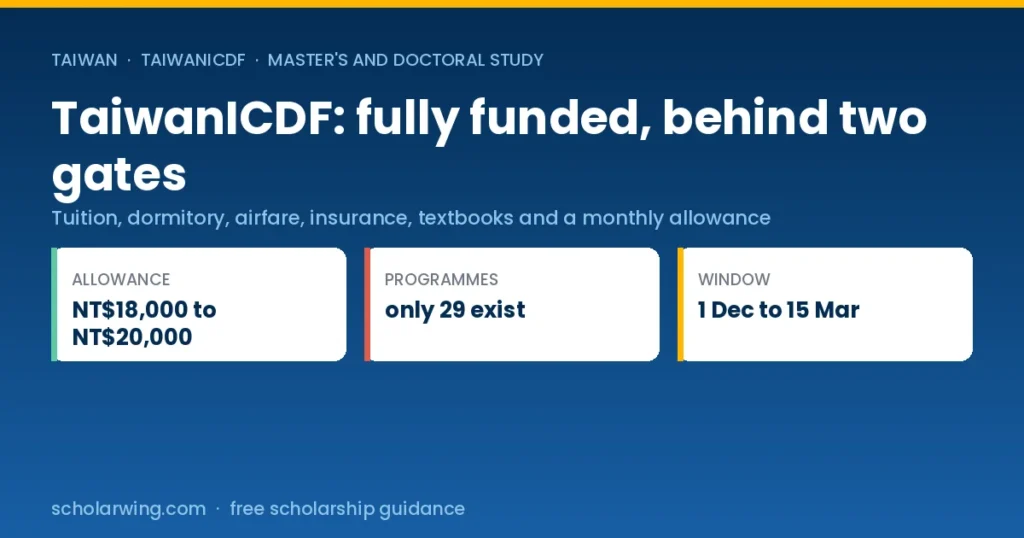
The TaiwanICDF International Higher Education Scholarship pays for a master’s or a doctorate in Taiwan, and it pays for all of it. Tuition, housing, return airfare, insurance, textbooks and a monthly allowance.
Applications open on 1 December each year and close on 15 March.
Most posts about it stop there, and that is where the trouble starts. Two gates decide this scholarship long before anybody reads your statement, and neither one has anything to do with how good you are.
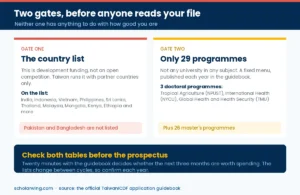
Gate one: your country must be on the list
TaiwanICDF is development funding, not an open international competition. Taiwan runs it with partner countries, and if your passport is not on that list, nothing else matters.
The published list spans Asia Pacific, West Asia, Africa, the Caribbean, Central and South America, and Europe. India, Indonesia, Vietnam, the Philippines, Sri Lanka, Thailand, Malaysia and Mongolia appear on it. So do Kenya, Ethiopia, Uganda, Tanzania, South Africa and a long list of Latin American and European countries.
Pakistan and Bangladesh do not appear on the published list.
We say that plainly because leaving it out would waste readers’ months. If you hold a Pakistani or Bangladeshi passport, open the current year’s guidebook and check the country table before you do anything else. The list changes between cycles, so confirm rather than taking our word or anybody else’s.
Gate two: only 29 programmes exist
This surprises nearly everybody. TaiwanICDF does not fund study at any Taiwanese university in any subject. It funds a fixed menu.
In the most recent published guidebook the menu held 29 programmes in total.
Three doctoral programmes. Tropical Agriculture at NPUST, International Health at NYCU, and Global Health and Health Security at TMU. That is the entire PhD offering.
Twenty-six master’s programmes, spread across engineering and science (nine), business and management (five), agriculture (three), public health and medicine (three), education (two), and four others.
So if you want a PhD in electrical engineering, or a master’s in law, this scholarship does not exist for you no matter how strong your record is. Read the programme table first. Everything else is wasted effort until you have found your own line in it.
What it covers
Once you pass both gates, the funding is genuinely complete.
- Round-trip economy airfare, on the most direct route
- Student dormitory housing, which is required rather than optional
- Tuition, credit fees and insurance, including the mandatory Ministry of Education policy
- Textbooks required by instructors, subject to approval
- A monthly allowance paid into a local bank account: NT$18,000 for a master’s, NT$20,000 for a PhD
Note the housing line. You live in the university dormitory; this is a condition, not a perk you can trade for a rent allowance.
How the application actually works
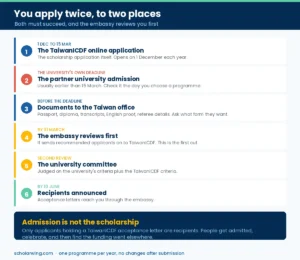
You apply twice, to two different places, and both must succeed.
One. The online TaiwanICDF application, between 1 December and 15 March.
Two. The partner university’s own admission application, by that university’s own deadline, which is usually earlier than 15 March. Check it the day you decide on a programme.
Three. Documents to the ROC (Taiwan) embassy, consulate or representative office in your country: passport or proof of nationality, your highest diploma and transcripts, proof of English proficiency unless English is an official language where you live, and referee details. Whether they want hard copies depends on the office, so ask them directly.
Four. The embassy reviews first and sends recommended applicants to TaiwanICDF by 31 March.
Five. The university’s academic committee reviews second, with TaiwanICDF.
Six. TaiwanICDF announces recipients, in principle by 10 June, and acceptance letters reach you through the embassy.
One line in the guidebook deserves repeating: university admission alone does not give you the scholarship. Only applicants holding a TaiwanICDF acceptance letter are recipients. People get admitted, celebrate, and then discover the funding went elsewhere.
Rules people break
One programme a year. You choose one, and you cannot change it after submission or after acceptance.
No deferral, no extension. If you need extra time to finish, you fund it yourself.
No stacking. You cannot hold another Taiwan government scholarship for the same academic year.
Your diploma must arrive by 31 July of the enrolment year. Finishing students should check their university can issue it in time.
Previous holders of a Taiwanese, MOFA Taiwan or MOE scholarship must have graduated before the stated cut-off to apply again.
Part-time work is allowed, within Taiwan’s employment law.
What to do before 1 December
Now. Find the current guidebook and check two tables: the eligible country list, and the 29 programmes. Those two checks take twenty minutes and decide whether the rest is worth doing.
If you pass both. Contact the ROC (Taiwan) embassy or representative office in your country and ask what they want and in what form. They are the first reviewer, and a office that knows your name before March is worth more than any polish on your statement.
November. Prepare your English proficiency proof, your transcripts and your diploma. Arrange referees. The SOP generator and CV reviewer will get your documents into shape, and the reference letter generator shows what a usable letter contains.
1 December. Apply on the first day, and check the university’s own admission deadline immediately, because it usually falls well before 15 March.
If the country list rules you out
For readers in Pakistan and Bangladesh in particular, this one most likely closes before it opens, and we would rather tell you now.
The fully funded routes that do take Pakistani and Bangladeshi applicants include the Chinese Government Scholarship through CSC, the fully funded year at Tsinghua through Schwarzman Scholars, the two-year master’s at Peking University through the Yenching Academy, and the CAS route we explained in our CAS-TWAS guide.
And for a funded doctorate with no country list at all, European universities employ doctoral researchers on salaries see the ORFeus network, DTU in Denmark and Örebro in Sweden.
Check the country list before the prospectus. Every time, for every scholarship.