
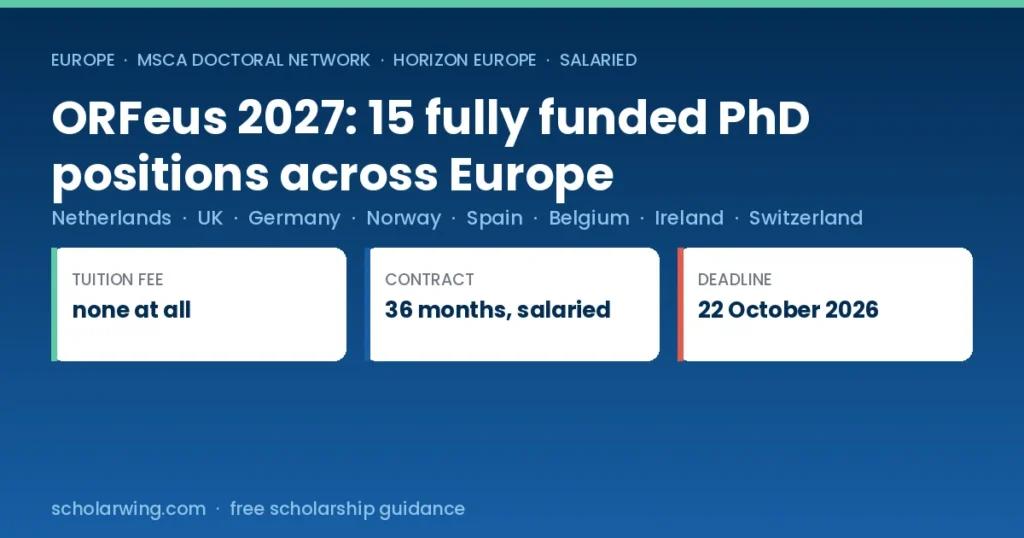
ORFeus Doctoral Network 2027: 15 Fully Funded PhD Positions Across Europe
A European research network has opened fifteen PhD positions, and the applications close on 22 October 2026 at 23:59 CET. The network is called ORFeus. It runs on Horizon Europe money under the Marie Skłodowska-Curie Actions, grant agreement 101309891.
Before the list, read one sentence, because it changes how you should think about PhD applications in Europe for the rest of your life.
There is no tuition fee, and the university pays you a salary.
Not a reduced fee. Not a fee waiver you have to win separately. No fee exists in the first place. You sign a full-time employment contract for 36 months. You get social security. And You get a living allowance adjusted for the cost of living in whichever country hosts you, plus a mobility allowance, plus a family allowance if you have dependants. The network pays for your travel to its training events and funds a three-month secondment with an industry partner.
The advert also states the eligibility line plainly: applicants of any nationality may apply. No cap on prior research experience either.
Why that sentence matters so much
Most students from Pakistan, India, Nigeria and Bangladesh learn about PhD funding through British adverts, and British adverts teach the wrong lesson.
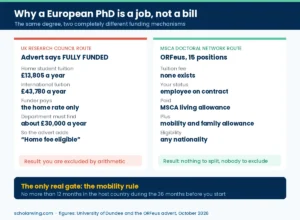
A UK medical PhD advert says FULLY FUNDED at the top. It lists a stipend. Then, most of the way down the page, it adds one line: available to applicants eligible for Home tuition fees.
That line does the damage. UK research councils cover tuition only at the home rate. At Dundee this year a PhD in Medicine Band 3 costs £13,805 for a home student and £43,780 for an international one. The funder pays £13,805. Somebody has to find the remaining £30,000, every year, for three or four years. Most departments cannot, so they write “Home fee eligible” into the advert and the problem goes away — along with you.
It has nothing to do with your grades. It is arithmetic.
Now look at what happens in the Netherlands, Germany, Norway or Sweden. A doctoral position there is a job, not a degree you buy. No home rate exists and no international rate exists, so there is nothing to split and nobody to exclude. That is the whole reason we keep pointing students at continental Europe. We wrote the UK side of this story in detail in our UK medical PhD funding guide, and the same mechanism shows up in our Karolinska doctoral positions post.
ORFeus is the clearest example of the pattern we have seen all year.
What the research is actually about
The network studies what biologists call the dark proteome.
Your genome contains thousands of very short open reading frames — smORFs — that make tiny proteins called microproteins. For decades the annotation software skipped them, because they looked too small to matter. They matter. They appear in cancer biology, in how bacteria infect us, and in which fragments the immune system displays on a cell surface. Several of them look like drug targets and several look like vaccine targets.
So the fifteen projects split into three groups.
Discovery and annotation — finding the microproteins in the first place. Machine learning to predict smORFs across species. Nanopore single-molecule translation mapping. Catching rare translation events. Microprotein behaviour during bacterial infection. Crosslinking mass spectrometry for secreted microproteins.
Function and regulation — working out what they do. Computational design of microprotein binders. lncRNA translation in human neurons. Evolutionary analysis of newly born genes. Single-cell translation measured after base editing. Thermal proteome profiling.
Cancer and immunology — turning the biology into medicine. smORF-derived antigens in HPV-driven cancer. Genetic variation inside smORFs. Stress-induced codon substitutions as neoepitopes. CRISPR screens for antigen presentation. HLA presentation of cryptic peptides.
The positions on the portal
Nine of the fifteen appear on the public recruitment portal with a named supervisor and a host institution. Here they are.
| Project | Supervisor | Host |
|---|---|---|
| AI-driven cross-species smORF prediction | Owen Rackham | University of Southampton, UK |
| Single-molecule translation mapping | Uwe Ohler | Max Delbrück Center, Berlin |
| Discovering rare proteins across the smORF landscape | Eivind Valen | University of Oslo |
| Microprotein interactions in bacterial infection | Jyoti Choudhary | Institute of Cancer Research, London |
| Secreted microproteins via bioorthogonal tagging and XL-MS | Simon Elsässer | University of Freiburg |
| Computational design of microprotein binders | Danny Sahtoe | Hubrecht Institute, Utrecht |
| smORF translation from lncRNAs | Julie Aspden | University of Leeds |
| Predicting microprotein function through evolution | Mar Alba | Hospital del Mar Research Institute, Barcelona |
| Single-cell translation after targeted base editing | Alexander van Oudenaarden | Hubrecht Institute, Utrecht |
The remaining six sit behind the portal’s own filters rather than on the landing page. The network advert says fourteen host institutions take part, spread across the Netherlands, the United Kingdom, Germany, Belgium, Ireland, Spain, Norway and Switzerland, and that the Princess Máxima Center in Utrecht coordinates the whole thing. So open the portal and run its location filter before you decide nothing fits you.
A note on two British entries. Southampton and Leeds appear in this list, and both are in the UK. They do not carry the home-fee restriction, because the money comes from Horizon Europe under MSCA rules rather than from a UK research council. This is the one route into a British PhD that bypasses the problem described earlier.
Who can apply
You need a master’s degree, or an equivalent qualification, in molecular biology, biochemistry, genetics, bioinformatics, computational biology, computer science, immunology or a near neighbour. You must be able to enrol in the host’s doctoral programme. If you have not finished the master’s yet, you can still apply as long as you hold the degree before the start date.
You must not already hold a doctorate.
Then there is the rule that disqualifies more applicants than any other, and almost nobody reads it.
The mobility rule, explained properly
In the 36 months before your recruitment date, you must not have lived or carried out your main activity in the host country for more than 12 months.
Main activity means work or study. Holidays do not count. Conferences do not count. Language courses do not count. Compulsory national service does not count. Time spent in a refugee status procedure does not count.
The rule applies per project, not per network. So if you did a two-year master’s in Germany, the Max Delbrück and Freiburg projects are closed to you, while Oslo, Utrecht, Barcelona, Southampton and Leeds remain open. Read the rule against each project separately.
If you are applying straight from Pakistan, India, Nigeria or Bangladesh, you almost certainly pass it everywhere.
One detail worth flagging: the portal’s eligibility section names the Netherlands, while its own FAQ refers to the host institution’s country. Those two statements do not say the same thing. Check the specific advert, and if it still reads ambiguously, email the contact on that advert and ask. We would rather you send one short email than lose a year.
What the contract gives you
- 36 months, full time, possible extension depending on the host’s rules
- MSCA living allowance, adjusted by the host country’s correction coefficient
- Mobility allowance, and a family allowance if it applies to you
- Full social security under MSCA conditions
- Enrolment in a doctoral programme at the host institution
- A secondment of roughly three months with an industry or research partner
- Network-wide training, with travel and accommodation paid
The portal does not publish a euro figure, and we will not invent one. MSCA rates change by call and by country, so read the number on the advert you apply to.
Positions start around March 2027.
How to apply without wasting the two weeks
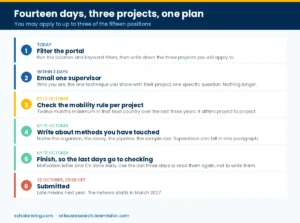
You may apply to up to three projects. That limit is a gift, and most applicants misuse it.
Do not send the same application three times. Read all fifteen project descriptions, then shortlist by one test: which methods have your own hands actually touched? If you have run Python over sequencing data, Southampton, Oslo and the base-editing project are yours to argue for. If you have done mass spectrometry, the Choudhary and Elsässer projects are. And If you have worked on HLA or antigen presentation, the cancer-immunology group is where you belong.
Then write about that work specifically. Name the organism, the assay, the pipeline, the sample size. A supervisor reading forty applications can tell in one paragraph whether you have done the thing or only read about it.
Three practical moves for the next fourteen days:
Today. Open the portal, run the location and keyword filters, and write down the three projects you will apply to and why.
Within three days. Email the supervisor of your first choice. Keep it short — who you are, the one technique you share with their project, one specific question about the work. Our email reviewer will tell you what a professor deletes in four seconds.
By 19 October. Have the motivation letter and CV finished, so the last three days go to checking rather than writing. The SOP generator and the CV reviewer exist for exactly this stage.
Apply here: orfeusresearch.teamtailor.com
The bigger lesson
ORFeus closes on 22 October and then it is gone. The pattern behind it does not close.
Every year, networks like this one open across Europe under the same MSCA rules — salaried, fee-free, open to any nationality, with a mobility rule as the only real gate. Students who understand that apply to them. Students who only read British adverts spend their twenties convinced that a funded PhD abroad was never meant for them.
It was. Learn the mechanism once and you will see these positions everywhere.