
Funded PhD Positions in Sweden: 16 Open Now at Karolinska Institutet
Karolinska Institutet currently advertises sixteen funded doctoral positions, and every one of them closes this month.
Before the list, one sentence that decides whether any of this applies to you, and it is the opposite of what most scholarship advice assumes:
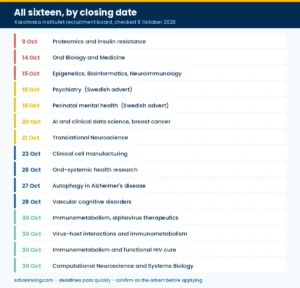
In Sweden, a PhD is a job. Sweden’s own national study portal puts it plainly — “When you apply for a PhD programme in Sweden, you’re actually applying for a job” — and describes doctoral study there as carrying “no tuition fees, no scholarships” and a monthly salary instead.
You are not applying for funding. You are applying for employment. That difference is why these positions are open to applicants from Pakistan, Nigeria, India, Bangladesh and everywhere else, with no fee barrier anywhere in the process.
How a Swedish doctoral position actually works
Karolinska employs you on a contract. Its own staff pages describe the doctoral studentship as a full-time post. Part-time is possible at the student’s request, but never below 50 per cent.
You draw a salary, which a local collective agreement sets rather than a scholarship committee.
You accrue real employment benefits. Vacation, parental leave under Swedish law, sick pay — Karolinska pays your salary for the first fourteen days of illness and the national insurance office takes over from day fifteen — and, importantly, pensionable income. A stipend gives you none of that.
The contract runs in renewable blocks. The first appointment lasts a maximum of one year, renewals run up to two years at a time, and total employment may not exceed the equivalent of four years of full-time doctoral education, with extensions allowed for illness, parental leave and similar grounds.
Up to 20 per cent of your post can go to teaching or departmental duties, and when it does, the appointment extends by the same amount of time. So departmental work lengthens your contract rather than eating your research.
There is no tuition fee at doctoral level. Sweden charges tuition to non-EU students at bachelor’s and master’s level, which confuses a lot of applicants. Doctoral positions sit outside that entirely, because they are employment.
Why this matters more than it sounds
Compare it with Britain, where most medical PhD funding fails international applicants for a structural reason rather than an academic one.
UK research council studentships pay tuition only at the home fee rate. The difference between the home rate and the international rate — often £25,000 to £38,000 a year — has to come from the department, a co-funder or the student. Most departments cannot find it, so the advert says Home fee eligible and the application ends there. We explain the whole mechanism in our guide to why “fully funded” UK medical PhDs reject international students.
In Sweden that arithmetic does not exist. No home rate, no international rate, nothing for anybody to find.
The same holds in Germany, where the Cologne Graduate School of Ageing Research is currently advertising fully funded doctoral positions on exactly the same employment basis.
The sixteen positions, by deadline
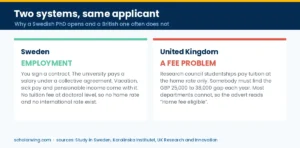
Verified on Karolinska’s recruitment board on 8 October 2026. Deadlines pass quickly and the board changes weekly, so confirm each one on the advert before you apply.
| Closes | Position | Department |
|---|---|---|
| 9 Oct | Proteomics and insulin resistance in metabolic disease | Microbiology, Tumor and Cell Biology |
| 14 Oct | Oral Biology and Medicine | Odontology |
| 15 Oct | Epigenetics, Bioinformatics and Neuroimmunology | Clinical Neuroscience |
| 18 Oct | Psychiatry (advert in Swedish) | Clinical Neuroscience |
| 19 Oct | Perinatal mental health (advert in Swedish) | Institute of Environmental Medicine |
| 20 Oct | AI and clinical data science for breast cancer | Oncology-Pathology |
| 21 Oct | Translational Neuroscience | Physiology and Pharmacology |
| 23 Oct | Clinical cell manufacturing | Laboratory Medicine |
| 26 Oct | Oral-systemic health research | Odontology |
| 27 Oct | Translational neuroscience: autophagy in Alzheimer’s disease | Clinical Neuroscience |
| 28 Oct | Vascular cognitive disorders | Neurobiology, Care Sciences and Society |
| 30 Oct | Immunometabolism for alphavirus therapeutics | Laboratory Medicine |
| 30 Oct | Virus-host interactions and immunometabolism | Laboratory Medicine |
| 30 Oct | Immunometabolism and functional HIV cure | Laboratory Medicine |
| 30 Oct | Computational Neuroscience and Systems Biology | Neuroscience |
One worth singling out, because it suits a different profile from the rest: the AI and clinical data science for breast cancer position sits in the Computational Breast Imaging Group under Associate Professor Fredrik Strand, and asks for solid Python together with machine learning or image analysis experience. It closes on 20 October, and there is one place.
Three of the adverts appear in Swedish. Karolinska normally accepts applications in English, but check the advert rather than assuming.
What you need
A master’s degree, or at least 240 credits of which 60 sit at advanced level, or knowledge Karolinska judges substantially equivalent.
English at the required level, equivalent to English B or English 6 in the Swedish upper secondary system.
The specific skills each advert names. This is the part that decides outcomes. The AI position wants Python and machine learning; the laboratory positions want bench techniques. A generic application to a technique-specific post goes nowhere.
Documents, typically a personal letter and CV, your degree project and any publications, and documentation certifying both general and specific eligibility.
How to apply well
Pick one or two, not sixteen. Supervisors spot an application that came from somebody else’s advert, and applying to four positions in one department does more harm than good.
Write about methods, not adjectives. Name the techniques you have actually run, the systems you have worked in, and a result — including one that failed and what you changed. That reads as a researcher. “Hardworking and passionate” reads as nothing.
Write to the named contact before you apply, with one short, specific question about the project. Most applicants never do, and a supervisor who has already replied to you reads your application differently. Our free email reviewer checks that message before a professor sees it.
Get the CV right. European academic CVs carry no photograph, no date of birth and no marital status. Our free CV reviewer goes through yours line by line and tells you what to fix, cut and add.
Both tools are free, need no account, and sit with the rest on our free tools page.
Frequently asked questions
Are Karolinska PhD positions really fully funded?
They work as salaried posts. You receive a monthly salary under a collective agreement, employment benefits and pensionable income, and you pay no tuition fee.
Do international students pay tuition for a PhD in Sweden?
No. Sweden charges tuition to non-EU students at bachelor’s and master’s level, but doctoral positions are employment and carry no fee.
Is there a nationality restriction?
The adverts set none. Eligibility runs on your degree, your English and the skills the project needs.
How long is the contract?
The first appointment lasts up to one year, renewals up to two years at a time, and total employment may not exceed the equivalent of four years of full-time doctoral study, with extensions for illness, parental leave and similar.
Will I have to teach?
Up to 20 per cent of the post can go to teaching or departmental duties, and the appointment extends by the same period when it does.
Do I need to speak Swedish?
Not for the research. Some adverts appear in Swedish, and Karolinska normally accepts applications in English, but confirm on the advert.
Do I need IELTS?
Karolinska sets its own English requirement, and several qualifications satisfy it. Where a medium of instruction letter applies to your case, our free MOI generator produces the request letter for your registrar.
What if these deadlines have passed by the time I read this?
Karolinska advertises doctoral positions continuously on its recruitment board, and new ones appear most weeks. The mechanism described above does not change; only the dates do.
What to do today
Open the board, read the two or three adverts closest to your own training, and check their exact requirements. Then write to the named contact with one specific question about the project, and start your application with the deadline written at the top of the page.
For the wider picture of where funded doctoral study is genuinely open to international applicants, read our guide to UK medical PhD funding alongside the Cologne ageing research positions in Germany.
We checked every statement in this post against Study in Sweden and Karolinska Institutet’s own staff and recruitment pages on 8 October 2026. The vacancy list reflects that date; Karolinska’s board changes weekly, so confirm any position on its own advert before applying. If you find something here that no longer matches the official page, write to us at scholarwingofficial@gmail.com and we will correct it.
Sources: Study in Sweden, PhD programmes · Karolinska Institutet, Employment as a doctoral student · Karolinska Institutet doctoral recruitment board