
12 Fully Funded PhD Positions in Germany 2027: Cologne Ageing Research
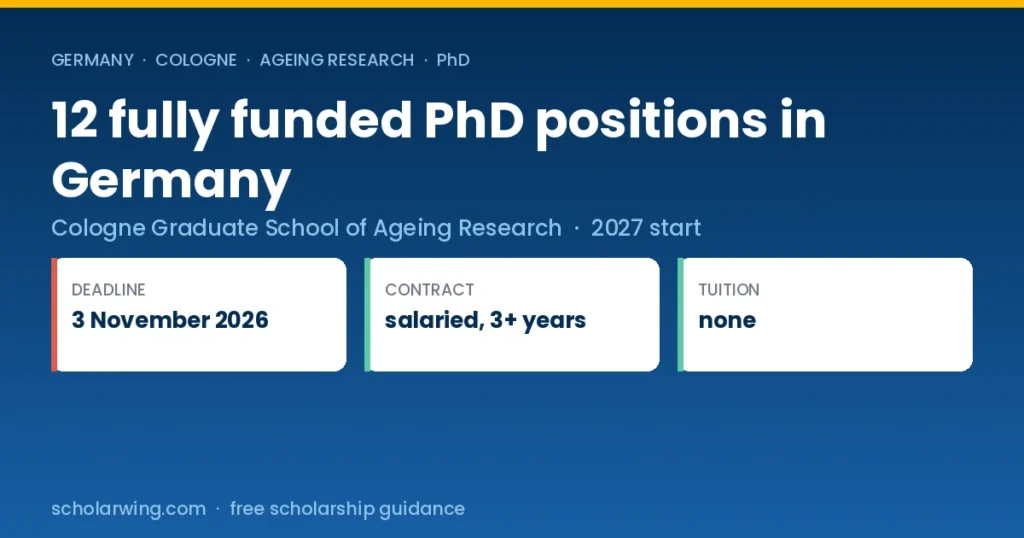
The Cologne Graduate School of Ageing Research is offering up to 12 fully funded PhD positions starting in 2027, and the application window closes on 3 November 2026.
Read one line carefully before anything else, because it is the part that separates this from most of what gets advertised as a scholarship:
These are work contracts, not stipends. You sign an employment contract with a German research institution, you receive a salary with social security and health insurance, and the contract runs for at least three years from the start. Germany’s public universities charge no tuition fees, so there is no fee gap for anyone to cover and no home rate to exclude you.
If you have read our guide to why “fully funded” UK medical PhDs reject international students, this is the alternative that guide points towards.
Who is actually offering this
The Cologne Graduate School of Ageing Research is a joint venture between four serious institutions:
- the University of Cologne Excellence Cluster CECAD
- the University Hospital of Cologne
- the Max Planck Institute for Biology of Ageing
- the Max Planck Institute for Metabolism Research
Together they run 49 interdisciplinary research groups. That matters more than the name on the advert, because it tells you how wide your choice of supervisor and project will be once you are in.
The programme runs entirely in English.
What you get
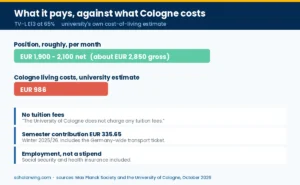
A salaried contract of at least three years. Pay follows the German public sector scale, TV-L E13 at 65 per cent, or an equivalently paid Max Planck Society PhD support contract.
In practice, a full-time E13 position pays roughly €4,388 a month gross for a single person, so a 65 per cent position comes to around €2,850 gross. What reaches your account depends on your tax class and deductions, and usually lands somewhere near €1,900 to €2,100 a month.
Set that against the University of Cologne’s own estimate of student living costs: about €986 a month, covering rent at €442, food at €200, health insurance at €120, and the rest. The position pays roughly double what the university expects you to spend.
No tuition fees. Cologne states it plainly: “The University of Cologne does not charge any tuition fees.” You pay only the semester contribution, €335.65 for winter semester 2025/26, and that includes your public transport ticket for Germany and student services.
Annual conference travel grants come with the position.
Social security and health insurance, because this is employment rather than a scholarship. That difference matters for your visa, your residence permit and your pension record.
Who can apply
A master’s degree — an MSc or equivalent in Biology, Cell or Molecular Biology, Biochemistry, Bioengineering, Bioinformatics, Biophysics, Genetics, Medical Biology, Translational Medicine, or a related field.
An excellent academic record at both bachelor’s and master’s level, together with a clear interest in ageing research. Say something specific about why ageing, not why Germany.
English at C1 level, written and spoken. The programme runs in English and the advert states this requirement directly.
The eligibility list sets no nationality restriction, which is the normal position for a German work contract. We still advise every applicant to confirm their own case on the application portal, because the advert does not address it either way.
The programme states that applications from people with disabilities receive preference where qualifications are equal, and that women are strongly encouraged to apply in areas where they are underrepresented.
Dates
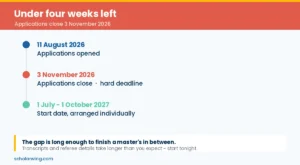
Applications open: 11 August 2026 Applications close: 3 November 2026 Start date: individually arranged, between 1 July and 1 October 2027
Two things follow from that calendar. You have under four weeks, so the work starts tonight rather than next week. And the gap between the deadline and the start is long enough that you can finish a master’s in between, which is why the programme accepts applicants who are close to completing one.
How to apply
Applications go through the programme’s own portal at application.ageing-grad-school.de. Questions go to the coordination office at cga-coordination@uni-koeln.de.
The announcement does not list the required documents, so open the portal first and read its checklist before writing anything. German programmes commonly ask for a CV, transcripts, a motivation letter, and the contact details of referees, and some want a short research statement.
Three things worth getting right.
Your CV. German academic CVs are plain, factual and reverse-chronological, with no photograph needed for a research position and no personal details beyond contact information. Our free CV reviewer checks yours line by line and tells you exactly what to fix, remove or add.
Your motivation letter. Write about ageing research specifically — a mechanism, a question, a paper that caught you — rather than about your ambition to study abroad. Forty-nine research groups means the committee is reading for where you would fit. Our personal statement generator helps you structure it, though the substance has to be yours.
Any email you send the coordination office. Keep it short and ask one clear question. Our email reviewer checks it before a coordinator ever sees it.
An honest word on your odds
“Up to 12” means twelve at most, not twelve guaranteed. Graduate schools attached to Max Planck institutes draw applications from everywhere, and the standard is high.
That said, this competition is a different shape from a scholarship competition. Nobody is comparing your financial need or counting your leadership activities. The committee is asking one question: would this person do good science in one of our labs? Your master’s work, your methods, and your ability to talk about a research question carry the decision.
So write the application a scientist would write. Name techniques you have actually used. Describe a result, including one that did not work and what you changed. That reads as a researcher; a list of adjectives does not.
Why Germany keeps coming up in our guides
This position is a clean example of a pattern worth understanding, because it will shape where you apply for years.
Across much of continental Europe — Germany, the Netherlands, Belgium, Sweden, Denmark, Austria — a PhD is a job. The institution employs you, pays you a salary, and charges no meaningful tuition. There is no domestic fee and no international fee, so the arithmetic that closes British and American doors to international applicants never arises.
That is why a student from Pakistan, Nigeria, India or Bangladesh working in a medical or biological field often has better odds in Germany than in Britain, with no scholarship application anywhere in the process.
The place to watch for more of these is EURAXESS, the European Commission’s own research jobs portal, where institutions post vacancies directly. Filter by research field and job type, and check it weekly.
What to do tonight
Open the portal, read the document checklist, and write down what you are missing. Transcripts and reference contacts take longer to gather than anyone expects, and you have under four weeks.
Then run your CV through our free CV reviewer and fix what it flags. Every tool on our free tools page costs nothing and needs no account.
We checked every figure in this post against the Max Planck Society’s own announcement and the University of Cologne’s published costs on 8 October 2026. Salary scales change each year and semester contributions change each semester — confirm the current figures on the programme’s portal before you rely on them. If you find something here that no longer matches the official page, write to us at scholarwingofficial@gmail.com and we will correct it.
Sources: Max Planck Society announcement of the Cologne Graduate School of Ageing Research positions · University of Cologne, Costs and Financing · German TV-L public sector pay scale