
The Nanyang Global Scholarship at NTU, and the Three-Year Bond Nobody Mentions
Nanyang Technological University runs one of the most generous undergraduate awards in Asia, and it carries no nationality restriction at all. Students from Pakistan, India, Nigeria and Bangladesh compete on the same terms as everyone else.
NTU calls it the Nanyang Global Scholarship. Most posts call it the Nanyang Scholarship, which is why so many people search for it and find nothing on NTU’s own site.
The money is real. So is a commitment that comes attached, and almost nobody writes about it.
What it covers
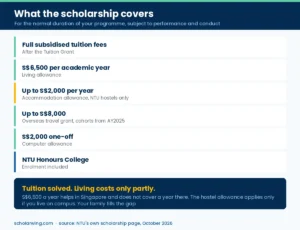
- Full subsidized tuition fees, after the Tuition Grant
- A living allowance of S$6,500 per academic year
- An accommodation allowance of up to S$2,000 a year, for students living in NTU hostels only
- An overseas travel grant of up to S$8,000, under the Travel Grant Form terms, for cohorts from AY2025
- A one-off computer allowance of S$2,000
- Enrolment in the NTU Honors College
It runs for the normal duration of your programme, conditional on good academic performance and conduct.
Be clear-eyed about the living allowance. S$6,500 a year in Singapore helps, and it does not cover a year of living there. Add the hostel allowance, which only applies if you live on campus, and you still have a gap your family fills. This award solves tuition completely and living costs partially.
The three-year bond
Here is the sentence that should shape your decision.
NTU states that the scholarship carries no bond beyond the three-year bond that applies to all Singapore permanent residents and international students under the MOE Tuition Grant Scheme.
Read it twice, because the phrasing hides the size of it. The scholarship adds no bond of its own, but the Tuition Grant underneath it does, and every international student who takes that grant takes the bond with it.
In plain terms: accepting subsidized Singaporean tuition commits you to working for a Singapore-registered company for three years after you graduate.
For many students that is a benefit rather than a cost. A guaranteed route into the Singapore job market, in a country where graduate salaries are high, is something people pay consultants for.
But if your plan is to return home immediately after your degree, or to move on to a master’s in Europe or North America, you need to understand this before you accept, not after. Check the current terms of the Tuition Grant Scheme on the Ministry of Education’s own site, because the scheme governs it, not NTU.
This is the honest version of Singaporean funding. Compare it with the European model, where a doctorate is salaried employment with no obligation attached, as in our DTU Denmark post, or with SINGA, Singapore’s own fully funded PhD route, which works on an entirely different basis.
Who they are looking for
Outstanding results in A-Levels, a Singapore polytechnic diploma, the NUS High School Diploma, the IB Diploma, or a Year 12 equivalent. That last category is where most Pakistani and Indian applicants sit, with HSSC, intermediate or equivalent qualifications.
Excellent co-curricular records, and strong leadership qualities and potential.
Note the weighting. Grades get you considered. The co-curricular record and leadership evidence decide it, which is why the application asks what it asks.
How to apply, in the right order
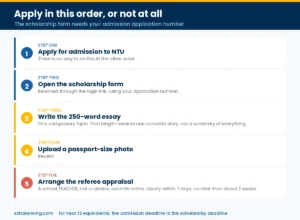
One. Apply for admission to NTU first. The scholarship form needs your application number, so there is no way to do this in the other order.
Two. Complete the scholarship form, reached through the login link using that application number. It contains a personal essay of up to 250 words on one compulsory topic.
Two hundred and fifty words is very short. It rewards a single concrete story told properly far more than a summary of everything you have ever done. The SOP generator will help you cut to one.
Three. Upload a recent passport-size photograph.
Four. Arrange the referee appraisal. A school teacher submits it online not a family member or relative. NTU asks for this ideally within 7 days of your application and no later than around 2 weeks.
That window is tight, and it is the most common reason an otherwise strong application stalls. Speak to your teacher before you submit, not after.
Deadlines and interviews
NTU does not publish a single scholarship deadline. The dates follow your qualification.
For Year 12 equivalents. the category most of our readers fall into, the closing date is the admission application closing date for that qualification. So the admission deadline is your scholarship deadline. Find it on NTU’s admissions page for your qualification and work backwards from there.
Interviews. For A-Level, polytechnic diploma, NUS High School Diploma and IB applicants, interviews run March to May, with shortlisted applicants emailed by mid-May. For Year 12 equivalents, interviews happen within two months of your NTU offer, and shortlisted applicants hear within a month of the offer.
Check your email daily during those windows. People miss interview invitations.
If you receive an offer for Medicine or the Renaissance Engineering Programme, NTU directs you to check the scholarship outcome with your school rather than through the usual route.
The conditions that follow you
The award is not unconditional once granted:
- A minimum CGPA of 3.5 out of 5.0, reviewed every semester
- No other scholarships, bursaries, university loans or awards at the same time, without University approval
- You take on a student ambassador or similar role when asked
- NTU can withdraw it for unsatisfactory progress or behavior
- Ending it early requires repayment
That CGPA threshold deserves a moment. Reviewed every semester means one bad semester puts the award at risk, in a system and a language that may both be new to you. Plan your first year accordingly.
Worth it?
For a student who wants a strong engineering, science or business degree in Asia, and who is open to starting their career in Singapore, this is among the best offers available anywhere, and the open eligibility makes it genuinely winnable.
For a student who plans to study further abroad straight afterwards, the bond is a real constraint rather than a footnote.
Decide on that question first. Everything else in the application follows from it.