
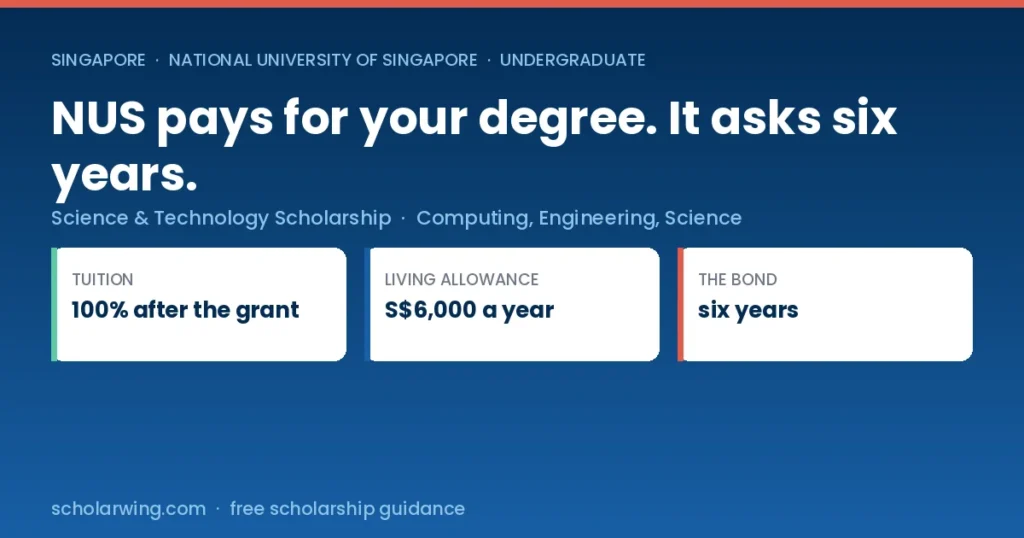
The NUS Science & Technology Scholarship: Six Years, and Why That Number Matters
The National University of Singapore runs a freshmen scholarship that covers tuition completely, adds a yearly living allowance, pays your accommodation and flies you in. Students from Pakistan, India and Bangladesh qualify.
It also carries a six-year bond, and that number is the whole decision.
Let me set out what it gives first, then what it asks.
Who can apply
Three conditions sit at the front, and the first one rules out a lot of people who share this award.
You must be a citizen of an Asian country or region, excluding Singapore. This is not an open international scholarship. Applicants from Africa, Latin America or Europe fall outside it entirely. Pakistani, Indian, Bangladeshi, Sri Lankan and Nepali students qualify.
You must apply to an eligible programme. Computing, Engineering or Science, with exclusions. Infrastructure and Project Management is out on the engineering side. Environmental Studies and Pharmacy are out on the science side.
The eligible list includes Computer Science, Artificial Intelligence, Business Analytics and Information Security at the School of Computing; Electrical, Mechanical, Chemical and other engineering majors at the College of Design and Engineering; Computer Engineering across both; and Physics, Mathematics, Chemistry, Life Sciences, Data Science and Analytics and Statistics at the College of Humanities and Sciences. Local double-degree programmes count if the home programme sits on the list.
You must be a freshman. Transfer applicants from local or overseas universities cannot apply.
Beyond that: outstanding high school results, an excellent co-curricular record, and strong leadership potential.
What it covers
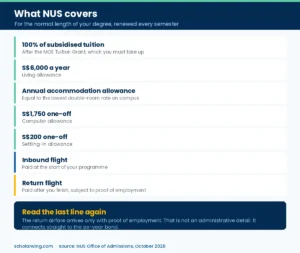
- 100% of subsidized undergraduate tuition, after the MOE Tuition Grant, which recipients must take up
- A living allowance of S$6,000 a year
- An annual accommodation allowance equal to the lowest double-room rate for on-campus housing
- A one-time computer allowance of S$1,750
- A one-time settling-in allowance of S$200
- Travel allowance for your inbound flight at the start, and the return flight after you finish
Note that last line carefully. The return airfare depends on proof of employment, which connects directly to the bond below.
The award runs for the normal length of your degree, renewed each semester.
The six-year bond
Recipients serve six years with a Singapore-registered company immediately after graduation.
Six years, not three. For a four-year engineering degree, that means ten years of your life committed to Singapore from the day you arrive.
I am not saying that to frighten anyone. For a student who wants to build a career in Singaporean tech, finance or engineering, this is an extraordinary deal: a world-ranked degree paid for, and a guaranteed six-year runway in one of Asia’s strongest job markets. People spend a great deal of money chasing exactly that.
But say it plainly to yourself before you accept. If your plan involves a master’s in Europe at 23, or returning home to family obligations, or any career that is not in Singapore, this award does not fit that plan, and no amount of prestige changes the arithmetic.
Check the current terms on NUS’s own page before you sign anything, because bond conditions get revised.
NUS or NTU?
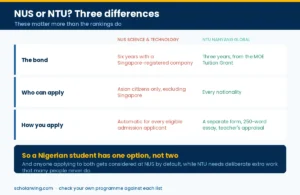
Most students considering this are also looking at NTU’s Nanyang Global Scholarship. They differ in three ways that matter more than the universities’ rankings.
The bond. NUS Science & Technology: six years. NTU Nan yang Global: three years, and that three-year obligation comes from the MOE Tuition Grant rather than from the scholarship itself.
Who can apply. NUS: Asian citizens only, excluding Singapore. NTU: every nationality.
How you apply. NUS considers every eligible admission applicant automatically. NTU requires a separate scholarship form, a 250-word essay and a teacher’s referee appraisal.
So a Nigerian student has one option, not two. And a student who applies to both universities gets considered at NUS by default, while an NTU application needs deliberate extra work that many people never do.
How you apply, and why that matters
There is no separate application form. NUS considers every eligible student who applies for undergraduate admission.
That sounds convenient, and it has a hidden consequence: your admission application is your scholarship application. The co-curricular record and leadership evidence you put into it carry the scholarship decision too, so do not treat those sections as padding.
Selection interviews run January to July, by email invitation. NUS announces outcomes by mid-July. Check your email through that window; people miss invitations.
NUS states that it may award nothing at all if no candidate reaches the required standard, and that decisions are final.
NUS does not publish a scholarship deadline on this page. The admission deadline is your deadline find it on the NUS admissions dates page for your qualification.
The conditions after you win
- GPA of at least 3.50 or equivalent, plus good conduct. NUS renews it each semester
- No other scholarship, fellowship, bursary, grant, award or allowance at the same time, apart from the MOE Tuition Grant
- You must earn at least 75% of your graduation credits in Singapore, so overseas exchange is capped at a quarter of your degree, and any overseas programme must finish before September of the year before you graduate
- Early withdrawal may require repaying everything disbursed
That 75% rule surprises people. If a year abroad was part of why Singapore appealed to you, read it again.
The honest summary
A fully funded science, computing or engineering degree at a university ranked among the world’s best, with living costs partly covered and no separate form to submit. For the right student that is close to unbeatable.
The right student is one who intends to work in Singapore afterwards. Everything in this award follows that assumption, from the six-year bond to the return airfare that only arrives with proof of employment.
Decide that question honestly first. If the answer is yes, apply to NUS and treat your admission application as the scholarship application it actually is. If the answer is no, look at SINGA for postgraduate study, or at the European route where a doctorate is salaried employment with no obligation attached our DTU Denmark post and ORFeus guide set that out.