
SINGA Singapore: A Fully Funded PhD You Apply To Twice a Year, and One Rule Everyone Misses
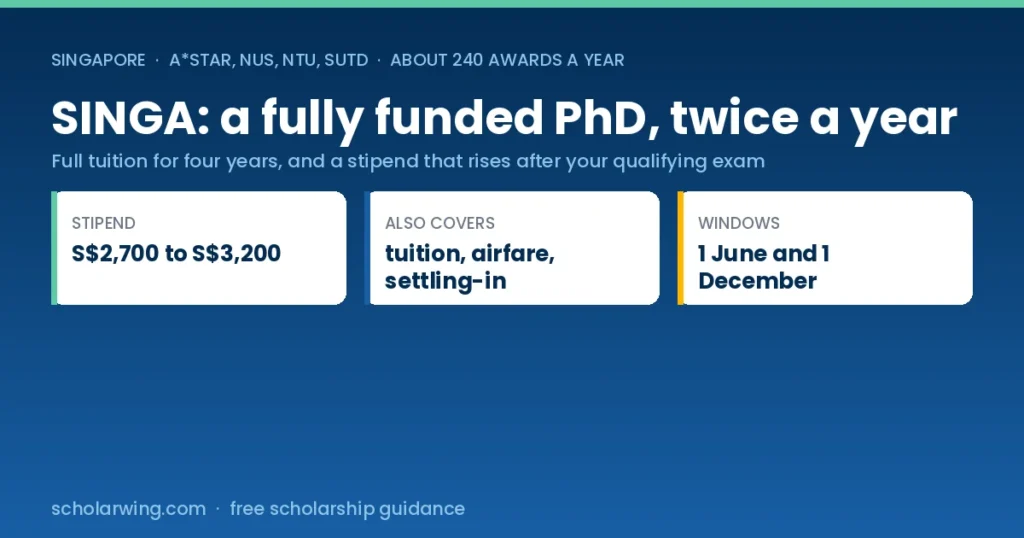
The Singapore International Graduate Award pays full tuition for four years and puts a monthly salary in your account while you do a PhD at A*STAR, NUS, NTU or SUTD. Roughly 240 awards go out each year.
It also runs on a structure almost nobody explains properly, and getting that structure wrong is the single most common reason strong applicants fail.
Two windows, two intakes
SINGE does not have one annual deadline. It has two, running back to back.
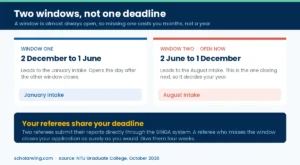
- 2 December to 1 June: leads to the January intake
- 2 June to 1 December: leads to the August intake
That means a window is almost always open, and it also means the window closing on 1 December is open as you read this.
If you miss one, the next opens the following day. Nothing is lost for a year, which is unusual and worth knowing before you panic.
What it pays
- Full tuition for four years
- S$2,700 a month, rising by S$500 to S$3,200 a month once you pass the PhD qualifying examination, usually twelve to eighteen months in
- A one-time settling-in allowance of S$1,000
- A one-time airfare grant of up to S$1,500
Four years of stipend and top-up. Your family contributes nothing.
The rule everyone misses: SINGA funds projects, not students
This is the part that decides applications.
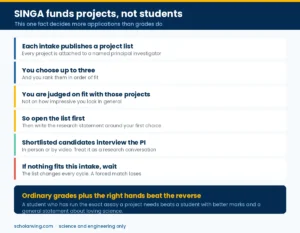
SINGA is not a general PhD fund that you win and then take to a supervisor. Each intake publishes a list of specific research projects, each attached to a principal investigator. You read that list, choose up to three projects, and rank them.
The consequence follows directly. Your application is judged on fit with those projects, not on how impressive you are in the abstract. A student with excellent grades who writes a general research statement about their passion for science loses to a student with ordinary grades who can show they have run the exact assay the project needs.
So the order of work runs backwards from what most people do. Open the project list first. Find the two or three projects where your own hands have touched the methods. Then write everything around those.
If no project fits you this intake, wait for the next list rather than forcing a weak match. The list changes every cycle.
Who cannot apply
Singapore citizens and permanent residents fall outside the scheme, which is the point of it.
Graduates of Singaporean institutions are also excluded under the published terms. If you did your bachelor’s or master’s in Singapore, check this carefully before investing time.
Anyone outside science and engineering. SINGA covers biomedical sciences, physical sciences, engineering and computing. It does not fund business, law, humanities, social sciences or education. No amount of strength elsewhere changes that.
What you actually need
A bachelor’s degree in science, engineering or a related field, with strong results. A master’s helps and does not appear as a requirement.
Strong English. TOEFL or IELTS may be required depending on your background.
Two referees, who submit their reports through the SINGA system themselves. Give them four weeks. A referee who misses the window closes your application as surely as you missing it would.
Your documents: the application form, transcripts, degree certificates, your passport bio page, a CV, a research statement, English test scores where they apply, and a publications list if you have one.
How it runs after you submit
Shortlisted candidates interview with the principal investigators and host faculty, in person or by video. This follows from the project-based design. the person who would supervise you decides whether you fit the work.
Offers arrive in the months before the intake begins.
Prepare for that interview as a research conversation rather than a scholarship panel. Expect questions about the methods in your own thesis, and read two or three recent papers from the group whose project you ranked first.
Seven weeks, if you want the August intake
This week. Open the project list for this intake. Shortlist three projects by one test: which methods have you actually used? Our CV reviewer will show you what in your background is worth leading with.
Within a week. Ask your two referees, and tell them they submit directly through the system and that the deadline is theirs too. Our reference letter generator shows what a usable letter contains.
By mid-November. Write the research statement around your first-choice project. Name the technique, the organism or system, the equipment, the sample size. The SOP generator will structure it.
By 25 November. Submit, and check that both referee reports have landed.
If SINGA is not for you
The science-and-engineering limit rules out many readers, and the project-based design suits some people far better than others.
If you want a funded PhD where you negotiate directly with one supervisor rather than ranking a list, continental Europe employs doctoral researchers on salaries with no tuition fee at all see the ORFeus doctoral network, our DTU Denmark post, the Urban Future group at Bonn and Örebro in Sweden.
For Asia more broadly, the CSC China scholarship covers far more fields, and our CAS-TWAS guide explains the Chinese Academy of Sciences route.
One habit carries across all of them. Read what the funder is actually buying. SINGA buys progress on named projects. Europe buys an employee. China’s government scholarships buy a graduate. Match yourself to what they want, and the application writes itself.