
A Funded PhD in Amsterdam on Head Injury and Dementia, Where 1 December Is Not the Real Deadline
The Netherlands Institute for Neuroscience is recruiting a PhD student to work on why repeated head injuries lead to dementia. The advert lists 1 December 2026 as the closing date.
Read the next line of that advert, because almost nobody who shares this does.
Evaluation of candidates starts immediately and continues until the position is filled.
That changes everything about your timing. The first of December is the last possible day, not the day decisions get made. A strong application arriving in late October competes against a handful of others. The same application arriving on 29 November may arrive after the group has already found someone.
Apply in the next two weeks or accept that you are gambling.
What the position pays
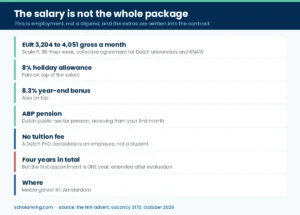
The salary runs €3,204 to €4,051 gross per month for a full-time 38-hour week, on scale P of the collective agreement for Dutch universities and KNAW.
But the salary is not the whole package, and this is where Dutch positions quietly beat the numbers people quote:
- 8% holiday allowance
- 8.3% year-end bonus
- Pension accrual with ABP, the Dutch public-sector pension fund
- Other allowances on top
There is no tuition fee, because a Dutch PhD candidate is an employee rather than a student. You build pension rights from your first month.
The contract structure: four years in total, but the first appointment runs for one year, with extension for the remaining three subject to evaluation. That is standard in the Netherlands. Know it before you move.
What the research actually is
Repeated mild head injuries — from contact sport, from falls, from work — raise the risk of memory decline and dementia years later. Why that happens at the level of individual cells remains largely unknown.
This project looks inside the hippocampus, the part of the brain that forms memories and one of the few regions where new neurons appear in adulthood. The focus sits on inflammation and neurogenesis: what microglia, astrocytes and immature neurons do after repeated injury.
The methods are the modern ones. Single-nucleus RNA sequencing of postmortem human brain tissue, and in vitro iPSC models.
The work runs in the Neurogenesis & Neurodegeneration group led by Dr Evgenia Salta at the Netherlands Institute for Neuroscience, which is part of the Royal Netherlands Academy of Arts and Sciences, together with Carlos Fitzsimons’s group at the Swammerdam Institute for Life Sciences, University of Amsterdam. The address is Meibergdreef 47 in Amsterdam.
Who they want, stated plainly
A master’s in biomedical sciences, neuroscience or a related field.
Then the line that decides most applications:
Hands-on experience with coding, omics analysis and single-cell transcriptomics is required.
Required, not preferred. If you have never analysed a single-cell dataset or written your own analysis scripts, this particular position will not work out, and reading that now saves you a week. iPSC cell culture experience counts as a plus rather than a requirement.
They also ask for excellent English, strong organisation, attention to detail, teamwork and persistence.
The advert carries no nationality restriction. European doctoral positions rarely do — the same pattern runs through our TU Delft post, DTU in Denmark and Örebro in Sweden.
What to send, and the four things people leave out
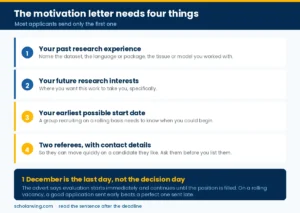
You submit a detailed CV and a motivation letter. The advert specifies exactly what that letter must contain, and most applicants supply only the first item:
- Your past research experience
- Your future research interests
- Your earliest possible start date
- The names and contact details of at least two referees
Items three and four look administrative and are not. A group recruiting on a rolling basis wants to know when you could start, and referee details let them move quickly on a candidate they like. Leaving those out marks you as someone who did not read the advert.
One more thing to expect: the institute may ask for a Certificate of Good Conduct during hiring. In Pakistan that is a police character certificate, and it takes time, so start finding out how to obtain yours now rather than after an offer.
Questions go to Dr E. Salta at e.salta@nin.knaw.nl.
Your two weeks
Today. Check the hard requirement honestly. Have you written analysis code and worked with single-cell data yourself? If not, look at the other positions in this series instead.
Tomorrow. Write the motivation letter with all four required elements. Name the dataset you analysed, the package or language you used, the tissue or model you worked with. The SOP generator will structure it and the CV reviewer will clean up the CV beside it.
Within three days. Ask your two referees before you list them. Our reference letter generator shows what a usable letter contains.
Within a week. Submit. On a rolling evaluation, a good application sent early beats a perfect one sent late.
If this one is not yours
The coding and single-cell requirement rules out many strong biologists, and that is simply what this group needs.
Keep the mechanism, which is not rare. Across the Netherlands, Denmark, Sweden and Germany, a doctorate is salaried employment with holiday pay, a year-end bonus and pension, and no tuition fee anywhere in it. We have written up four more live examples: the ORFeus doctoral network, TU Delft, DTU in Denmark and the Urban Future group at Bonn.
And one habit worth keeping from this post: read the sentence after the deadline. It often matters more than the date itself.