
A Salaried PhD at TU Delft, and the Contract Detail Nobody Shares
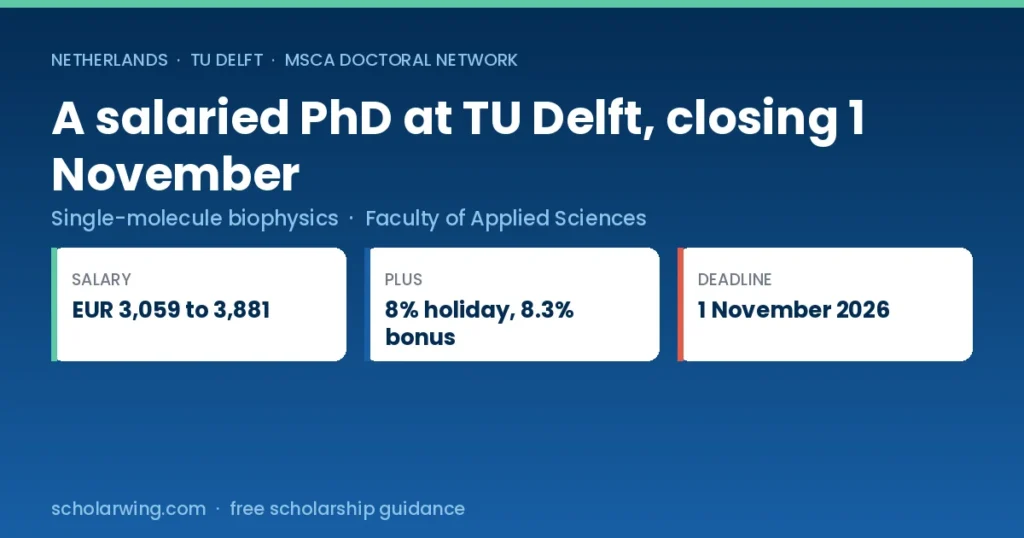
Delft University of Technology is recruiting a PhD in single-molecule biophysics, and applications close on 1 November 2026.
It pays €3,059 to €3,881 gross per month, rising from year one to year four under the collective agreement for Dutch universities, plus 8% holiday allowance and an 8.3% end-of-year bonus. There is no tuition fee, because Dutch doctoral candidates are employees rather than students.
The advert also contains two details that almost nobody repeats when they share this, and both change how you should approach it.
Detail one: four years, but in two contracts
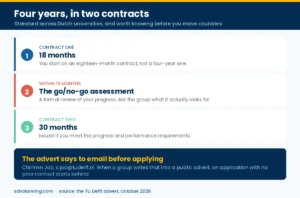
The position runs for four years in principle. In practice it arrives as two contracts.
First, an eighteen-month contract. Within fifteen months there is a formal go/no-go progress assessment.
Then, if you pass, a thirty-month contract for the rest.
This is standard across Dutch universities, and it is not a trap. But it means your first fifteen months carry a real decision point, and you should know that before you move continents. Ask in your first conversation with the group what that assessment actually looks for.
Detail two: the advert tells you to email first
The advert strongly recommends contacting Chirlmin Joo at c.joo@tudelft.nl before you apply.
Read that as an instruction rather than a courtesy. When a group writes that line into a public advert, an application that arrives with no prior contact starts behind the ones that did.
So the order of work is: email this week, apply next week. Not the reverse.
The mobility rule is the real gate
This position sits inside an EU-funded Marie Skłodowska-Curie Doctoral Network, under Horizon Europe — the project is called MORPHEOS, grant 101311970.
That funding brings the rule that decides eligibility more often than grades do:
At recruitment, you must not have lived or carried out your main activity — work or study — in the Netherlands for more than 12 months during the previous 36 months. This applies regardless of nationality.
Holidays do not count. Short courses do not count. If you are applying from Pakistan, India, Nigeria or Bangladesh and have never lived in the Netherlands, you pass it comfortably. If you did a master’s in Delft or Amsterdam, this specific position is closed to you, however strong you are.
The flip side of MSCA funding is the part worth remembering: no nationality restriction at all, and no tuition fee to find. We set out the same mechanism in our ORFeus doctoral network guide, and the contrast with Britain, where research councils pay only the home fee rate, in our UK medical PhD funding guide.
The research
You would use single-molecule fluorescence and biochemistry, combined with computational methods, to study protein–ligand and protein–peptide interactions. The work involves generating single-molecule multiplexing data and using it to validate machine learning predictions, with therapeutic applications pursued through international collaborators.
That pairing is the point. The group wants someone who can run the bench experiments and handle the computational side, not one or the other.
One honest flag. The MORPHEOS project title refers to neuromorphic fluidic circuits built from artificial ion channels, which does not obviously match the research described in the advert. It may be a separate work package inside the same network. Ask about it in your first email — it is a reasonable question and it shows you read past the headline.
What they ask for
- An MSc, or close to completion, in physics, biophysics, computational biology or a related field
- Strong Python and data analysis skills
- Familiarity with molecular biology techniques
- Excellent English
- The ability to work in a collaborative, international, interdisciplinary team
Applications go through the online form only. The advert states plainly that anything sent by email or post is not processed. You upload a CV and a motivation letter.
Your three weeks
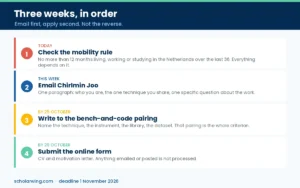
Today. Check the mobility rule against your own last three years. Everything else depends on it.
This week. Email Chirlmin Joo. One short paragraph: who you are, the one technique you share with the project — single-molecule imaging, Python analysis pipelines, protein biochemistry, whatever is genuinely yours — and one specific question about the work. Our email reviewer will tell you what gets deleted in four seconds.
By 25 October. Write the motivation letter around the bench-and-code pairing, because that pairing is the whole selection criterion. Name the technique, the instrument, the library, the dataset. The SOP generator will structure it and the CV reviewer will clean up the CV beside it.
By 29 October. Submit through the online form, two days early.
If this project is not yours
Most readers will not have single-molecule experience. The mechanism behind this position is not rare at all.
Across the Netherlands, Germany, Denmark, Sweden and Norway, a doctorate is salaried employment with no tuition fee and, usually, no nationality bar. We have written up four more live examples: the ORFeus network, DTU in Denmark, the Urban Future group at Bonn and Örebro in Sweden.
Read these as job adverts, not scholarship announcements, and the whole category opens up.