
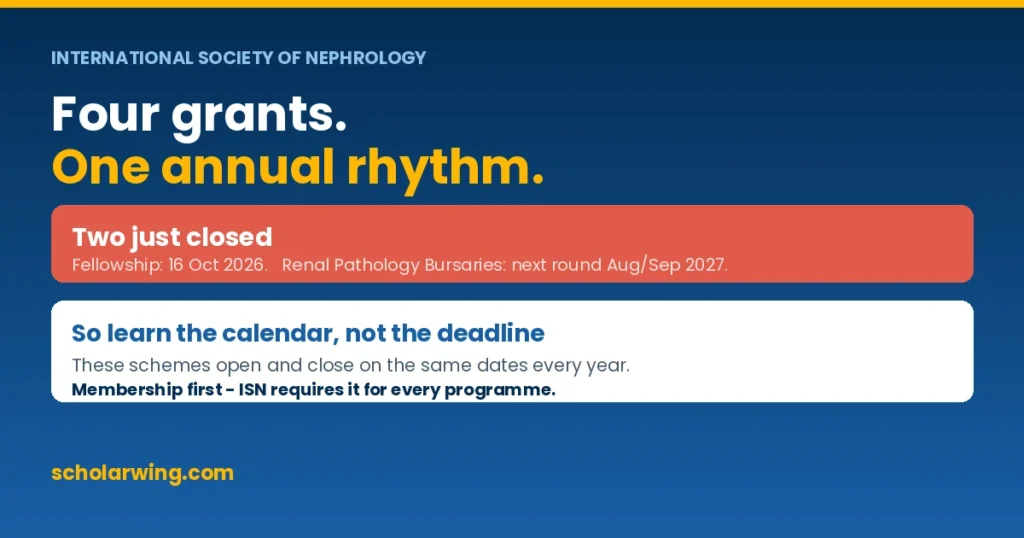
Four ISN Grants for Nephrologists:
If you are a nephrologist in Pakistan reading this in late October, you have just missed two ISN deadlines. That is not a reason to close the page. It is the reason to read it, because every one of these grants runs on a fixed annual cycle, and knowing the cycle is worth more than knowing any single deadline.
The gate that applies to everything
ISN’s own programmes portal states plainly that all programmes require ISN membership, and that you must register on the portal to submit anything.
So membership is step zero, and it is the step to complete now rather than in the week an application opens. Across this series we have seen schemes where membership closes hours before applications do. Do not learn that lesson twice.
One: the ISN Fellowship
The ISN Fellowship funds hands-on training at a host centre you choose, for doctors from low- or middle-income countries, where the purpose is in-person training not otherwise available at your home institution or in your country.
Its 2026 window ran from 1 July to 16 October 2026 at 23:59 CEST. Expect a similar window next year and prepare through the first half of the year rather than the last week.
ISN asks you to show three things: that you can handle the training you propose, that there is a real need in your home country, and that your training plan addresses that need. It also advises starting at least a month before the deadline simply to gather documents.
Read those three requirements again, because they explain why most applications fail. The weak application describes what the applicant wants to learn. The strong one describes a gap in the applicant’s country, and positions the training as the thing that closes it.
The part almost nobody knows. The same fellowship portal also carries the Ravi Mehta AKI Fellowships and the Fellowships in Glomerular Diseases, while the IACN-ISN-HKSN Fellowships and the Interventional Nephrology Scholarships run on separate portals. If acute kidney injury, glomerular disease or interventional nephrology is your area, you have a more specific and less crowded route than the general fellowship.
ISN publishes no amounts on the fellowship page itself, pointing instead to its programme guidelines document. We print no figure here, and you should read those guidelines before budgeting anything.
Two: the Renal Pathology Bursaries
These support attendance at named renal pathology events — conferences, workshops and courses — with each bursary contributing to registration and/or travel and accommodation.
The 2027 event list is specific, and worth seeing because it tells you where this subspecialty actually gathers:
Renal pathology for the nephrologist, Imperial College London, 4 to 5 March 2027. Renal Pathology WCN course at WCN’27, Kuala Lumpur, 1 April 2027. European Renal Pathology Course, Amsterdam, June 2027, which includes a two-week mini-sabbatical. 50th Columbia Renal Biopsy Course, 14 to 16 July 2027, online. ISRTPCON, India, mid-September 2027.
Note the Amsterdam course. A two-week mini-sabbatical attached to a course is training, not just attendance. And note the Columbia course runs online, which removes the visa question entirely.
Who qualifies: an ISN member who is a nephrologist, pathologist or trainee under 45, living in a low, lower-middle or upper-middle-income country, with fundamental knowledge of renal pathology, and involved in, or able to become involved in, diagnostic evaluation of renal biopsy specimens at their home institution.
The file is three items: a CV in English, maximum four pages; a letter of support from your home institution on official letterhead, signed and dated; and a statement of goals covering your current renal pathology knowledge, what you expect to gain, and the impact on local services.
The 2027 round has closed. The next opens in August or September 2027.

Three: the Clinical Research Program, and the March rule
This funds research and education projects involving nephrologists, health workers and local authorities, to detect and manage chronic non-communicable disease including CKD, AKI, hypertension, diabetes and cardiovascular disease.
Now the rule that will cost people their year.
From 2026, you must first send a short abstract to your ISN Regional Coordinator by 1 March, using ISN’s abstract template, at least two months before the final deadline. Only then do you complete the full online application by 1 May. ISN describes 1 May as the only general round each year.
Two gates, two months apart. An applicant who finds this scheme in April has already missed it, even though the headline deadline has not arrived. That is the single most useful sentence on this page.
Eligibility runs to ISN members from lower, lower-middle or upper-middle-income countries. A separate track exists for French-speaking nephrologists in Africa, run with SFNDT, where applicants contact the Clinical Research Coordinator before 1 March.
Our guide on writing a research proposal covers building the abstract that has to survive the Regional Coordinator stage.
Four: the Educational Ambassadors Program
This one works in reverse, and that makes it the most overlooked.
Your centre requests an expert, who then travels to you to deliver hands-on training for up to four weeks, or to help set up a service. ISN accepts applications year-round, submitted at least three months before the training date.
You do not travel. Nobody needs a visa for you. No congress fee arises. For a department that cannot release a consultant for six months abroad, this is often the more realistic route, and it trains several people at once rather than one.
Alongside it sits the Continuing Medical Education Program, which supports faculty travelling to speak at regional nephrology events, accepted year-round and submitted three to six months before the event. If your society or department runs a meeting, that is your route.
Both are institutional asks. Forward this section to your head of department, in the same way our post on WOAH and FAO training routes asks veterinary readers to forward the twinning gap to their dean.
The calendar to save
1 March — Clinical Research abstract to your Regional Coordinator. 1 May — Clinical Research full application. Around July — ISN Fellowship opens. August or September — Renal Pathology Bursaries open. Around mid-October — ISN Fellowship closes. Year-round — Educational Ambassadors, at least three months ahead; CME, three to six months ahead.
Put those six lines in your phone today. Our free CV builder will have the four-page CV ready before the first of them arrives.

FAQ
Do I need ISN membership?
Yes. ISN’s portal states that all programmes require it.
When does the ISN Fellowship open?
Its 2026 window ran 1 July to 16 October 2026. Expect a similar cycle.
What does the Fellowship fund?
Hands-on training at a host centre abroad that is not otherwise available at home.
Are there other ISN fellowships?
Yes. Ravi Mehta AKI Fellowships and Fellowships in Glomerular Diseases sit on the same portal, with IACN-ISN-HKSN Fellowships and Interventional Nephrology Scholarships on separate ones.
How much do they pay?
ISN does not publish amounts on these pages. Read the programme guidelines.
What are the Renal Pathology Bursaries?
Support towards registration and/or travel and accommodation for named renal pathology events in 2027.
Who can apply for them?
ISN members who are nephrologists, pathologists or trainees under 45, living in a low, lower-middle or upper-middle-income country.
Are they open now?
No. The 2027 round has closed, and the next opens in August or September 2027.
What is the March rule?
From 2026, Clinical Research applicants must send an abstract to their ISN Regional Coordinator by 1 March, before the 1 May full application.
Can my hospital get a visiting expert?
Yes, through the Educational Ambassadors Program, for up to four weeks, applied for at least three months ahead.
Which ISN schemes accept upper-middle-income countries?
The Renal Pathology Bursaries and the Clinical Research Program.
Where else should I look?
Our medical and health sciences scholarships page carries the rest of the field.