
FEMS Grants:
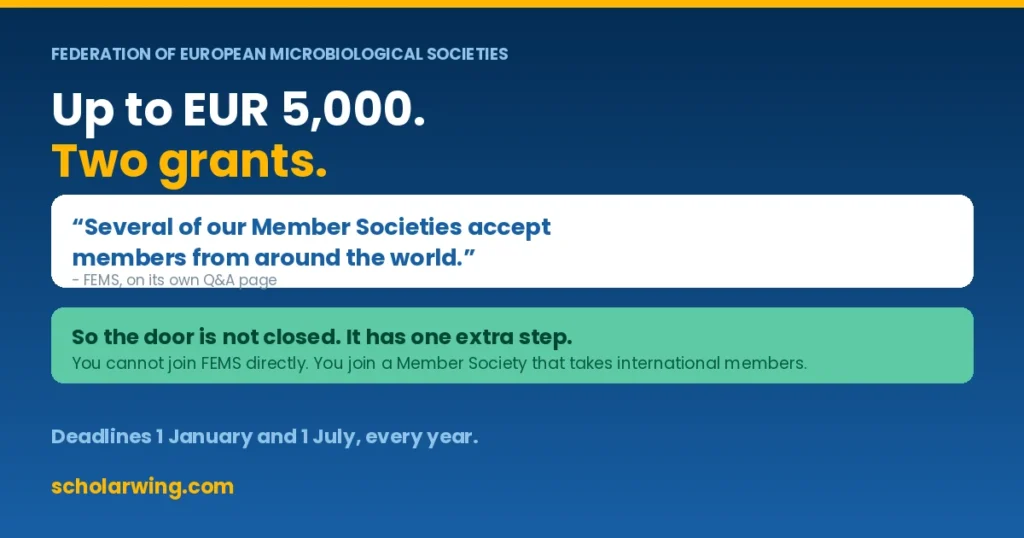
Most microbiologists outside Europe skip FEMS grants after one look, because the word European sits in the organization’s name. That decision costs them up to five thousand euros, and it rests on a misreading.
The membership rule, read properly
FEMS is a coalition of more than 56 Member Societies across 41 countries, representing a network of about 30,000 individual microbiologists.
FEMS states two things plainly. Individuals cannot join FEMS directly. And “unless you are member of one of the FEMS Member Societies, you cannot enjoy the benefits of FEMS.”
If the post stopped there, it would be another closed door for readers in Pakistan.
It does not stop there, because FEMS adds a third sentence on the same page: “several of our Member Societies accept members from around the world.”
Read that again. You do not need a FEMS Member Society in your own country. You need membership of one that takes international members, and FEMS says several do.
That is the whole route, and it runs one step long. Find which societies accept international members, join one, and both grants described below open to you.
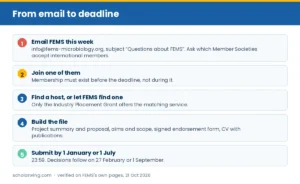
FEMS does not name those societies on the page we read, which is why the first action in this post is an email rather than an application. Write to info@fems-microbiology.org with the subject line “Questions about FEMS”, and ask which Member Societies accept members from outside Europe and what each costs.
Do that this week. Membership has to exist before a deadline, not during it, and we have watched that single mistake end applications across this whole series.
The Research and Training Grant
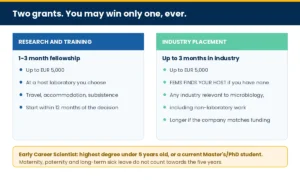
This funds a fellowship of one to three months, with up to €5,000 towards travel, accommodation and subsistence.
It is the conventional route: you identify a host laboratory, agree a project, and go and do a focused piece of work that your own institution cannot support.
The fellowship must take place within twelve months of the decision date, which gives real planning room, including time for a visa.
The Industry Placement Grant, and why it may suit you better
This funds up to three months at an industry host company, again with up to €5,000.
Three things make it unusually accessible.
One: FEMS will find your host. If you apply without a host company, FEMS connects you with a suitable one, and encourages you and the company to develop the project proposal together. No other funder in this series does that. Everywhere else, finding the host is the hardest and loneliest part of the application.
Two: FEMS defines industry widely. Any industry relevant to microbiology qualifies, including non-laboratory work. Quality assurance, regulatory affairs, production, product development — not only bench science.
Three: the placement can run longer than three months if the company provides matching financial support. So a good placement can become a longer one without a second application.
FEMS encourages industry placements to begin within three months of the decision, though it allows up to twelve. That is tighter than the Research and Training Grant, so factor your visa timeline in before choosing this route.
Who counts as early career
Both grants are for active microbiologists who qualify as Early Career Scientists.
FEMS defines that as holding your highest degree — Bachelor’s, Master’s or PhD — obtained less than five years before the application deadline, or currently studying for a Master’s or PhD.
Maternity leave, paternity leave and long-term sick leave do not count towards the five years. That is a fair rule and worth knowing, because many funders in this series have no such allowance.
So a current MPhil or PhD student in Pakistan qualifies today, once the membership question is settled.
The calendar, which never changes
1 January, 23:59 — applications close. 27 February — decisions. 1 July, 23:59 — applications close. 1 September — decisions.
Two rounds a year, on the same dates, for both grants. FEMS had closed applications when we checked, and says information on the next opening will appear on its grants pages.
Work backwards from 1 January. Membership first, then a host or a FEMS introduction, then the proposal. None of that fits into December.
What the application asks for
An online form carrying your contact details, a project summary and a project proposal — and for the Industry Placement Grant, the host company’s details. Alongside it you upload the aims and scope, a signed endorsement form, and a CV with publication list.
Our free CV builder produces the CV, and our guide on writing a research proposal covers the proposal, which is the part a panel actually reads.
The obligations after you win
FEMS is specific about what follows, and people lose money here.
Within six weeks of the project period ending, submit the report form and grantee statement. Within six weeks of the placement ending, submit a signed claim form with scanned tickets, invoices or receipts.
FEMS processes claims only when it has the scans, the report and the grantee statement. So keep every boarding pass and every receipt from the day you travel, and treat the paperwork as part of the grant rather than an afterthought.
You must also hold appropriate insurance, since FEMS states it is not responsible for injury or ill effects related to the project, and acknowledge FEMS support in presentations and publications.
The rule that decides your strategy
Each individual may have only one successful application.
So these are not two chances. Pick the one that fits: the Research and Training Grant if you know exactly which laboratory and which technique you need, the Industry Placement Grant if you want industry experience or if finding a host alone has stopped you before.
Where this sits
If you are building a wider list in this field, our guide to hidden microbiology and infectious diseases scholarships covers eight funders including ESCMID, and our post on the ESCMID Global 2027 grants covers the congress route that closes on 18 November 2026.
Those two work on a very similar principle to this one: a modest society membership turning into a funded opportunity. Our medical and health sciences scholarships page carries the rest.
FAQ
How much do FEMS grants pay?
Up to €5,000 for both the Research and Training Grant and the Industry Placement Grant.
How long are they?
The Research and Training Grant funds one to three months. The Industry Placement Grant funds up to three months, and longer if the company provides matching support.
Can I apply from Pakistan?
You must belong to a FEMS Member Society. FEMS states that several of its Member Societies accept members from around the world, so ask FEMS which ones.
Can I join FEMS directly?
No. Individuals join through a Member Society.
Who counts as an Early Career Scientist?
Someone who earned their highest degree less than five years before the deadline, or who is currently a Master’s or PhD student.
Does parental or sick leave count against the five years?
No. FEMS excludes maternity, paternity and long-term sick leave.
What if I have no host company?
FEMS connects Industry Placement Grant applicants with a suitable host company.
What counts as industry?
Any industry relevant to microbiology, including non-laboratory work.
When are the deadlines?
1 January and 1 July, each at 23:59, with decisions on 27 February and 1 September.
Which documents do I need?
An online form with project summary and proposal, the aims and scope, a signed endorsement form, and a CV with publication list.
What do I owe afterwards?
A report form and grantee statement within six weeks, and a signed claim form with scanned receipts within six weeks.
Can I win both grants?
No. Each individual may have only one successful application.