
WOAH and FAO Training Routes:
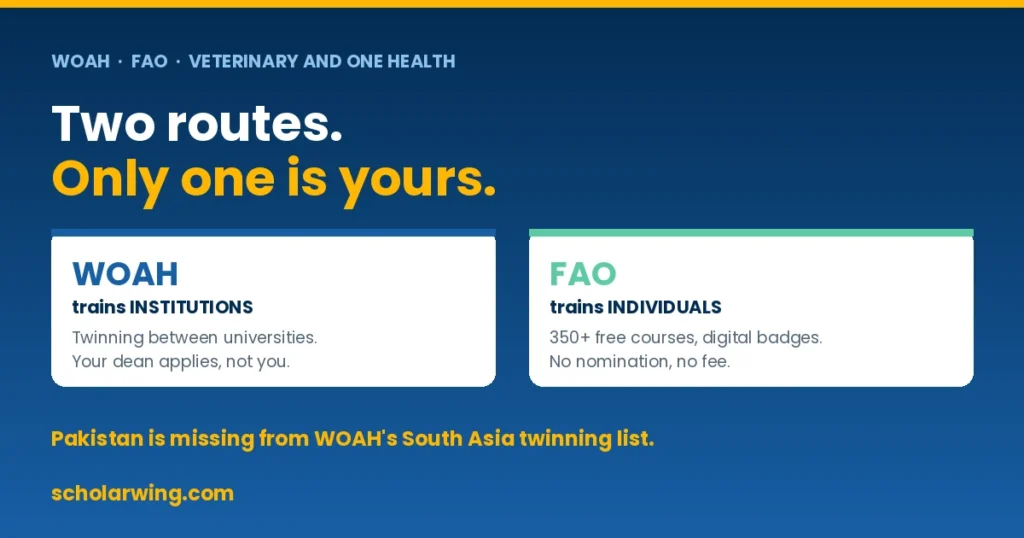
Two international organizations shape veterinary and animal health training worldwide. Only one of them will ever deal with you personally, and knowing which saves you months.
WOAH trains institutions, not people
The World Organization for Animal Health builds capacity through twinning: a formal partnership in which an established institution in one country works with a counterpart in another, usually to strengthen teaching, laboratory capability or regulation.
WOAH’s own example makes the shape clear. The Royal Veterinary College in the United Kingdom twinned with Jordan University of Science and Technology, aligning the Jordanian curriculum with WOAH’s Day 1 competencies and adding joint postgraduate research.
Read that carefully. The beneficiaries are students and staff at JUST, but neither applied for anything. Two institutions agreed, and everyone inside gained.
WOAH also publishes guidance that veterinary schools are meant to build their teaching around: its Recommendations on the Competencies of Graduating Veterinarians and its Guidelines on Veterinary Education Core Curriculum, offered mainly to developing and in-transition countries, with WOAH strongly recommending that establishments in Member Countries consult them.
So the lever here is institutional, and the person who can pull it is your dean, your head of department or your Veterinary Statutory Body.
The gap in South Asia, and what to do about it
WOAH’s South Asia veterinary education briefing lists the region’s twinning projects:
Tufts University, USA, with Chattogram Veterinary and Animal Sciences University, Bangladesh, 2014 to 2019.
Massey University, New Zealand, with the University of Peradeniya, Sri Lanka, 2014 to 2018.
University of Calgary, Canada, with Guru Angad Dev Veterinary and Animal Sciences University, India, 2020 to 2024.
No Pakistani institution appears on that list.
Three of Pakistan’s neighbors have run a twinning project with a North American or Australasian veterinary school. Pakistan, on that document, has not.
If you are a student or junior vet reading this, you cannot fix that yourself. But you can forward this paragraph to someone who can. A dean, a vice chancellor, a Pakistan Veterinary Medical Council member. The ask is simple: look at WOAH’s twinning programme, and ask WOAH’s regional representation for Asia and the Pacific what a Pakistani application would involve.
Two further openings sit in the same document. WOAH lists a South Asia VEE and VSB Network as “to be launched”, and a Veterinary Statutory Body Support Programme as “coming soon”. Institutions that ask before a programme launches are the ones in the first cohort.
For context, Asia holds more than 300 veterinary education establishments, most accredited nationally, and no regional accreditation standard or body exists. That is precisely the vacuum these networks exist to fill.
What WOAH offers an individual
Less, but not nothing.
WOAH’s competency packages include modules on leadership, outbreak response, animal welfare and trade, some delivered online and some in person. The region also runs a VetEd Asia scientific conference, continuing professional development webinars through its regional veterinary association channels, and periodic workshops.
WOAH’s own briefing does not state who is eligible for those modules or how to enroll, so treat them as a question for WOAH’s regional representation rather than a programme you can join today. We print no enrolment route here, because WOAH

FAO trains individuals, free, starting today
Now the half of this post you can act on within the hour.
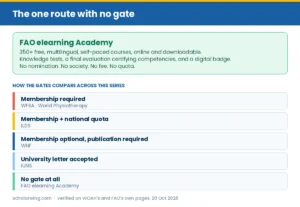
The FAO eLearning Academy offers more than 350 multilingual, self-paced e-learning courses, free of charge, online and in downloadable form. Each course carries knowledge tests tied to measurable objectives, and a final evaluation certifies your competencies and grants a digital badge.
There is no nomination, no national society, no membership fee and no quota. After nine posts in this series documenting gates — society membership, national quotas, five-year windows, regional restrictions — this is the one route with no gate at all.
FAO built it deliberately for geographically dispersed learners and for communities affected by gender bias, which is to say for exactly the reader who cannot travel to a congress in Stockholm or Florence.
Use it strategically rather than casually. A digital badge in food safety, animal health, biosecurity or One Health is not a degree, but on a CV it shows a selection panel that you train yourself without being told to. Our free CV builder has a place for exactly this, and our veterinary and One Health scholarships page carries the degree funding these badges will support rather than replace.
FAO’s other routes, and an honest note
FAO also runs programmes that place people inside the organization, including an internship programme, a fellows programme and a volunteer programme.
FAO’s own pages for these would not load when we checked, and we will not reprint stipend figures, age limits or deadlines from scholarship aggregator sites, because those are routinely wrong. Go to FAO’s own employment pages for the current terms, and treat any figure you see elsewhere as unverified until FAO states it.
That caution is the point of this site. A wrong stipend figure costs a reader a month of planning.
Step-by-step
Step 1, today: register with the FAO eLearning Academy and complete one course end to end, including the final evaluation, so you hold a badge rather than a half-finished enrolment.
Step 2, today: choose courses that match your intended specialism, not whatever appears first. Biosecurity, food safety, antimicrobial resistance, One Health.
Step 3, this week: send the South Asia twinning paragraph above to your dean or head of department, and ask whether your institution has ever approached WOAH.
Step 4, this week: write to WOAH’s regional representation for Asia and the Pacific and ask what a Pakistani veterinary education establishment needs before WOAH will consider it for twinning, and when the South Asia VEE and VSB Network launches.
Step 5, November: ask WOAH who may enroll in its competency modules on leadership, outbreak response, animal welfare and trade, and whether individual veterinarians outside government service qualify.
Step 6, November: go to FAO’s own employment pages for the internship, fellows and volunteer programmes, and read the terms there rather than anywhere else.
Step 7, December: build the record. Badges, a CV, and a research idea. Our guide on writing a research proposal covers the last of those.
Step 8, ongoing: watch for the two WOAH programmes listed as launching, since early cohorts are always the least competitive.
FAQ
Does WOAH give scholarships to veterinarians?
Not in the way people expect. WOAH’s capacity building runs through institutional twinning rather than individual awards.
What is twinning?
A formal partnership between an institution in one country and a counterpart in another, to strengthen teaching, laboratory capability or regulation.
Can I apply for twinning myself?
No. Your university, laboratory or Veterinary Statutory Body does.
Has Pakistan had a veterinary twinning project?
WOAH’s South Asia briefing lists projects in Bangladesh, Sri Lanka and India, and names no Pakistani institution.
What are the Day 1 competencies?
WOAH’s recommendations on what a graduating veterinarian should be able to do, which twinning projects often align a curriculum to.
Does WOAH train individuals at all?
It lists competency modules on leadership, outbreak response, animal welfare and trade, some online and some in person. Eligibility and enrolment are not published, so ask WOAH.
What is the FAO eLearning Academy?
Over 350 free, multilingual, self-paced courses, with a final evaluation that certifies competencies and grants a digital badge.
Does it cost anything?
No.
Do I need a nomination or membership?
No. It is the only route in this series with no gate.
Is a digital badge worth anything?
It is not a degree. On a CV it shows a panel that you train yourself without being told to.
What else does FAO run?
Internship, fellows and volunteer programmes. Check FAO’s own employment pages for terms, since aggregator figures often get them wrong.
What is the single best first step?
Finish one FAO course today, and send the twinning gap to your dean this week.