

Study Medicine in Cuba Free:
Of the sixteen countries in this series, Cuba is the only one where Pakistan has already done the thing at scale, and almost forgotten about it.
What happened the last time
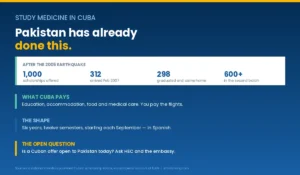
After the 2005 earthquake, Cuba offered 1,000 scholarships in medicine to Pakistani students. The Higher Education Commission of Pakistan ran the selection.
About 312 students arrived in February 2007. A second batch followed the next year. The first group, 298 of them, graduated and came home, and reports put a second batch of more than 600 graduating afterwards.
So when someone tells you a free medical degree abroad sounds too good to be true, the correct answer is that several hundred Pakistani doctors have already done it.
The school is the Escuela Latinoamericana de Medicina, ELAM, in Havana. It enrolled students from 18 countries in 1999 and from 110 countries by 2012, with figures of around 19,550 students reported that year.
What the scholarship actually covers
Two sources set out the package, and they agree on its shape.
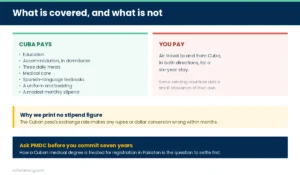
A national education ministry’s own published notice states that the Cuban Government pays for the scholar’s education, accommodation, food and medical care, and that the student pays air travel to and from Cuba.
Accounts of the ELAM package go further: tuition, dormitory housing, three daily meals, Spanish-language textbooks, a uniform, bedding, and a monthly stipend.
Two honest notes belong beside that. The monthly stipend is modest, and we are deliberately not converting it into dollars or rupees, because the Cuban peso’s exchange rate makes any such figure misleading within months. And the sending country’s own ministry sometimes adds a small allowance on top — on the notice we read, that government added US$40 a month of its own. Whether Pakistan would do the same is a question for HEC.
The course, and the language
Six years. Twelve semesters. Beginning each September. Taught in Spanish.
Before the medicine starts, there is preparation. The pre-medical programme includes an intensive Spanish course alongside science and mathematics. For the Pakistani students who went in 2007, that preparation ran as a one-year language course that included a premedical certificate.
That is the honest shape of the commitment: roughly seven years, one of them spent learning to study in Spanish.
Compare that with our Mexico guide, which asks for certified B2 Spanish before you apply and publishes no language year, and with our Brazil guide, which gives you a free Portuguese year in-country. Cuba sits with Brazil: you do not need the language to apply, you need it to continue.
How the selection travels
This is not a university application and it does not start online.
On the notice we read, the chain runs: your own country’s education ministry opens the call and shortlists, candidates sit a structured interview, nominations go to the Cuban embassy, and Cuba makes the final selection.
For Pakistan, the body that ran this in 2006 and 2007 was HEC. Whether HEC currently circulates Cuban offers is the single most important thing a reader can establish, and the first action in this guide is to find out.
The conditions on that notice are worth knowing because they shape who fits. Applicants had to be over 16 and under 25, in good health, prepared to live in Cuba for the whole programme, with a strong school record in the biological stream and a demonstrated standard of English. Candidates already registered as internal students at a state university fell outside it. Declining an offer after selection disqualified a candidate from that ministry’s future scholarships.
Those specifics came from one country’s call. Pakistan’s, if it runs, would carry its own.
Who this suits
A school-leaver with strong biology results and no route to a funded MBBS. The programme exists for this group, and seven years in Cuba makes obvious sense for almost nobody else.
Someone who intends to practise at home afterwards. The Pakistani cohorts came back. Anyone considering this should also check early how PMDC treats a Cuban medical degree for practice in Pakistan, which is a question for PMDC rather than for us, and which belongs in your plan before year one rather than after year six.
Not someone who needs a short commitment, and not someone unwilling to study in Spanish.
And not a postgraduate applicant. Cuba runs postgraduate scholarship offers separately, and we did not examine them here.

Where this sits against the rest of the series
Across sixteen countries, the funded medical route has been the hardest thing to find. Our Egypt guide found that medicine, dentistry and pharmacy at Egyptian public universities run far more expensive for foreign students than the arts faculties, at figures around USD 4,000 to 8,000 a year. Most European routes do not fund undergraduate medicine for internationals at all.
Cuba is the exception, and it is an exception with a Pakistani precedent attached. That combination is why this post deserves publishing even though its current status needs confirming.
Eligibility criteria
These come from the published notice we read, which another country issued. Pakistan’s conditions, if a call runs, may differ.
1. An age between 16 and 25 at the application date.
2. Strong school results in the biological stream.
3. A demonstrated standard of English, alongside the Spanish you will acquire in Cuba.
4. Good health, and readiness to live in Cuba for the full programme.
5. Nomination through your own country’s education ministry, with the Cuban embassy receiving it and Cuba selecting.
6. Your own airfare to and from Cuba, since the scholarship does not cover travel.
Step-by-step application process
Step 1, today: write to HEC and ask whether any Cuban Government scholarship offer is currently circulated for Pakistani students, and if so, when. This is the whole post in one email.
Step 2, today: write to the Cuban embassy and ask the same question from the other side, since the embassy receives nominations.
Step 3, this week: ask PMDC how it treats a medical degree from Cuba for registration and practice in Pakistan. Ask before you commit seven years, not after.
Step 4, November: check your age against the window. Over 16 and under 25 on the notice we read. This disqualifies more applicants than any academic rule.
Step 5, November: gather your biology-stream results and your English evidence.
Step 6, December: begin Spanish anyway. The programme teaches it, but arriving with some makes the preparatory year work rather than merely survive.
Step 7: prepare for an interview, since the selection on the notice we read ran through a structured interview rather than on paper alone.
Step 8: budget the airfare, in both directions, for a six-year stay.
Step 9: plan for seven years, not six, because the language and pre-medical preparation sits in front of the twelve semesters.
FAQ
Can Pakistani students study medicine free in Cuba?
Pakistan has done so before. After the 2005 earthquake, Cuba offered 1,000 scholarships and HEC ran the selection, with hundreds of Pakistani doctors graduating. Whether a current offer exists is a question for HEC and the Cuban embassy.
What does the scholarship cover?
On a published ministry notice, the Cuban Government covers education, accommodation, food and medical care. Accounts of ELAM’s package add dormitory housing, three daily meals, textbooks, a uniform, bedding and a monthly stipend.
What do I pay for?
Air travel to and from Cuba.
How long is the degree?
Six years of medicine in twelve semesters, starting each September, with Spanish and pre-medical preparation before it. For Pakistani students that preparation was a full year.
What language is it taught in?
Spanish. You do not need it to apply, but you will study it intensively before the medicine begins.
How old do I have to be?
On the notice we read, over 16 and under 25. Pakistan’s call, if it runs, may set its own window.
How do I apply?
Not directly. Your own country’s education ministry opens the call and shortlists, nominations go to the Cuban embassy, and Cuba selects.
Is there a stipend?
Yes, a modest monthly one. We do not publish a converted figure, because the Cuban peso’s exchange rate makes any conversion unreliable.
Will PMDC accept my degree?
Ask PMDC directly, before you apply. This is the most important question in the post that we cannot answer for you.
Is there a postgraduate route?
Cuba publishes postgraduate scholarship offers separately. This guide does not cover them.