
Study in Brazil Free:
Fourteen countries into this series, Brazil produces the sentence we have been looking for.
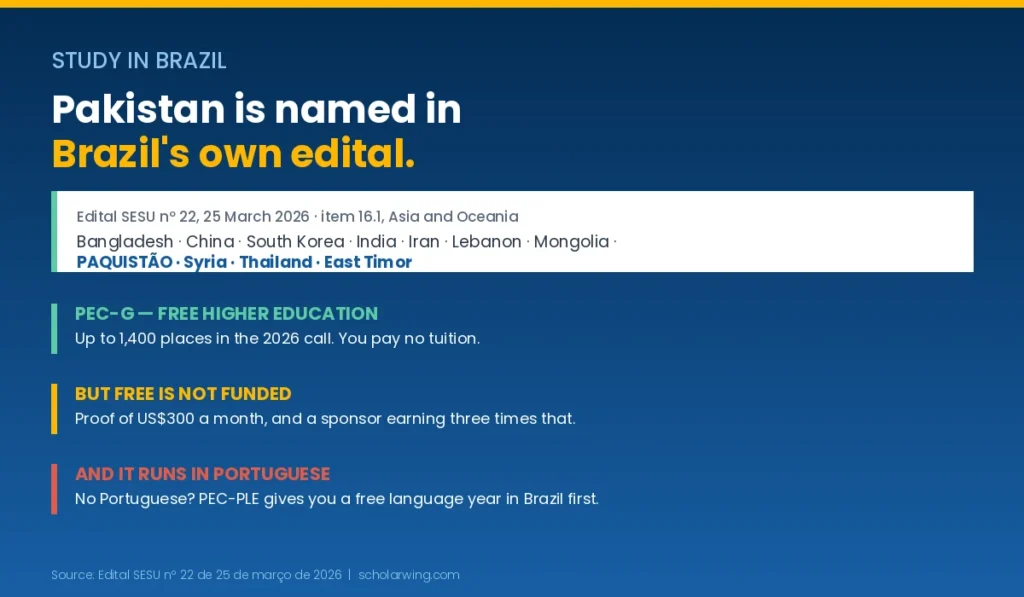
Open Brazil’s own call document — Edital SESU nº 22, dated 25 March 2026 — go to item 16.1, and read the list of participating countries under Asia and Oceania. Bangladesh. China. South Korea. India. Iran. Lebanon. Mongolia. Paquistão. Syria. Thailand. East Timor.
Pakistan is there, in the funder’s own document, and almost nobody in Pakistan has written about this programme.

What PEC-G actually is
The Programa de Estudantes-Convênio de Graduação, PEC-G, offers formação superior gratuita — free higher education — to citizens of developing countries that hold educational, cultural or scientific agreements with Brazil. Brazil’s Ministry of Foreign Affairs and Ministry of Education run it together with Brazilian universities.
The 2026 call offers up to 1,400 places: up to 700 concurrent places across PEC-PLE and PEC-G, and up to 700 exclusively for PEC-G with entry in 2027.
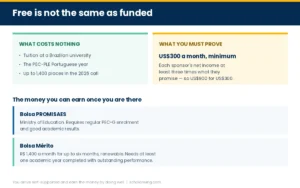
You study a full undergraduate degree at a Brazilian university, and you pay no tuition for it.
The qualifier to read before you get excited
Here is the distinction this whole series keeps returning to, and Brazil makes it unusually explicit. PEC-G is free. It is not funded.
The edital requires a financial responsibility term and proof of support of at least US$300 a month, with each sponsor’s net monthly income at least three times the amount they promise. So a family promising US$300 must show income of at least US$900 a month.
Two scholarships exist once you are inside the system, and both reward performance rather than need at entry. Bolsa PROMISAES, from the Ministry of Education, requires regular enrolment as a PEC-G student and good academic results. Bolsa Mérito, from the foreign ministry’s Instituto Guimarães Rosa, pays R$ 1,400 a month for up to six months, renewable by fresh application, and requires at least two semesters or one academic year completed with outstanding performance. Recipients may request a return-travel allowance after finishing the course.
Read that sequence properly. You arrive self-supported, and you earn the money by doing well once you are there.
The gate, and it is a language again
Portuguese decides who can use this programme.
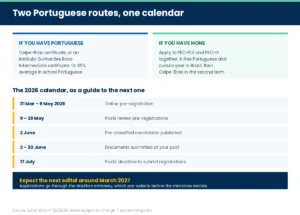
A PEC-G applicant must hold a Celpe-Bras certificate, or an Intermediate-level certificate from an Instituto Guimarães Rosa course, by the deadline in the calendar. If you studied Portuguese as an official school subject throughout high school, a 65% average in that subject substitutes for it.
For a Pakistani applicant, neither of those usually applies, which brings you to the route the edital builds for exactly this situation.
PEC-PLE. Applicants without Portuguese at school apply to both PEC-PLE and PEC-G. You spend your first year in Brazil on a free Portuguese and Brazilian culture course, then sit Celpe-Bras in the second semester, and move into the degree afterwards.
So Brazil does not ask you to arrive fluent. It asks you to commit an extra year, in Brazil, funded by yourself at the same US$300 a month standard. That is a real cost and an honest one, and it is more than most countries in this series offer a non-speaker. Our guides on Tunisia and Argentina found the same language wall with no equivalent bridge across it.
One warning from the edital itself: candidates who registered only for a first-semester Celpe-Bras and did not pass are disqualified. Treat the exam as a single serious attempt rather than a trial run.
Who may apply
The edital’s conditions are specific, and several of them surprise people.
You must be a national of a participating country, living abroad, with no Brazilian nationality or right to it, and no Brazilian visa or residence authorisation other than a tourist visa. You must be at least 18 by 1 January 2027. You must have completed high school outside Brazil, with a minimum global average of 60%. And you sign a financial responsibility term and a compromise term.
That residence condition catches people who assume a head start helps. Already living in Brazil on a student or work permit disqualifies you from the programme designed to bring you there.
How the application actually travels
This is not an online application to a university, and the chain matters because it sets your timeline.
Online pre-registration opens first. In the 2026 cycle it ran from 31 March to 9 May 2026, with posts reviewing pre-registrations from 9 to 29 May, pre-classified candidates published on 2 June, candidates called to submit documents at their post between 2 and 30 June, and the posts’ own deadline to submit pre-classified registrations on 17 July.
Then the selection: applications are made at Brazilian diplomatic missions or consulates in your home country, those missions carry out pre-selection, and MRE and MEC make the final selection. Universities receive the list of selected students afterwards for reception and enrolment.
So the Brazilian embassy is a stage in your application rather than a source of advice about it, and the dates above are last cycle’s. Expect the next edital around March 2027 and watch for it.
Who Brazil suits
It suits an 18 to 23-year-old with a solid school record — the edital sets 60% as the floor — who can be supported at US$300 a month and who is willing to spend a year on Portuguese.
It suits a family that can show income three times what it promises, which is the condition most applicants overlook until the documents stage.
It does not suit someone who needs a stipend from day one. For that, our guides on Thailand, where one scholarship lists its nationality as simply Pakistan, Qatar, where a doctorate carries a full waiver and a monthly stipend, and Brunei, whose own FAQ says all nationalities are eligible, remain the strongest in this series.
And it does not suit a postgraduate applicant, since PEC-G is an undergraduate programme. Brazil runs a separate postgraduate scheme, which we have not checked and do not describe here.
Eligibility criteria
1. Nationality of a participating country, with Pakistan named in the 2026 edital.
2. Living abroad, with no Brazilian nationality, visa or residence authorization beyond a tourist visa.
3. At least 18 by 1 January of the entry year.
4. High school completed outside Brazil, with a minimum global average of 60%.
5. Portuguese: a Celpe-Bras certificate, an Instituto Guimarães Rosa Intermediate certificate, or a 65% average in school Portuguese. Otherwise apply to PEC-PLE alongside.
6. Financial support of at least US$300 a month, with each sponsor’s net income at least three times what they promise.
Step-by-step application process
Step 1, today: check the three disqualifiers. Your age on 1 January of the entry year, your school average against the 60% floor, and whether anyone in your family can evidence income at three times the support they promise. Any one of these ends the application, so settle them first.
Step 2, this week: start Portuguese. Not later. If you have none, you are on the PEC-PLE route, and arriving with some Portuguese makes that year work rather than merely pass.
Step 3, November: contact the Brazilian embassy and ask what a Pakistani applicant files, since missions handle registration and pre-selection.
Step 4, December: prepare the financial documents. The responsibility term, sponsor income evidence, and bank statements. This is the slowest part of a Brazilian file.
Step 5, January: order certified copies and translations of your school certificate and transcript.
Step 6, February: find out where you can sit Celpe-Bras, and whether a sitting is reachable from Pakistan. If not, PEC-PLE is your route and the application changes accordingly.
Step 7, March 2027: watch for the new edital. Last cycle it appeared on 25 March with pre-registration opening days later.
Step 8, as soon as it opens: pre-register online. The 2026 window ran about six weeks, from 31 March to 9 May.
Step 9, June: be ready to submit documents at the post within the month-long window the calendar allows.
FAQ
Can Pakistani students apply to study free in Brazil?
Yes. Brazil’s 2026 PEC-G edital names Pakistan among the participating countries, under Asia and Oceania, alongside Bangladesh, India, Iran, Thailand and others.
Is it really free?
Tuition is free. Living is not. The edital requires proof of support of at least US$300 a month, and each sponsor must show net monthly income of at least three times what they promise.
How many places are there?
Up to 1,400 in the 2026 call: up to 700 concurrent PEC-PLE and PEC-G places, and up to 700 for PEC-G entering 2027.
Do I need Portuguese?
Yes. A Celpe-Bras certificate or an Instituto Guimarães Rosa Intermediate certificate, or a 65% average if you studied Portuguese at school.
What if I speak no Portuguese at all?
Apply to PEC-PLE and PEC-G together. You spend your first year in Brazil on a free Portuguese and Brazilian culture course, then take Celpe-Bras in the second semester.
What grades do I need?
A minimum global high school average of 60%, on the 2026 edital.
Is there any scholarship once I am there?
Yes, two. Bolsa PROMISAES from the education ministry, and Bolsa Mérito at R$ 1,400 a month for up to six months, renewable, which requires at least a year completed with outstanding results.
Where do I apply?
Through a Brazilian diplomatic mission or consulate in your own country. Missions pre-select, and the two ministries make the final decision.
When does it open?
The 2026 cycle pre-registered from 31 March to 9 May. Expect the next edital around March 2027.
Can I apply for a master’s?
No. PEC-G is undergraduate. Brazil runs a separate postgraduate programme, which this guide does not cover.