
Neuroscience Scholarships 2027:
This is the first guide where our main advice points at a deadline two years from now.
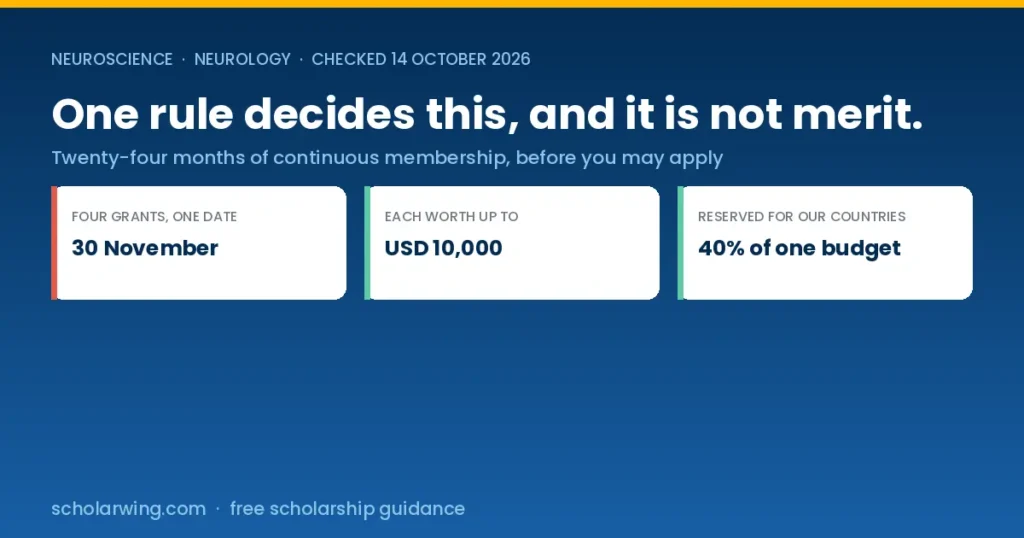
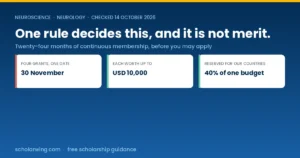
Neuroscience hides serious money. Four grants worth up to US$10,000 each close on the same day, 30 November, and one of them reserves 40% of its entire budget for applicants from developing countries. But the society behind them applies a rule that almost nobody writes about: you must have held continuous membership for at least 24 months before you may apply, and a single missed renewal year disqualifies you.
So the honest answer for most readers is that November 2026 belongs to people who joined in 2024. Your deadline is November 2028, and the only thing that reaches it is joining today. One shortcut exists, and we explain it below.
A correction first
Search for neuroscience funding and you will still find CAEN, the Committee for Aid and Education in Neurochemistry, listed across scholarship sites with its old categories 1A, 1B, 1C and 2A.
The International Society for Neurochemistry’s own page states that the CAEN scheme “has been discontinued as of 2025.” Two schemes replaced it: Career Support Grants and the Laboratory Exchange Grant. The eligibility rules changed with the names, so an application built from an old CAEN page fails before anyone reads it. Treat every CAEN listing you find elsewhere as out of date.
The ISN cluster: four grants, one date
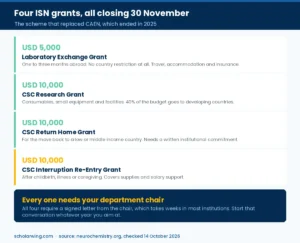
The Laboratory Exchange Grant — up to US$5,000. It funds a visit of at least one month and up to roughly three months to an established group abroad, covering travel, accommodation and insurance. The host lab pays the laboratory costs and must say so in writing. Each host may take only one visiting member per calendar year, and you must return to your home country afterwards.
This grant sets no country restriction at all, which makes it unusual. The gate sits entirely on membership, and we come back to that below. The deadline falls on 30 November for visits in the following January to December, and travel must happen within 12 months of your acceptance letter.
The CSC Research Grant — up to US$10,000. It helps a young researcher become independent, paying for consumables, small equipment, shared facilities and animal housing, with up to 20% available for attending ISN events. The detail worth underlining: 40% of the total budget goes to applicants from developing or underdeveloped countries by World Bank classification. Pakistan sits in that group, and few funders ring-fence money this openly.
The CSC Return Home Grant — up to US$10,000. It eases the move back from a postdoc in a developed country to a low- or middle-income country, and asks for a written institutional commitment confirming a position and laboratory space. PhD students and early-career postdocs cannot apply; this one targets people within ten years of their postdoc who hold independent status at home.
The CSC Interruption Re-Entry Grant — up to US$10,000. It supports senior researchers coming back after childbirth, serious illness or extended caregiving, covering supplies and salary support for the applicant or a staff member. You must show a strong track record before the interruption.
All four close on 30 November, and all four require a signed letter from your department chair, so start that conversation now regardless of which year you aim at.
The clock problem, and the one way around it
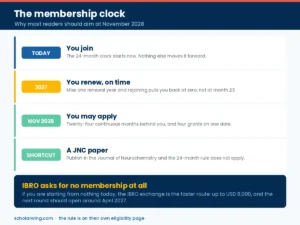
ISN asks the Laboratory Exchange Grant applicants to have held continuous membership for at least 24 months by the application round. The Career Support Grants ask the same 24 months, plus an active Postdoc membership with at least three years post-doc, or Full membership within ten years of the doctorate.
The word doing the work is “continuous”. ISN’s page excludes “Students and Postdocs who have not continuously renewed their ISN membership each year.” Letting a year lapse and rejoining does not restart you at month 23; it removes you. A membership you forget to renew in 2027 costs you the 2028 and 2029 rounds.
The shortcut. The Laboratory Exchange Grant accepts an alternative to the 24 months: applicants who have published in the Journal of Neurochemistry by the application round qualify without the membership history. If you have a JNC paper, your clock already ran. If you are working toward one, that paper now carries a second value you may not have counted.
Funding also pays only if you hold active membership in the year of the visit, so the membership has to stay alive through the whole process, not just at application.
IBRO: the regional route, no membership needed
The International Brain Research Organization runs Exchange Fellowships for PhD neuroscience students and early-career postdocs within five years of starting their first postdoc. Applicants must live in Asia-Pacific, Latin America, Africa or the US and Canada, and European applicants use a separate FENS/IBRO-PERC scheme instead. The exchange must cross a border, with the host laboratory in a different country from your own.
For Asia-Pacific applicants, two shapes exist. The Classic Exchange runs four to six months and pays up to US$8,000. The Short Exchange plus Scientific Meeting runs from two weeks to four months and pays up to US$2,500. Africa receives up to US$6,000 for a minimum of three months, Latin America up to US$7,500, and the US and Canada up to US$8,000.
IBRO pays 80% two months before you travel and the remaining 20% after you finish and file your report, which falls due within three months of the exchange ending. A host acceptance letter is mandatory and at least one reference letter is required, with two encouraged.
The 2026 round closed on 15 April 2026, so watch for the next window around the same point in 2027. No applicant membership requirement appears on the scheme page, which makes this the fastest route for someone starting from nothing today.
WFN: a clinical route for neurologists
The World Federation of Neurology and the Indian Academy of Neurology run an Asia-Oceania Department Visit Programme aimed at young neurologists from Asian Oceanian low or lower-middle income countries. It places two colleagues for four weeks at the Department of Neurology at the Post Graduate Institute of Medical Education and Research in Chandigarh, India.
Two things recommend it. The region matches Pakistan directly, and four weeks in a high-volume neurology department sits within reach of a working registrar in a way that a six-month research exchange does not. The notice we read carried a 3 August 2025 deadline and did not state what the programme pays, so write to the project manager at jade@wfneurology.org for the current round and the funding terms before you plan around it.
Eligibility criteria: the four gates
Membership history, measured in continuous years. ISN’s 24-month rule decides more applications than merit does, and a lapsed year cannot be repaired. IBRO and WFN ask for none.
Career stage, measured from the doctorate. IBRO wants PhD students or postdocs within five years of starting. The CSC grants want at least three years post-doc, or Full membership within ten years of the PhD. The Return Home Grant excludes students and early-career postdocs outright.
Where you live, and where you will return. The Laboratory Exchange Grant requires you to go home afterwards. The Return Home Grant requires your home country to be low- or middle-income. IBRO sorts applicants by region and pays different amounts accordingly.
A host who commits in writing. IBRO calls the host acceptance letter mandatory. ISN requires a host letter confirming the lab will cover consumables. The Return Home Grant needs a written institutional commitment naming your position and lab space. No host, no application.
Step-by-step application process
Step 1 — Join ISN today, whatever your plans. The 24-month clock starts the day you join and nothing else moves it. Set a calendar reminder for every renewal, because one missed year resets you to nothing.
Step 2 — Ask whether the shortcut applies to you. A Journal of Neurochemistry publication replaces the 24-month requirement for the Laboratory Exchange Grant. Check your own publication list before you assume you must wait.
Step 3 — Aim at IBRO for next spring. It asks for no membership history, takes PhD students, and the round should open around April 2027. For a Pakistani applicant, the Classic Exchange at up to US$8,000 over four to six months offers the most substance.
Step 4 — Find your host six months before any deadline. Write to three group leaders whose published work overlaps yours. Say what you want to learn, how long you would stay, and what you will take home. Ask directly whether the lab can cover consumables, since ISN requires that commitment in writing.
Step 5 — Secure the departmental letter early. All four ISN grants require a signed letter from your department chair, and the Return Home Grant adds a recommendation from your current head of laboratory. These take weeks in most institutions.
Step 6 — Build a budget with quotes. ISN asks for a detailed budget and expects you to list any other funding you hold. IBRO’s two-part payment means you must be able to cover the final 20% yourself until your report clears.
Step 7 — File the report. IBRO wants it within three months of finishing, ISN within two months plus a short public statement. ISN also requires prior approval before you change host lab or make major project changes, and warns that failing to notify may lead to cancellation or repayment.
FAQ
I am an MBBS doctor interested in neurology, not a PhD researcher. What fits me?
The WFN department visit, since it targets practicing neurologists from low and lower-middle income countries in your region. The ISN and IBRO schemes assume a research track, with IBRO requiring PhD enrolment or a postdoc.
Is ISN membership expensive?
ISN publishes its membership rates on its own site, and we did not verify the student or LMIC rate while writing this, so check before you budget. Treat the fee as the cost of starting a two-year clock rather than as a purchase.
Does any of these pay for a master’s or PhD in neuroscience?
None of them. They fund exchanges, research supplies and returns home. For a funded doctorate, European salaried PhD positions remain the route, which our biomedical sciences guide sets out.
Why do scholarship sites still list CAEN?
Because nobody re-reads a funder’s page once they have written about it. ISN states on its own site that CAEN ended in 2025. We find this pattern constantly, and our pathology guide ran into the same problem with closed and renamed awards.
Do I need IELTS for any of this?
None of the schemes we read asked for an English test. These are research and professional awards, so your English shows in the proposal and in your correspondence with the host.
Is 40% of a budget reserved really unusual?
Yes. Most funders either restrict a grant to low and middle income countries entirely or say nothing at all. A stated share set aside inside an open competition sits between the two, and it means your application competes mainly against others from similar countries. Cancer research uses the stricter version, which our oncology guide covers.