
How to Study in Tunisia:
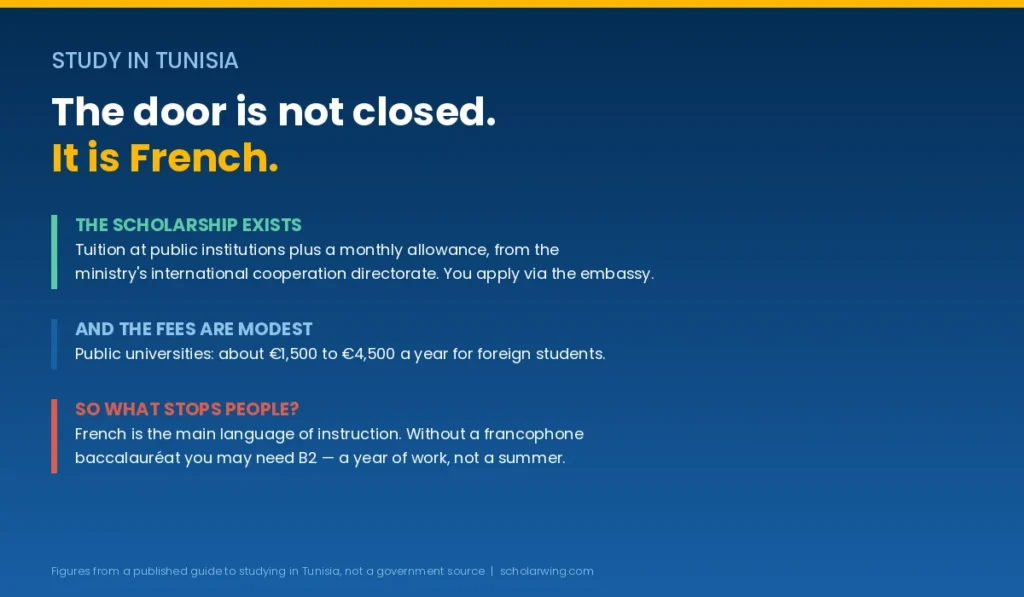
Twelve countries into this series, Tunisia produces a result we have not had before. The scholarship is not restricted by nationality, the fees are modest, and the thing standing between most Pakistani readers and a place is neither money nor politics. It is a language.
The scholarship, and who hands it out
Tunisia’s state scholarship comes from the Ministry of Higher Education and Scientific Research, through its international cooperation directorate. It covers tuition at public institutions and pays a monthly allowance.
The important detail is procedural rather than financial. Scholarship applicants apply through the embassy, while everybody else applies directly to institutions. That single sentence puts Tunisia in the same family as the routes we found in Brunei, where a ministry endorses two pages of your form, and separates it from Thailand, where a university takes your file without anybody’s signature.
So if the scholarship is your target, your first contact is diplomatic, not academic, and the timetable belongs to an embassy rather than to a university calendar.
Private institutions run their own money alongside this, in the form of merit-based partial scholarships or reductions of 20% to 50%. Those are discounts rather than awards, and they come from the institution directly.
The language gate, stated plainly
Here is where most readers of this post will decide.
French is the main language of instruction at Tunisian universities, and the guide is specific about where: science, technical and economics fields in particular. Arabic is the official language of the country.
For admission, a baccalaureate from a francophone country is generally enough. Without one, you may be asked for B2 French, which is a real level — comfortable conversation and academic reading, not a short course.
So be honest with yourself at this stage rather than three months into a file. If you have no French and no intention of acquiring it, the Tunisian public system is not your route, whatever its fees say.
The English exception
Tunisia does have an English answer, and it is worth knowing because it is unusual for the region.
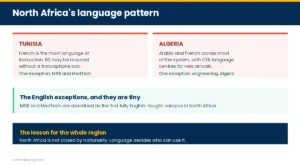
MSB and MedTech, part of South Mediterranean University, are described as the first fully English-taught campus in North Africa.
That matters beyond Tunisia. Our guide on studying in Algeria found the same shape: a French and Arabic system with one English exception, there being engineering at the University Pole of Excellence in Algiers. North Africa is not closed to English speakers; it simply concentrates them in a very small number of places.
The trade-off is price. MSB and MedTech sit at the top of Tunisia’s private fee range, which the next section puts in context.
What it costs
Tunisia prices its universities modestly by any standard your readers will compare against.
Public universities charge foreign students roughly 5,000 to 15,000 Tunisian dinars a year, which the guide puts at about €1,500 to €4,500.
Private institutions charge roughly 6,000 to 22,000 dinars, about €1,750 to €6,000, with MSB and MedTech at the expensive end of that band.
Set those against the rest of this series. Latvia works out near €7,000 for a full year including living. Türkiye’s state universities start around €100 a year. Tunisia sits between them on tuition, with the French requirement as the thing that really decides whether it is available to you.
How you actually get in
The Tunisian process has a specific first step that people miss, and it has a name.
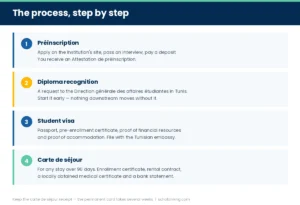
You begin with a pre-enrollment, the prescription. You apply on the institution’s own website, pass an interview, and pay a deposit. What you receive in return is an Attestation de préinscription, and that document is what the rest of the process runs on.
Your previous qualification then needs recognition. A request goes to the Direction générale des affaires étudiantes in Tunis to have your diploma recognized — the same kind of equivalence step we met in Egypt and Algeria, and the same advice applies: start it early, because nothing downstream moves without it.
For the visa, deal with the Tunisian embassy and ask what a Pakistani applicant files. The documents named for a student visa are a passport, the pre-enrollment certificate, proof of financial resources and proof of accommodation.
Once you are in the country for more than 90 days, you need a carte de séjour, applied for at a police station with your certificate of enrollment, a rental contract, a medical certificate obtained locally and a bank statement. Keep the receipt, because the permanent card can take several weeks to arrive.
Who Tunisia suits
It suits anyone who already reads French, for whom the whole public system opens at €1,500 to €4,500 a year.
It suits a reader willing to spend a year on French first, since the fee level makes that investment rational in a way it would not be for a more expensive country.
And It suits an English-speaking applicant with a private budget, through MSB or MedTech, understanding that those sit at the top of the private range.
It does not suit a reader who needs full funding and has no French, because the scholarship routes into the public system lead into French-taught faculties. For funding that reaches Pakistani applicants in English, our guides on Qatar and Thailand remain the two strongest in this series.
Eligibility criteria
1. A recognized previous qualification, through a request to the Direction générale des affaires étudiantes in Tunis.
2. French at B2, unless you hold a baccalauréat from a francophone country.
3. A pre-enrollment, which involves an application, an interview and a deposit.
4. For the scholarship: an embassy application, rather than a direct one to a university.
5. Proof of financial resources and accommodation for the student visa.
6. A carte de séjour for any stay beyond 90 days.
Step-by-step application process
Step 1, today: answer the French question honestly. If the answer is no and will stay no, your Tunisian route is MSB or MedTech with a private budget, and the rest of this list changes accordingly.
2, this week: contact the Tunisian embassy and ask two things — whether Pakistani nationals may apply for the state scholarship, and what the current cycle requires. The scholarship runs through them, so they are the only reliable source on it.
Step 3, this week: shortlist institutions and check each one’s language of instruction before you check its fees. In Tunisia that order matters.
4, November: begin diploma recognition with the Direction générale des affaires étudiantes.
Step 5, November: apply for pre-enrollment at your chosen institution, and prepare for the interview that forms part of it.
6, December: if French is your plan, start it now. B2 is a year of serious work from a standing start, not a summer.
Step 7, once you hold the Attestation de préinscription: begin the visa file, with proof of financial resources and accommodation.
8, on arrival: arrange the medical certificate locally and apply for the carte de séjour within your first 90 days.
Step 9: keep the receipt for that application, since the permanent card takes several weeks.
FAQ
Does Tunisia offer scholarships to international students?
Yes. The Ministry of Higher Education and Scientific Research runs a state scholarship through its international cooperation directorate, covering tuition at public institutions plus a monthly allowance. Applications go through the embassy.
Can Pakistani students apply?
The route exists and is not described as nationality-restricted, but we could not confirm Pakistan’s inclusion from an official Tunisian page. Ask the embassy before building a plan around it.
Do I need French?
For the public system, usually yes. French is the main language of instruction, especially in science, technical and economics fields, and B2 may be required without a francophone baccalauréat.
Is anything taught in English?
Yes. MSB and MedTech, part of South Mediterranean University, are described as the first fully English-taught campus in North Africa.
What does it cost?
Public universities charge foreign students roughly 5,000 to 15,000 dinars a year, about €1,500 to €4,500. Private institutions charge roughly 6,000 to 22,000 dinars, about €1,750 to €6,000.
What is a préinscription?
A pre-enrollment. You apply on the institution’s website, pass an interview and pay a deposit, and receive an Attestation de préinscription that the rest of the process depends on.
Does my degree need recognition?
Yes, through a request to the Direction générale des affaires étudiantes in Tunis. Start it early.
What do I need for the student visa?
A passport, the pre-enrollment certificate, proof of financial resources and proof of accommodation. File with the Tunisian embassy.
Do I need a residence card?
Yes, for stays over 90 days. You apply at a police station with your enrollment certificate, rental contract, a locally obtained medical certificate and a bank statement.
Are there discounts at private universities?
Yes, merit-based partial scholarships and reductions of 20% to 50%, awarded by the institutions themselves.