
How to Study in India from Pakistan:
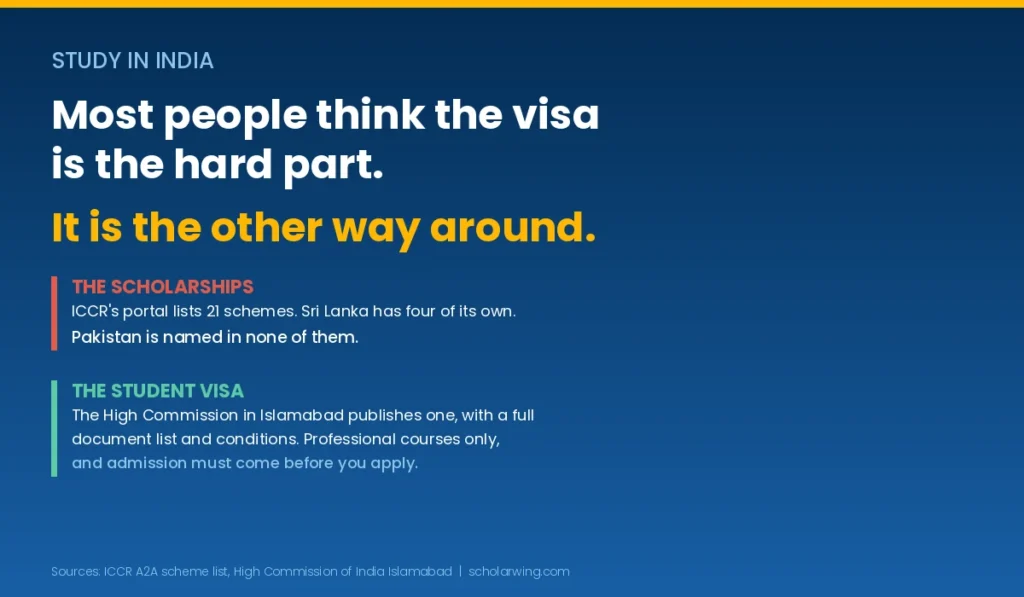
Almost every question we receive about India assumes the same thing: that the visa is impossible and the scholarship is worth a try.
The official pages say the reverse, and that single correction is the reason for this post.
What ICCR’s own portal shows
The Indian Council for Cultural Relations runs India’s scholarships for foreign students through its A2A portal, and the portal lists 21 schemes.
Read down the eligibility column and the pattern is clear. Most schemes name a single country or a small group: Sri Lanka has four of its own, Nepal, Bhutan, Maldives, Mongolia, Bangladesh and Malaysia each have theirs, Mekong Ganga covers five Southeast Asian states, and India-Africa Maitri covers African countries.
Pakistan is named in none of them.
A handful of schemes name a category rather than a list. The Atal Bihari Vajpayee General Scholarship says “Asian and American, Eurasia, Europe, Oceania Countries”. The Dr. A.P.J. Abdul Kalam Commonwealth Scholarship says only “Commonwealth countries”. The AYUSH Non-BIMSTEC scheme refers to 102 countries without naming them.
We are not going to tell you those include Pakistan, because the portal does not say so and guessing is how readers lose months. We are going to tell you that the Commonwealth scheme is the one worth one email, since Pakistan is a Commonwealth member and the scheme names no countries at all. Write to ICCR and ask. If the answer is yes, that is a genuinely new route for Pakistani students and nobody has published it.
Now the part everybody gets backwards
The High Commission of India in Islamabad publishes a student visa for Pakistani passport holders, and it publishes exactly what the file must contain.
The documents it names: a letter of admission from a recognized and approved academic institution in India, proof of adequate financial standing for study and living costs in the form of a bank statement, a copy of your NADRA card with a notarized English translation, a utility bill — electricity, gas or landline — as address proof, and a valid polio vaccination certificate.
That last pair is where applications fail. A notarized translation and a polio certificate are not difficult, and they are also not things anybody assembles in a week.

The four conditions that decide whether this applies to you
One: professional courses only. The page names engineering, medicine, law and management. If your plan is a general arts or science degree, this route is not built for it.
Two: admission comes first. The page states that no visa is granted to explore or secure admission to an Indian institution. Your entire application, from choosing the university to receiving the offer letter, happens while you are in Pakistan.
Three: you leave after you finish. The page puts it directly: all students from Pakistan, after completion of their studies, will have to leave India. Plan around a degree, not around what might follow it.
Four: registration on arrival. You must register with the police or FRRO within 24 hours of arriving, and give 24 hours’ notice before departure. Those are short windows, and missing them is an administrative problem you do not want in a country where your stay is already conditional.
Two smaller notes. At school level, the visa covers only recognized international schools that admit international students and carry high fee structures. And courses in music, dance, yoga and similar subjects qualify only at institutions recognized by the Ministry of Home Affairs in New Delhi.
On fees, the High Commission states that under a 2012 agreement between the two countries, Pakistani citizens pay PKR 100 per application for all visa categories. It also states, as every mission does, that the fee is non-refundable and that paying it guarantees nothing.
So what does “free” actually mean here
Honestly? For most readers, it does not.
With no ICCR scheme naming Pakistan, the realistic route into India is self-funded study in a professional course, with a bank statement proving you can pay for it. That is a real option for some families and an impossible one for most, and pretending otherwise helps nobody.
Where the funded routes actually are
If funding is the constraint rather than the country, this series has already mapped the alternatives, and two of them are close by and genuinely open.
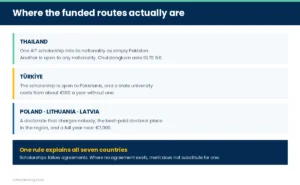
Our guide on studying in Thailand free found a scholarship at the Asian Institute of Technology with nationality listed simply as Pakistan, another open to any nationality, and a Chulalongkorn award asking only IELTS 5.0. Our guide on studying in Türkiye free found both a scholarship open to Pakistanis and state universities charging from around €100 a year.
Further out, Poland offers doctoral study that charges nobody tuition, Lithuania pays the best-funded doctorate in that region, and Latvia prices a full year near €7,000.
One rule explains all of it, India included. Scholarships follow agreements. Where no agreement exists, no amount of merit substitutes for one. India’s visa page is detailed and workable. Its scholarship list simply does not have our name on it.
Eligibility criteria
1. A professional course. Engineering, medicine, law or management, as the visa page names them.
2. An admission letter from a recognized, approved institution, obtained before you apply for the visa.
3. Proof of adequate financial standing, as a bank statement covering study and living costs.
4. A NADRA card copy with a notarized English translation.
5. A utility bill in the form of an electricity, gas or landline bill, as address proof.
6. A valid polio vaccination certificate.
Step-by-step application process
Step 1, today: decide whether you can self-fund. With no ICCR scheme naming Pakistan, this is the question the whole plan rests on, and answering it first saves everything else.
Step 2, today: send one email to ICCR asking whether Pakistani nationals may apply under the Dr. A.P.J. Abdul Kalam Commonwealth Scholarship, which names Commonwealth countries without listing them. A clear answer either way is worth having.
Step 3, this week: confirm your course is professional. Engineering, medicine, law or management. If it is not, read our Thailand and Türkiye guides instead.
Step 4, this week: check the institution is recognized and approved. The visa page requires it, and an offer from an unrecognized institution is a wasted application.
Step 5, November: apply for admission from Pakistan. No visa exists for travelling to look for a place.
Step 6, November: start the NADRA translation and the polio certificate. Both are simple and both take longer than people expect.
Step 7, December: assemble the bank statement showing you can cover study and living costs.
Step 8, once you hold the admission letter: apply to the High Commission. The fee is PKR 100, non-refundable, and it guarantees nothing.
Step 9, on arrival: register with the police or FRRO within 24 hours, and give 24 hours’ notice before you leave.
FAQ
Can Pakistani students get an ICCR scholarship?
ICCR’s portal lists 21 schemes and names Pakistan in none of them. A few schemes name categories such as “Commonwealth countries” without listing members, so ask ICCR directly rather than assuming either way.
Is there a student visa for Pakistani nationals?
Yes. The High Commission of India in Islamabad publishes one, with a document list and conditions. This surprises most readers more than the scholarship answer does.
Which courses does it cover?
Professional courses, named on the page as engineering, medicine, law and management. School-level study is limited to recognized international schools with high fee structures, and music, dance and yoga courses to institutions recognized by the Ministry of Home Affairs.
Can I travel to India to look for admission?
No. The page states that no visa is granted to explore or secure admission. The offer letter comes first.
What documents does the visa need?
An admission letter from a recognized institution, a bank statement proving financial standing, a NADRA card copy with a notarized English translation, a utility bill as address proof, and a valid polio vaccination certificate.
How much does the visa cost?
PKR 100 per application for all categories under a 2012 agreement between the two countries. It is non-refundable and does not guarantee a visa.
Do I have to register after arriving?
Yes, with the police or FRRO within 24 hours of arrival, and you must give 24 hours’ notice before departure.
Can I stay and work after graduating?
No. The page states that all students from Pakistan must leave India after completing their studies.
So can I study in India for free?
On current official listings, no funded route names Pakistan. The realistic option is self-funded study in a professional course.
Where should I look instead?
Thailand and Türkiye are the two nearest countries in our series with routes genuinely open to Pakistani applicants, including one scholarship reserved for Pakistan.