
Study in Lithuania Free:
This is the fourth country we have checked in a row, and it finally breaks the pattern in your favor.
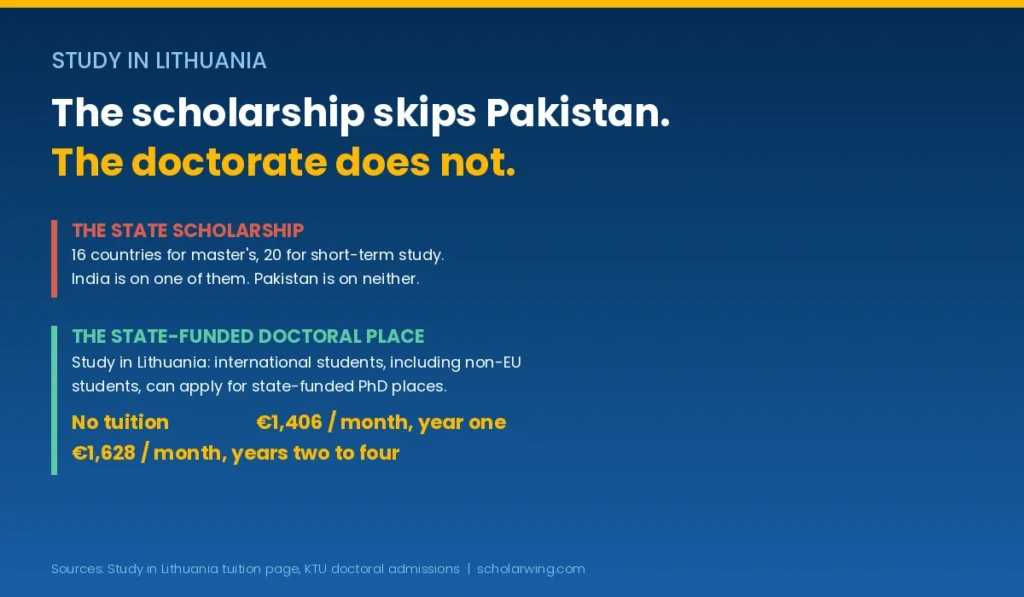
The first three went the same way. Poland’s famous scholarships exclude Pakistan. Slovenia reserves free study for its neighbors. Latvia’s state scholarship lists 39 countries and skips us. Lithuania’s national scholarship does exactly the same thing.
Then you reach the doctoral page, and the numbers stop looking Baltic and start looking generous.

The closed door first, so nobody wastes a month on it
The Lithuanian State Scholarship for full-time master’s studies names sixteen countries plus foreign citizens of Lithuanian origin: Armenia, Azerbaijan, China including Taiwan, Georgia, Indonesia, Israel, Japan, Kazakhstan, Moldova, New Zealand, the Philippines, South Korea, Ukraine, the United States, Uzbekistan and Vietnam.
The short-term studies scholarship uses a slightly wider list, adding Australia, Canada, India and the United Kingdom.
Pakistan appears on neither. As with Latvia and Poland, the reason is diplomatic rather than academic: these scholarships run on cooperation agreements, and no agreement names Pakistan.
Two things about that scholarship deserve a mention anyway, because Pakistani sites describe it as fully funded and it is not. It pays 8 Basic Social Amounts, which came to €592 a month in 2026, and it covers study costs only up to the national standard study cost — at a university charging more, the student pays the difference. Holders must also reach A1 Lithuanian within their first academic year. The 2026 master’s deadline fell on 20 April and the short-term deadline on 17 April, both at 4pm Vilnius time, through the agency’s own online system rather than by email.
Now the page that matters
Study in Lithuania’s own tuition page lists who may hold a state-funded place, and the third line is the one to read twice.
EU citizens may apply for state-funded places. Citizens of selected non-EU countries may apply for the master’s scholarships. And then: “international students, including non-EU students, can apply for state-funded PhD places.”
No country list. No cooperation agreement. And no Lithuanian origin requirement.
What a state-funded doctoral place is actually worth
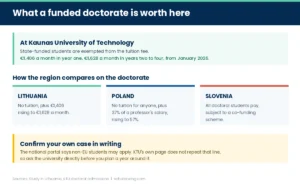
Kaunas University of Technology publishes the figures on its own doctoral admissions page, and they are not modest.
Students admitted to state-funded positions are exempted from the tuition fee. On top of that, from 1 January 2026, a doctoral candidate receives €1,406 a month in the first year and €1,628 a month in years two to four. Some candidates also reach additional awards from the Research Council of Lithuania or the university’s own fund, though nobody should count on those.
Set that beside the rest of the region. Our guide on studying in Poland free found Polish doctoral schools charging nobody tuition and paying a scholarship set at 37% of a professor’s base salary, rising to 57%. Lithuania pays more, in cash, with the figure published rather than calculated. Our guide on studying in Slovenia free found the opposite case entirely, where the university lists all doctoral students among those who pay.
The practical details are easy enough. A non-EU applicant pays a €132 application fee at KTU. Holders of certain third-country qualifications sit a mathematics test, the OMPT-D. The scholarship schedule runs four years, which tells you the programme length. And the timing is the thing to diary: KTU expects to publish its next round in February 2027, with the main admission usually held in June and July.
If the doctorate is not your stage yet
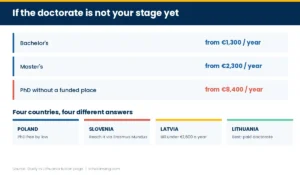
Lithuania prices taught degrees low, in the same way Latvia does. Study in Lithuania’s own averages start at €1,300 a year for a bachelor’s and €2,300 a year for a master’s. A doctorate outside a state-funded place starts at €8,400, which is exactly why the funded place matters so much.
Those bachelor’s and master’s numbers put Lithuania alongside Latvia at the affordable end of the European Union, and our guide on studying in Latvia works through what a realistic full year costs once living expenses go in. The same arithmetic applies here, and nobody’s permission is required for either.
Eligibility criteria
1. For the state-funded doctorate: a master’s degree and a research project. Doctoral admission runs on your proposal and a supervisor, not on a scholarship form.
2. For the state-funded doctorate: nothing about your nationality, according to Study in Lithuania’s own wording. Confirm your own case with the university before you build a year around it, because university pages do not always repeat the national portal’s line.
3. A mathematics test, for some applicants. KTU requires the OMPT-D from holders of certain third-country qualifications, so ask early whether your degree triggers it.
4. For the Lithuanian State Scholarship: citizenship of one of the listed countries. Pakistan is not among them, and A1 Lithuanian is required within the first year for those who are.
5. For a taught degree: admission plus the fee, starting around €1,300 a year for a bachelor’s.
6. English, not Lithuanian, for most international programmes. Our scholarships without IELTS page covers the institutions accepting a medium-of-instruction certificate, though you should confirm directly.
Step-by-step application process
Step 1, today: work out whether you are a doctoral applicant. If you hold a master’s, this is the best-paid open door in the four countries we have checked, and the rest of this list is for you.
Step 2, this week: write to Lithuanian universities’ doctoral offices and ask one direct question in writing: can a Pakistani national be admitted to a state-funded doctoral place, and what does it pay in 2027. Ask KTU, Vilnius University and Vilnius Gediminas Technical University, since the answer may differ.
Step 3, this week: ask whether your degree triggers the OMPT-D mathematics test, and if so, when it runs.
Step 4, November: identify supervisors, not programmes. A doctoral place belongs to a research topic and a person. Our guide on asking a professor for a reference letter covers opening that correspondence properly.
Step 5, November: request transcripts and a grading-scale explanation. Pakistani universities are slow with the second.
Step 6, December: write the research proposal. This is the document the place is awarded on, and our personal statement guide covers building an argument rather than listing interests.
Step 7, December: build a European-format CV with our free CV builder.
Step 8, February 2027: watch for the admission round. KTU expects to publish then, with the main admission usually in June and July.
Step 9, once a year: recheck the state scholarship country lists. They change, India sits on one of the two lists already, and the day Pakistan appears is the day this advice changes.
FAQ
Can Pakistani students apply for the Lithuanian State Scholarship?
No. The master’s scholarship names sixteen countries plus people of Lithuanian origin, and the short-term scholarship adds four more including India. Pakistan is on neither list.
Is that scholarship fully funded?
No. It pays €592 a month on the 2026 figure and covers study costs only up to the national standard study cost, so students at pricier universities pay the difference. Holders must also reach A1 Lithuanian in their first year.
Can a Pakistani student get a funded PhD in Lithuania?
Study in Lithuania’s own tuition page states that international students, including non-EU students, can apply for state-funded PhD places. Confirm your own case with the university in writing before you rely on it.
What does a state-funded doctoral place pay?
At KTU, no tuition plus €1,406 a month in the first year and €1,628 a month in years two to four, on the figures published for 2026 onwards.
How does that compare with Poland?
Lithuania pays more in cash. Poland sets its doctoral scholarship at 37% of a professor’s base salary, rising to 57% after the mid-term evaluation, and also charges no tuition at all.
How long is the doctorate?
The published scholarship schedule covers four years, which indicates a four-year programme.
What does a taught degree cost?
From about €1,300 a year for a bachelor’s and €2,300 for a master’s on Study in Lithuania’s own averages, with a non-state-funded doctorate starting at €8,400.
Is there an application fee?
KTU charges non-EU applicants €132 for doctoral admission. Other universities set their own.
Will I need a math’s test?
Possibly. KTU requires the OMPT-D from holders of certain third-country qualifications. Ask before you assume either way.
When should I apply?
Diary February 2027, when the next round is expected, with the main admission usually falling in June and July.