
Pierre Elliott Trudeau Foundation Scholarships
The Pierre Elliott Trudeau Foundation Scholarship is the most generous doctoral award in Canada.
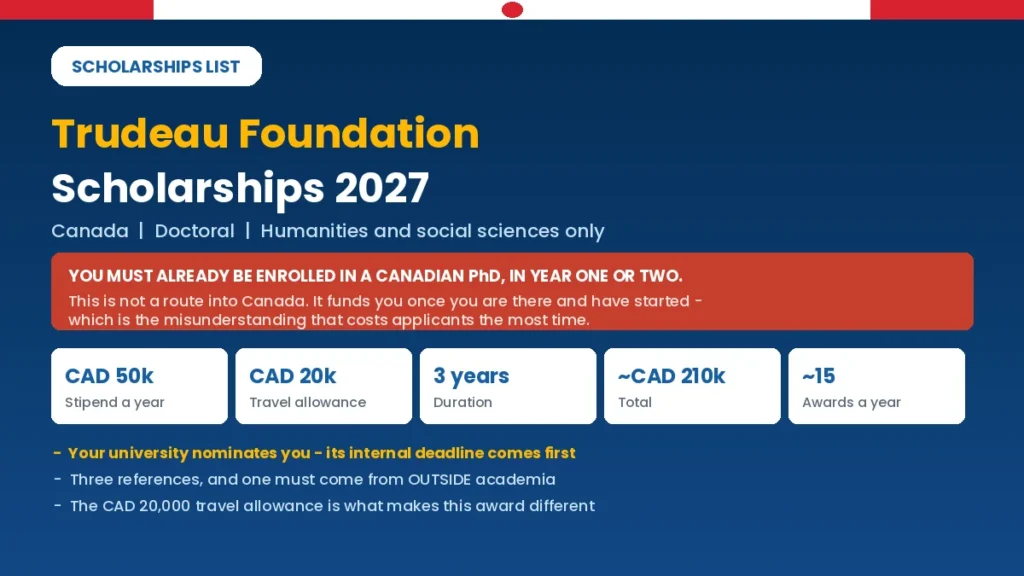
It pays an annual stipend of up to CAD 50,000 for three years, plus a separate allowance of up to CAD 20,000 a year for research, travel, language learning and leadership activities. Over three years that reaches roughly CAD 210,000.
Now the part that decides whether you can use it. You must already be enrolled in a doctoral programme at a Canadian university, in year one or two, when you apply.
That single condition removes most people who search for “fully funded PhD in Canada”. This is not a scholarship that brings you to Canada. It is a scholarship that funds you once you are there and have started.
Two further conditions narrow it again. Your research must sit broadly within the humanities or social sciences, which excludes most of the sciences and engineering. And your university must nominate you, you cannot send your file straight to the Foundation and have it considered.
What remains, for the people who do fit, is unusually good. Roughly 15 scholarships go out each year, the money is substantially above standard Canadian doctoral funding, and the award carries a leadership and public-engagement programme that several past scholars describe as worth more than the stipend.
This guide covers who qualifies, how the nomination actually works, what the four themes mean in practice, the reference letter that catches everyone out, and whether the award suits your plans.
Who Can Actually Apply
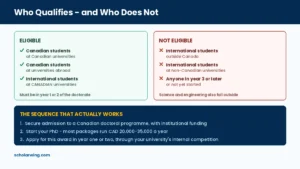
The Foundation recognises three categories of applicant:
Canadian students at Canadian universities. The core group.
Canadian students at universities outside Canada. A Canadian doing a doctorate at Oxford, Harvard or the Sorbonne can apply.
International students at Canadian universities. This is the route that matters to most readers of this site, and it is genuinely open, an international doctoral student in Canada competes on the same footing.
And the group that cannot apply: international students outside Canada, or at non-Canadian universities. If you hold a Pakistani, Indian, Nigerian or Bangladeshi passport and you are studying anywhere other than a Canadian university, this award does not reach you.
You must sit in year one or two of your doctorate at the time of application. Not before you start, and not in year three. The Foundation funds people early enough for the award to shape their doctorate.
Your field must relate broadly to the humanities or social sciences. The Foundation reads this reasonably widely public health, law, business and policy-adjacent work have all qualified where the research question fits, but a straightforward physics, chemistry, engineering or clinical laboratory project does not.
The practical conclusion for international readers. If Canada appeals to you and your field is in the humanities or social sciences, the sequence is: secure admission to a Canadian doctoral programme first, with whatever funding gets you there, then apply for this award in your first or second year. People who treat it as an entry route lose a cycle discovering otherwise.
What the Money Actually Is
The award has two separate components, and the second one is what makes this scholarship different from every other doctoral award in Canada.
The stipend: up to CAD 50,000 a year, for three years. This covers tuition and living costs. Canadian doctoral funding packages commonly run between CAD 20,000 and CAD 35,000, so this roughly doubles a typical package.
The allowance: up to CAD 20,000 a year, for three years. This is not extra stipend. It funds research travel, fieldwork, language learning, conference attendance and the Foundation’s own leadership programming. It exists so that scholars can go where their research takes them and build networks beyond their department.
Total: up to roughly CAD 210,000 over three years.
Older scholarship listings still quote CAD 40,000 plus CAD 20,000, which was the earlier rate. The figures have risen. Confirm the current amounts on the Foundation’s own page before you budget, because they change.
What the allowance means in practice. A doctoral student in political science studying refugee policy can do fieldwork in three countries rather than reading about them. A student of Indigenous legal traditions can spend months in communities rather than in a library. For humanities and social science research, the travel budget frequently matters more than the stipend, because it is the thing no other funding provides.
The Four Themes
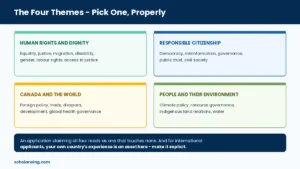
Your research must address at least one of the Foundation’s four founding themes. These are not keywords to sprinkle into an application reviewers assess the connection seriously.
Human Rights and Dignity. Work on equality, justice, migration, disability, gender, labour rights, access to justice, the treatment of minorities, humanitarian questions.
Responsible Citizenship. Democratic participation, media and misinformation, civic institutions, governance, public trust, civil society, the obligations that bind people to one another.
Canada and the World. Foreign policy, trade, diaspora communities, international development, global health governance, Canada’s place in multilateral institutions, comparative work that places Canada against other countries.
People and their Natural Environment. Climate policy, resource governance, Indigenous relationships with land, environmental justice, agriculture, water, the social dimensions of ecological change.
How to use them properly. Pick the one theme your work genuinely belongs to and build the application around it, rather than claiming three. An application arguing that a project touches all four reads as an application that touches none.
The Canada connection. The Foundation funds research that addresses issues shaping Canada’s future. Comparative and international work qualifies, a study of housing policy in four countries including Canada fits, as does work on a diaspora community, a trading partner or a shared environmental system. Research with no plausible line to Canada does not, however excellent it is.
For international applicants specifically. Your own country’s experience is an asset here rather than a problem. A Pakistani scholar working on climate displacement, a Nigerian scholar on resource governance, an Indian scholar on federalism each brings a comparative frame that Canadian-only applicants cannot. Make that explicit rather than apologizing for it.
How the Nomination Works
This is where applications quietly fail, because the process has a step most applicants do not know exists.
You register with the Foundation, and your application routes to your own university.
Your university runs an internal competition. It decides which of its doctoral students it will put forward. Most universities may nominate only a limited number, so you are competing against your own institution’s candidates before you reach the national competition at all.
Your university submits its nominations to the Foundation by the national deadline.
Two consequences follow, and both change how you should plan.
Your real deadline is your university’s internal one, not the Foundation’s. The Foundation’s 2027 window has run from 1 September to 6 November 2026. University internal deadlines fall weeks to months earlier, commonly through September and October. This is why you will see different dates on different websites, some quote the national date, some quote an institutional one. Find your own university’s date from your graduate studies office, and treat that as the deadline that binds you.
Your graduate studies office is your first contact, not your last. Email them early, ask when the internal competition opens, ask how many nominations the university holds, and ask who sits on the internal committee. Many departments also run a departmental step before the university-wide one, which pushes your effective start date earlier again.
Students who begin this in August for a November national deadline have usually already missed their institution’s internal date.
The Reference Letter Nobody Prepares For
The application asks for three references, and the third one surprises nearly everybody.
One from your doctoral supervisor. Straightforward.
One from another academic referee. Also straightforward.
One from outside academia. This is the one applicants scramble for in the final fortnight.
The Foundation wants evidence that you engage beyond the university, that someone in a community organization, a public body, a newsroom, an NGO, a professional association or a policy institute knows your work and can speak to its value.
If you already have that relationship, ask early. People outside universities are not in the habit of writing academic references and need more time, more context and more guidance than an academic referee does. Send them your research summary, the Foundation’s criteria, the deadline and a note on what the letter should address.
If you do not have that relationship, treat it as a finding about your application rather than a problem with the form. The Foundation is looking for engaged scholars, and an applicant with no non-academic connection to their field is telling the committee something. Build the relationship this year: present your work to a community group, write for a policy outlet, advise an organization working in your area, join a professional body. That work strengthens the whole application, not just the letter.
What the Selection Rewards
The Foundation states four things it looks for, and the weighting differs from a standard research scholarship.
Academic excellence. Necessary, and not sufficient. Every nominated candidate has it.
A research project addressing issues shaping Canada’s future. The project must matter outside the discipline. A reviewer should finish your summary able to say why the research changes something.
Commitment to positive impact. Evidence that you act on your convictions , organizing, advocacy, community work, policy engagement, teaching beyond requirement. The Foundation builds a community of engaged scholars, so it funds people who already engage.
Willingness to engage in dialogue. This one is unusual and genuine. Trudeau Scholars join a programme that brings them into sustained conversation with mentors, fellows and people who disagree with them. The Foundation looks for intellectual openness rather than certainty, and applications written as advocacy rather than inquiry tend not to succeed.
What that means for your writing. Where a research council application rewards methodological rigors, this one rewards significance and engagement alongside it. Spend proportionally more of your file on why the question matters and what you do about it, and less on the fine detail of your method.
A Note on the Foundation Itself
Anyone committing three years to a programme deserves to know the organization’s recent history, so here it is briefly and factually.
In April 2023 the Foundation’s president and its board of directors resigned, in a dispute over the handling of a donation linked to China and what they described as the politicization of the organization. The episode drew substantial Canadian media coverage and parliamentary attention, and it prompted a review of the Foundation’s governance.
The scholarship programme continued through all of it. The Foundation has named cohorts each year since, and the competition for 2027 has run on its normal schedule.
Mentioning this is not a warning. A doctoral applicant weighing a three-year commitment should know an organization’s recent record, and should find it in a guide rather than in a news search after accepting. The programme runs; the governance questions belong to the organization’s history; both facts are true at once.
Getting Into a Canadian Doctorate First
Since the award requires you to be enrolled already, the realistic path for an international reader starts a year or two earlier. This section covers that step, because without it nothing else here applies.
Canadian doctoral admission runs through a supervisor. In the humanities and social sciences, departments admit students a supervisor has agreed to work with. The application form matters less than the conversation that precedes it.
Write to academics in the autumn before you apply. Most Canadian doctoral deadlines fall between December and February for a September start. An email in October gives a professor time to consider you; an email in January does not.
Make the email short and specific. Name a paper of theirs, state your question, explain the connection, and ask one easy question. Attach your CV and nothing else.
Dear Professor Okonkwo,
I completed an MPhil in political science at the University of Dhaka, where my thesis examined how local government reform changed flood response in three riverine districts.
Your 2025 article on decentralization and climate adaptation argues that fiscal autonomy matters more than administrative autonomy. My Bangladeshi cases cut the other way, and I think the difference is worth explaining rather than averaging away.
I am preparing a doctoral application for September 2027 and would like to ask whether you are taking students. I can send a three-page proposal if that would help.
Kind regards, Nusrat Jahan
Expect funding with the admission offer. Canadian doctoral programmes in these fields usually attach a funding package CAD 20,000 to CAD 35,000 a year from fellowships, teaching assistantships and supervisor grants. This package is what makes the doctorate possible. The Trudeau award, if it comes later, sits on top of or in place of part of it.
Ask directly about the funding package before accepting. Guaranteed years, the teaching load attached, whether tuition comes out of the stipend or separately, and what happens in years five and six. Departments answer these questions readily, and the answers vary enormously between institutions.
Then plan the Trudeau application for your first or second year. Mark it in your calendar when you accept your offer, because by the time you are deep in coursework the internal deadline arrives faster than you expect.
Which Canadian Universities to Target
The scholarship is national, so it is worth the same wherever you hold it. Your choice of university should therefore turn on supervision and departmental strength rather than on the award.
Toronto, McGill and UBC hold the largest humanities and social science faculties and nominate candidates every year. They also attract the most applications, both for admission and in their internal competitions.
Ottawa and Carleton sit beside the federal government, which matters enormously for policy, governance and international affairs research. Access to officials, archives and policy networks is a genuine advantage for work on the Responsible Citizenship and Canada and the World themes.
Queen’s, Western and McMaster run strong mid-sized departments with lower internal competition than the big three, which can matter more than prestige when your university nominates only a handful of candidates.
Montreal’s francophone universities Université de Montréal, Laval, UQAM offer excellent social science research and a smaller applicant pool for anglophone international students willing to work bilingually. Quebec also charges lower tuition than most provinces.
Alberta, Saskatchewan and Manitoba lead on Indigenous studies, rural policy, agriculture and resource governance, which map directly onto the People and their Natural Environment theme.
Dalhousie and Memorial anchor ocean, fisheries and coastal community research on the Atlantic coast.
A strategic note worth weighing. Your university nominates a limited number of candidates. A strong applicant at a mid-sized university may face four internal competitors; the same applicant at Toronto may face forty. Supervision quality should decide your choice, but where two options are genuinely close, the smaller internal pool is a real consideration that almost nobody factors in.
Building the Application Over a Year
The strongest files take a year to assemble, and most of that year goes into things the form does not ask for directly.
Twelve months out. Identify your theme and sharpen the public significance of your project. Write one paragraph explaining why your research matters to someone outside your discipline, and rewrite it until a friend in another field understands it.
Ten months out. Begin the relationship that produces your non-academic reference. Offer to present your work to a community organization, a professional body or a policy group working in your area. This builds the letter and strengthens your impact case at the same time.
Eight months out. Ask your graduate studies office for the internal competition dates and the number of nominations your university holds.
Six months out. Draft the research summary. Show it to your supervisor and to one person outside your discipline, because both read your file.
Four months out. Approach all three referees formally. Give each one your summary, the Foundation’s criteria and the deadline. Give the non-academic referee more guidance than the others, since they will not have written this kind of letter before.
Three months out. Write the engagement and impact sections. These need specifics, what you organized, who you advised, what changed, so gather the details rather than generalizing.
Two months out. Submit to your university’s internal competition. This is your real deadline.
At the national deadline. Your university submits. Your work is done, and the waiting begins.
Six Mistakes That Cost Applicants This Award
Treating it as a route into Canada. You must already be enrolled in a Canadian doctorate, in year one or two. This is the misunderstanding that costs the most people the most time.
Applying from a non-Canadian university as an international student. Canadians abroad qualify. International students abroad do not.
Working to the Foundation’s deadline. Your university’s internal deadline comes first, and missing it ends your application before the Foundation ever sees it.
Claiming all four themes. Pick the one your work belongs to and make the case properly.
Leaving the non-academic reference to the end. It is the hardest of the three to obtain and the one most likely to arrive late or thin.
Writing a research-council application. This competition weighs significance, impact and engagement alongside rigors. A file optimized purely for methodological strength under-performs here.
How This Compares With Other Canadian Doctoral Funding
The Canada Graduate Research Scholarship – Doctoral is the national award that replaced Vanier, paying CAD 40,000 a year for three years. It covers all disciplines rather than only the humanities and social sciences, and it carries no leadership programme. Apply for both where you qualify; they do not compete.
Institutional doctoral funding at Canadian universities generally runs CAD 20,000 to CAD 35,000 a year through a mix of fellowships, teaching assistantships and supervisor grants. This is what most doctoral students live on, and it is usually the package that gets an international student into Canada in the first place.
The Canada Postdoctoral Research Award sits at the next stage, paying CAD 70,000 a year for two years after the doctorate, with a cap limiting foreign citizens to 20% of awards.
Provincial and donor awards exist at every university, typically CAD 10,000 to CAD 25,000, and attract far fewer applications than the national competitions.
The honest summary: the Trudeau award is the most generous and the most distinctive doctoral funding in Canada for humanities and social science researchers, and it is available only to people already inside the system. Plan your entry on institutional funding, then compete for this once you are there.
What Being a Trudeau Scholar Involves
The money is one part of the award. The programme is the other, and past scholars consistently describe it as the more valuable half.
Scholars join a cohort and take part in the Foundation’s gatherings, retreats and public-engagement activities alongside Trudeau Fellows, who are established academics, and Mentors, who are leaders drawn from public life, business, the arts and the non-profit world.
The design is deliberate. A doctoral student in environmental policy ends up in sustained conversation with a former deputy minister, a journalist, an Indigenous leader and a social scientist from a different discipline. That network is difficult to build from inside a department and it tends to shape careers more than a publication does.
The commitment is real too. Expect to attend events, present your work to non-specialist audiences, and engage with people whose views differ from yours. An applicant who wants only the stipend and no obligations should say so to themselves honestly before applying, because this programme asks for participation.
Frequently Asked Questions
How much is the Trudeau Foundation Scholarship worth?
Up to CAD 50,000 a year as a stipend plus up to CAD 20,000 a year as a research and travel allowance, for three years roughly CAD 210,000 in total. Older listings quote lower figures.
Can international students apply?
Yes, if you are enrolled at a Canadian university. International students at universities outside Canada cannot apply.
Do I need to be already studying in Canada?
Yes, unless you are a Canadian citizen studying abroad. You must be in year one or two of your doctorate when you apply.
Which fields qualify?
Research broadly within the humanities and social sciences that connects to at least one of the four Foundation themes. Most laboratory sciences and engineering fall outside.
How many scholarships are there?
Around 15 a year.
Do I apply directly to the Foundation?
You register with the Foundation, but your university runs an internal competition and nominates candidates. Your university’s internal deadline is the one that binds you.
When is the deadline?
The 2027 competition window has run from 1 September to 6 November 2026, with university internal deadlines falling earlier. Confirm both.
What is the unusual reference requirement?
Three letters: one from your supervisor, one from another academic, and one from outside academia.