
Adelaide Global Academic Excellence Scholarships
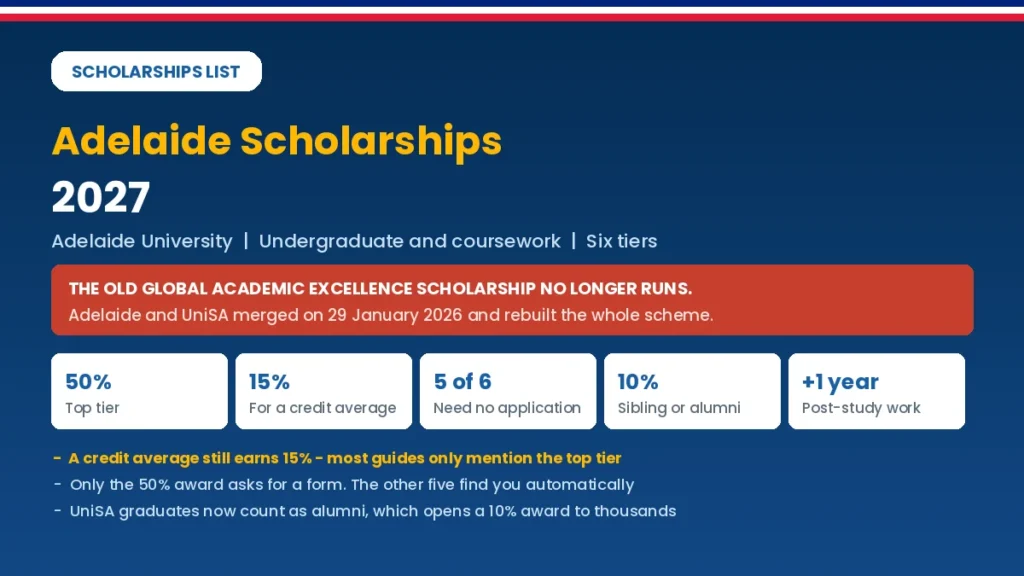
If you searched for the Adelaide Global Academic Excellence Scholarship and landed here, start with this: that scholarship, under that name, no longer runs.
On 29 January 2026, the University of Adelaide and the University of South Australia merged to create Adelaide University, a single institution of around 64,000 students across seven South Australian campuses. The old scholarship page now redirects, and the university has rebuilt the programme under new names with new thresholds.
Nearly every scholarship listing site still describes the old version, a 50% award requiring an ATAR of 98 or 99.9, two per faculty, with a 2020-era deadline. Students read those pages, decide their grades fall short, and never discover that the replacement scheme reaches considerably further down.
Here is what actually exists now. Adelaide University runs six international scholarship tiers, from 50% of tuition down to 10%. Five of the six are automatic, no form, no essay. And the entry point is not an ATAR of 99: a credit average earns a 15% reduction.
That last sentence is the useful one. Most guides only mention the top tier, which means a large group of perfectly good students conclude there is nothing for them at Adelaide. There usually is.
What Changed, and Why It Matters
The merger is not administrative trivia for an applicant. It changes three things you should know before you apply.
The institution. Adelaide University opened on 29 January 2026, combining the University of Adelaide founded in 1874, Australia’s third-oldest with the University of South Australia, which traced its lineage to 1856. Students who enrolled from 2025 onwards receive an Adelaide University degree.
The standing. The merged university placed around 82nd globally in the 2026 QS World University Rankings and around 133rd in the Times Higher Education rankings. Both predecessors ranked respectably; the combination sits comfortably inside Australia’s upper tier.
The scholarships. Adelaide rebuilt the whole international scheme. Old names, old ATAR thresholds and old award counts no longer apply, and pages quoting them are describing an institution that has since merged.
The practical instruction: check Adelaide University’s own scholarship page before you rely on any figure, including the ones here. A scheme barely a year old keeps changing, and this is the single most out-of-date corner of the Australian scholarship landscape right now.
The Six Tiers
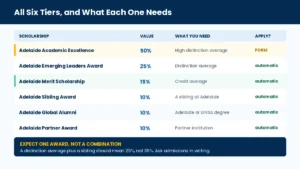
1. Adelaide Academic Excellence Scholarship — 50%
The top award. It reduces tuition by half for international students commencing an undergraduate or postgraduate coursework degree, and it asks for a high distinction average.
This is the only tier that requires a separate application form. Everything else happens automatically, which makes this form unusually worth filling in the effort is low and the competition is smaller than for schemes that everyone applies to.
2. Adelaide Emerging Leaders Award — 25%
A quarter off tuition for students with a distinction average. Assessed automatically when you apply for your degree.
3. Adelaide Merit Scholarship — 15%
The tier that changes the picture for most readers. A credit average earns a 15% reduction, assessed automatically.
A credit average is an ordinary-good result, not an exceptional one. On a AUD 54,000 engineering degree, 15% is about AUD 8,100 a year, or AUD 32,400 across four years, for a student who did nothing beyond apply.
4. Adelaide Sibling Award — 10%
If you have a sibling currently studying at Adelaide University, or a sibling who graduated from it, you qualify for a 10% reduction. Assessed automatically.
No academic threshold sits behind this one. It rewards a family connection, nothing more.
5. Adelaide Global Alumni Scholarship — 10%
For graduates of Adelaide University or the University of South Australia returning for a further degree. Assessed automatically.
The merger widened this considerably. A UniSA graduate from a decade ago now counts as an alumnus of the merged institution for this purpose, which brings a large group of people into eligibility who would never think to check.
6. Adelaide Partner Award — 10%
For students coming from an approved partner institution. Assessed automatically.
Your home university may hold a partnership you know nothing about. One email to your international office settles it, and it takes five minutes.
Can the Tiers Combine?
Almost certainly not, and this is worth understanding before you build expectations.
University fee-reduction schemes of this shape normally award one scholarship, the highest you qualify for rather than stacking them. A student with a distinction average and a sibling at the university should expect 25%, not 35%.
Adelaide’s page does not spell out the stacking rule in the detail an applicant would want, so ask admissions directly before you plan around a combined figure. One email, answered in writing, is worth more than any assumption.
What this means practically: the relationship awards sibling, alumni, partner matter most to students whose grades sit below the academic thresholds. A student with a credit average gets 15% on merit regardless. A student just under that line might get 10% through a sibling they never thought to mention.
What the Percentages Are Actually Worth
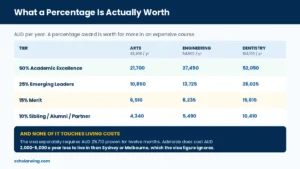
Percentage scholarships behave differently from fixed-dollar ones, and the difference catches people out.
Adelaide’s international tuition runs roughly AUD 43,400 to AUD 104,100 a year for undergraduate degrees arts and humanities near AUD 43,400, business around AUD 50,500 to AUD 52,200, engineering and the sciences around AUD 53,300 to AUD 54,900, and dental surgery reaching about AUD 104,100. Postgraduate degrees run roughly AUD 42,600 to AUD 81,400 a year.
So the same scholarship is worth wildly different sums:
| Tier | Arts, at 43,400 | Engineering, at 54,900 | Dentistry, at 104,100 |
|---|---|---|---|
| 50% Academic Excellence | 21,700 | 27,450 | 52,050 |
| 25% Emerging Leaders | 10,850 | 13,725 | 26,025 |
| 15% Merit | 6,510 | 8,235 | 15,615 |
| 10% relationship awards | 4,340 | 5,490 | 10,410 |
All figures are per year, in Australian dollars.
Two conclusions follow. A percentage award is worth more in an expensive course, which inverts the usual intuition that cheaper degrees are the frugal choice. And even the 50% tier leaves a dentistry student paying AUD 52,000 a year in tuition alone.
What Adelaide Still Costs After a Scholarship
None of these tiers touches living costs, and the student visa does not care about percentages.
The Australian subclass 500 visa requires proof of AUD 29,710 for twelve months of living costs, plus your first year of tuition, plus Overseas Student Health Cover and travel money. A scholarship letter counts only for the amount it names.
A three-year Bachelor of Arts, with the 15% Merit Scholarship:
| Item | Amount (AUD) |
|---|---|
| Tuition, 3 years at 43,400 | 130,200 |
| Less 15% Merit Scholarship | −19,530 |
| Living costs, 3 years at about 28,000 | 84,000 |
| Total | about 194,670 |
The same degree with the 50% Academic Excellence Scholarship:
| Item | Amount (AUD) |
|---|---|
| Tuition after 50% | 65,100 |
| Living costs | 84,000 |
| Total | about 149,100 |
Adelaide costs less to live in than Sydney or Melbourne commonly AUD 2,000 to AUD 5,000 a year less once rent is accounted for, which is a real and underrated part of the arithmetic. It does not change the visa’s AUD 29,710 requirement, which runs on a national average rather than on your city.
The Post-Study Work Advantage Nobody Mentions
Here is a benefit that outweighs several of these scholarship tiers and appears on none of the scholarship pages.
Australia’s Temporary Graduate visa, subclass 485, lets international graduates work after finishing. Graduates who studied and lived outside Sydney, Melbourne and Brisbane can apply for a second 485 visa, adding extra years of work rights.
The rules run on three location categories.
Category 1
Sydney, Melbourne, Brisbane earns no extension.
Category 2
covers designated cities and major regional centers, and Adelaide generally sits in Category 2, which attracts one additional year.
Category 3
the genuinely regional areas, can attract two.
An extra year of full Australian work rights is worth considerably more than a 10% tuition reduction, and for students weighing permanent residence it matters more still. Adelaide gets that year; Sydney and Melbourne do not.
The categories run on postcodes rather than city names, the rules change, and the Department of Home Affairs assesses each case individually, so confirm your postcode’s category rather than relying on this paragraph. But when you compare Adelaide against a Sydney or Melbourne offer, this belongs in the comparison alongside the scholarship percentage and the lower rent.
How to Apply
Step one: apply for admission. Every tier requires an offer, and the automatic tiers assess you from your course application. Apply as early as the intake allows.
Step two: clear every condition. Scholarship assessment generally follows an unconditional offer. A pending English result or a missing transcript delays the assessment that decides your award.
Step three: submit the Academic Excellence form if your average reaches high distinction. This is the only tier that asks for an application, and skipping it is the one genuine mistake available to you in this scheme.
Step four: tell admissions about a sibling, an alumni link or a partner institution. The automatic tiers assess what the university can see. If your sibling studied under a different surname, or your home university’s partnership is not flagged on your file, a short email makes the connection visible.
Step five: search the wider scholarship database. Adelaide runs faculty, donor and country-specific awards beyond these six tiers, most of which attract a fraction of the applications.
Writing the Academic Excellence Application
Since only the 50% tier asks for anything, treat that form seriously.
Selection runs through a scholarships committee weighing academic merit against a minimum threshold. Where a personal statement forms part of the application, the same rules apply that decide every merit scholarship.
Lead with evidence, not ambition. The project you completed, the research you assisted, the result you produced. One concrete paragraph beats three about your passion for the field.
Name the programme and the reason. A committee reading a statement that would apply to any Australian university discounts it. Name the course, the research Centre, the specific strength that brought you to Adelaide.
Explain your grades if they need explaining. Different grading systems convert unevenly. One clear sentence stating your class rank, your institution’s grading scale, or a specific disruption gives the committee something to work with.
Say what the degree leads to. Committees fund students with direction.
Keep financial need brief unless asked. This is a merit award.
Where Adelaide Is Genuinely Strong
Choosing a field where the university leads improves everything your supervision, your job prospects and your case for the top scholarship tier. Adelaide’s strengths concentrate in a handful of areas, several of which it holds nationally rather than merely locally.
Wine science and viticulture.
The Waite campus hosts one of the world’s leading wine research clusters, sitting alongside the Australian Wine Research Institute and CSIRO. For this field, Adelaide competes globally rather than nationally.
Agriculture and plant science.
Waite again, with grain, soil and crop science that serves one of Australia’s major agricultural states. Students from agricultural economies Pakistan, India, Nigeria, Kenya often find a better fit here than at a general metropolitan university.
Veterinary science.
The Rose worthy campus runs one of only a handful of Australian veterinary schools, and its facilities handle production animals at genuine scale.
Defense, space and photonics.
South Australia hosts Australia’s defense shipbuilding and the Australian Space Agency, and the university connects directly into both. Engineering and physics students who want work after graduation should weigh this heavily, because the state’s graduate jobs concentrate here.
Medicine and health sciences.
Both predecessors ran medical and health faculties, and the merged university carries a substantial clinical footprint across Adelaide’s hospitals.
Mining, petroleum and earth sciences.
South Australia’s resources sector supports strong geology and mining programmes with real industry links.
Nursing, education and social work.
These came largely from the UniSA side, which built its reputation on applied, profession-ready degrees. They tend to cost less than the engineering and health programmes, which changes what a percentage scholarship is worth.
A practical note on fit: the scholarship tiers apply across fields, but the dollar value of a percentage swings enormously by course, as the table above shows. A student choosing between an expensive and a modest programme should run both numbers rather than assuming the cheaper course is the cheaper decision.
A Timeline That Works
Working backwards from a February 2027 start:
Twelve months out, February 2026. Decide your course and check Adelaide’s entry requirements against your results. Book IELTS, TOEFL or PTE now rather than later, the English score sits behind both your offer and the timing of your scholarship assessment.
Eleven months out, March. Sit the English test, leaving room for a retake. Begin the transcript and attestation process, which runs six to eight weeks in many countries.
Ten months out, April. Email your home university’s international office and ask whether it holds a partnership with Adelaide University or either predecessor. That one question decides whether the 10% Partner Award applies to you.
Nine months out, May. Submit your admission application as the intake opens. Earlier applications sit in a smaller field, and the automatic tiers assess you from this application.
Eight months out, June. Clear every condition on the offer. Upload documents as they arrive rather than waiting for a complete set.
Seven months out, July. If your average reaches high distinction, submit the Academic Excellence application. Send admissions a short email naming any sibling at the university or any UniSA or Adelaide graduate in your family.
Six months out, August. Expect your scholarship outcome. Search Adelaide’s wider database for faculty and donor awards while you wait.
Five months out, September. Arrange proof of funds in an accessible account with a visible history. Moving money shortly before lodging the visa raises questions you would rather avoid.
Four months out, October. Lodge the subclass 500 visa, attaching every scholarship letter you hold. A 50% award meaningfully reduces the tuition evidence you must supply.
Two months out, December. Arrange accommodation. Adelaide’s rental market is easier than Sydney’s or Melbourne’s, which is one more reason the city suits a tight budget.
Six Mistakes That Cost Applicants These Awards
Working from pre-merger information. Almost every listing still names the Global Academic Excellence Scholarship with old ATAR thresholds. The scheme was rebuilt in 2026.
Assuming you need an ATAR of 99. The current entry point is a credit average, at 15%. A large group of eligible students never apply because they read the old top-tier requirement.
Skipping the Academic Excellence form. Five tiers are automatic, which trains applicants to expect no forms. The 50% award needs one.
Never mentioning a sibling or an alumni link. Three tiers rest on a relationship rather than on grades, and the university can only assess what it can see.
Expecting the tiers to stack. Expect the highest single award, and confirm in writing with admissions before budgeting otherwise.
Treating a percentage as a plan. Even 50% leaves tuition to pay, and none of these tiers touch the AUD 29,710 living-cost proof the visa requires.
Adelaide Compared With the Alternatives
Monash awards full tuition to four students a year and AUD 15,000 to twenty more, with pathway students excluded entirely. Adelaide’s scheme reaches far more students with smaller amounts. For a strong-but-not-exceptional applicant, Adelaide is the better expected value by a wide margin.
Melbourne gives 20% to around 225 undergraduates from 2027, restricted to countries with GDP per capita at or below US$10,000. Adelaide’s 15% tier carries no country restriction, which matters for Chinese, Malaysian and Gulf applicants who fall outside Melbourne’s rule.
Sydney runs a tiered automatic scheme paying AUD 5,000 to AUD 60,000, awarded once and not renewable. Adelaide’s percentages run for the degree, which usually makes them worth more over three or four years.
The Research Training Program funds Australian research degrees with full fees and a tax-free stipend of roughly AUD 36,000 and above. Any research candidate should look there first, because no coursework scholarship on this page competes with it.
Australia Awards Scholarships are the fully funded government programme for eligible developing countries. Applicants from Pakistan, Bangladesh, Nepal and much of Africa should check that list before relying on a tuition percentage.
The honest summary: Adelaide offers the most reachable international scholarship scheme among Australia’s larger universities. It will not fund your degree, but it reliably reduces it, and the reduction compounds with Adelaide’s lower living costs and the extra post-study work year.
Studying at Adelaide
Adelaide University runs seven campuses. The main city campus combines four adjacent North Terrace sites in the center of Adelaide, with further campuses at Mawson Lakes, Magill, Waite, Rose worthy, Whyalla and Mount Gambier. Waite and Rose worthy carry genuine strength in agriculture, wine science and veterinary science; Mawson Lakes in engineering and information technology.
Adelaide the city is smaller than Sydney or Melbourne and noticeably cheaper. Rent runs well below the eastern capitals, the city is compact enough to cross on foot, and public transport reaches the campuses easily. Students who want a large anonymous metropolis find it quiet; students who want to live near campus without paying Sydney rent find it ideal.
The merger brought two distinct institutional cultures together, a traditional research university and a strongly applied, industry-connected one. Expect some structural change over the next few years as faculties, course codes and systems settle. Ask specific questions about your programme rather than assuming continuity from either predecessor’s old website.
South Australia’s graduate job market is smaller than Victoria’s or New South Wales’, concentrated in defense, space, agriculture, wine, health and education. The extra 485 year helps, and so does a state that actively wants to retain international graduates.
Frequently Asked Questions
Does the Global Academic Excellence Scholarship still exist?
Not under that name. Adelaide University rebuilt its international scheme after the January 2026 merger, and the equivalent top tier is now the Adelaide Academic Excellence Scholarship at 50%.
What grades do I need?
A high distinction average for the 50% tier, a distinction average for 25%, and a credit average for 15%. The 10% awards rest on a sibling, alumni or partner-institution link rather than on grades.
Do I have to apply?
Only for the 50% Academic Excellence Scholarship. The other five tiers are assessed automatically from your course application.
Can I hold more than one tier?
Expect the highest single award rather than a combination. Confirm with admissions in writing.
Do these cover living costs?
No. All six reduce tuition only. The visa separately requires AUD 29,710 for twelve months of living costs.
Can UniSA graduates get the alumni award?
Yes. The merger means University of South Australia graduates count for the Adelaide Global Alumni Scholarship.
How much is tuition?
Roughly AUD 43,400 to AUD 104,100 a year for undergraduate degrees and AUD 42,600 to AUD 81,400 for postgraduate, depending heavily on the field.
Is Adelaide regional for migration purposes?
It generally sits in Category 2, which attracts one extra post-study work year on a second 485 visa. Confirm your postcode’s category, because the rules change.
Part of our complete guide to scholarships in Australia for international students — every major award compared.