
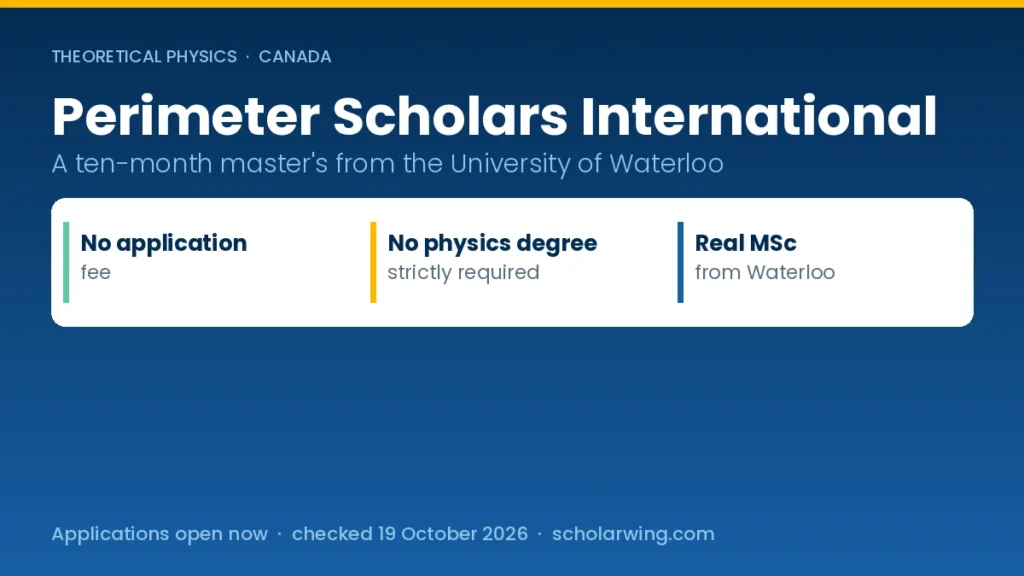
Perimeter Scholars International 2027:
Most physics funding we cover puts a gate in front of you. ICTP wants a degree equivalent to an MSc. The IMU Breakout Fellowship needs a professor to nominate you. CERN closed its doors to Pakistani nationals for this intake entirely.
Perimeter Scholars International has almost none of that. No application fee. No nomination. And Perimeter states plainly that a physics degree is not strictly required.
It is also a real master’s from the University of Waterloo, not a certificate. Applications opened this month.
What it is
Ten months at the Perimeter Institute in Waterloo, Ontario, ending with a Master of Science from the University of Waterloo. Students stay enrolled at Waterloo until the end of August.
Perimeter describes it as open to applicants with “diverse and non-traditional academic backgrounds demonstrating exceptional scientific talent,” and offers full financial support for most admitted students, including help with travel and immigration arrangements.
Read that funding line carefully. “Most admitted students” is not “all,” and Perimeter does not itemise what the support covers. Ask before you plan a year around it. Our wider Canada scholarships page covers the other routes into the country if PSI does not land.
The rule that surprises people
You do not strictly need a physics degree.
Perimeter wants proof that you understand undergraduate physics across five areas instead: classical mechanics, electromagnetism, special relativity, quantum mechanics and statistical physics. If you studied mathematics, engineering or computer science and taught yourself the physics properly, the door is open in a way it almost never is elsewhere.
One honest caveat sits underneath it. Enrolment in the University of Waterloo MSc normally expects an undergraduate degree in physics or a related field, so a non-physics applicant has to square the two rules. If that is you, write to Perimeter and ask directly rather than assuming either way.
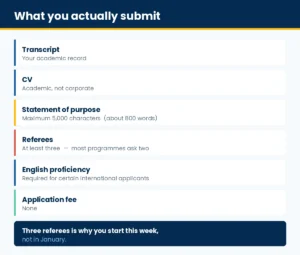
What you actually submit
Four things, and the list is shorter than almost any application on this site.
| Item | Detail |
|---|---|
| Transcript | Your academic record |
| CV | Academic, not corporate |
| Statement of purpose | Maximum 5,000 characters |
| Referees | At least three |
| English proficiency | Required for certain international applicants |
| Application fee | None |
Five thousand characters comes to roughly eight hundred words. That carries the entire argument for your admission, and brevity is the difficulty rather than the relief. Our personal statement guide covers the structure, and for PSI specifically the rule is simple: show that you understand physics rather than telling them you love it. Name a problem you worked through and what confused you about it.
Three referees is the detail that decides your timeline. Most applications ask for two. Finding a third academic who can speak to your physics takes longer than people expect, and February is closer than it looks. Our guide on asking a professor for a reference letter covers how to brief them.
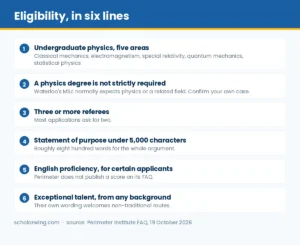
Eligibility criteria
1. Demonstrated understanding of undergraduate physics across classical mechanics, electromagnetism, special relativity, quantum mechanics and statistical physics.
2. A physics degree is not strictly required, though Waterloo’s MSc normally expects physics or a related field. Confirm your own case with Perimeter.
3. Three or more referees.
4. A statement of purpose under 5,000 characters.
5. English proficiency results, for certain international applicants. Perimeter does not name a score on the FAQ, so check whether you fall into that group and what it requires.
6. Exceptional scientific talent, from any background. Perimeter’s own framing is unusually open about non-traditional routes, and that is the sentence a strong self-taught applicant should take seriously.
Dates
| Event | When |
|---|---|
| Applications open | October 2026, per Perimeter’s FAQ |
| First-consideration deadline | 1 February at 11:59pm EST in the last cycle |
| Late applications | Considered “until all positions are filled”, with no guarantee |
That last row matters more than it reads. A late application is not rejected automatically, and it is also not safe. Treat 1 February as the real date and confirm this cycle’s deadline on Perimeter’s site, because they had not posted it when we checked.
Step-by-step application process
Step 1, this week: open the application. It is live. Everything below is easier once you have seen the form.
Step 2, this week: ask your three referees. This is the long pole and the reason to start today. Give them your transcript, the list of five physics areas PSI cares about, and a short note on why you want it.
Step 3, November: check the English requirement. Perimeter says certain international applicants must provide results. Find out whether you are one, because a test booking in January is a problem.
Step 4, November and December: write the statement. Eight hundred words, built around physics you have actually done. Draft it long, then cut it to the limit. The cutting is where it gets good.
Step 5, if you hold a non-physics degree: email Perimeter now. Ask how they reconcile their own openness with Waterloo’s enrolment rule for someone with your background. Their answer shapes whether you apply at all.
Step 6, January: submit. Before 1 February, not on it.
Step 7: do not treat “late applications considered” as a second deadline. Positions fill.
FAQ
Is there an application fee?
No. Perimeter states none.
Do I need a physics degree?
Not strictly, according to Perimeter. Waterloo’s MSc normally expects physics or a related field, so ask about your own case.
What physics do I need to know?
Classical mechanics, electromagnetism, special relativity, quantum mechanics and statistical physics, at undergraduate level.
Is it a master’s degree?
Yes. A Master of Science from the University of Waterloo.
How long is it?
Ten months, with enrolment at Waterloo until the end of August.
Is it funded?
Perimeter offers full financial support for most admitted students, plus help with travel and immigration. “Most” is their word, so confirm your own offer.
How many referees do I need?
At least three.
How long can my statement of purpose be?
Maximum 5,000 characters, which is about 800 words.
When is the deadline?
Applications opened in October 2026. The last cycle closed for first consideration on 1 February at 11:59pm EST. Confirm this cycle’s date on Perimeter’s site.
Do I need IELTS?
Certain international applicants must provide English proficiency results. Perimeter does not publish the score on its FAQ.