
GEBCO Training Programme 2027:
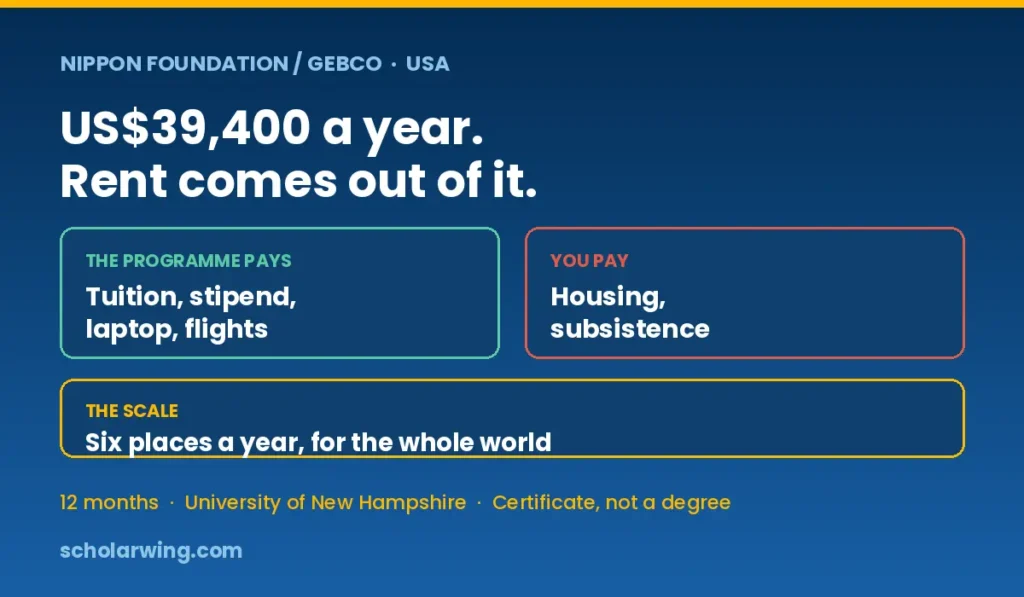
About US$39,400 a year, tuition paid separately, a laptop, your textbooks, flights, a research cruise. For twelve months in the United States.
Then one line further down GEBCO’s page: housing, subsistence and all other costs stay with you.
That is not a complaint. It is how you read this scholarship correctly. The stipend is high because it is doing two jobs, and a reader who treats it as pocket money will run short in New Hampshire by February.
What it is
The Nippon Foundation funds six students a year to spend twelve months at the University of New Hampshire, inside the Center for Coastal and Ocean Mapping and Joint Hydrographic Center at Durham, New Hampshire.
You come out with a Graduate Certificate in Ocean Mapping. GEBCO also calls it the Postgraduate Certificate in Ocean Bathymetry, which is the same thing under a different name.
Say the obvious thing plainly: this is a certificate, not a master’s. Twelve months of serious technical training in seabed mapping, at one of the few places in the world that teaches it properly, and your promotion board at home will still treat the paper differently from a degree. Decide which one your career needs before you apply.
The number that should decide where you look first
Six students a year, for the whole world. That is smaller than almost anything else on this site.
But read the selection line next to it, because it changes the odds for Pakistan specifically. GEBCO says selection “aims for a wide geographic spread of coastal countries.”
Pakistan is a coastal country with roughly a thousand kilometers of shoreline, a hydrographic department, a maritime security agency, and very few people applying to things like this. A spread rule rewards exactly that position. It will not carry a weak application, and it does mean a strong Pakistani file is not simply queued behind forty applicants from one region.
What it pays, and what it does not
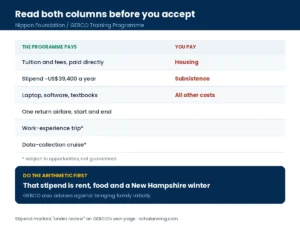
| The programme pays | The student pays |
|---|---|
| Tuition and fees, paid directly, not reimbursed | Housing |
| A stipend of about US$39,400 a year, marked “Under review” | Subsistence |
| Computer hardware, software and textbooks | All other costs |
| One return airfare to UNH at the start and the end | |
| Airfare and living costs for a work-experience trip to another bathymetry institution, subject to opportunity | |
| Airfare and living costs for a data-collection cruise, subject to opportunity |
Two more things belong in your planning.
GEBCO advises against bringing family initially. That is their own guidance on their own page, and it is unusual enough to be worth a conversation at home before you apply.
Two of the best parts are conditional. The work-experience placement and the cruise both carry “subject to opportunities”. Treat them as likely rather than promised.
Eligibility criteria
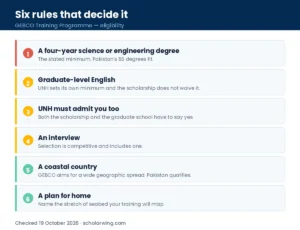
1. A four-year undergraduate degree in a related science or engineering discipline, as the minimum. Geology, geophysics, oceanography, civil or marine engineering, surveying, computer science and mathematics all sit close to this work. Pakistan’s four-year BS degrees fit the structure directly.
2. The ability to handle graduate coursework in English. GEBCO states that the coursework demands strong written and spoken English, and this is a technical course where that matters more than usual.
3. The University of New Hampshire’s own international entry requirements. The scholarship does not override the graduate school. Both have to say yes.
4. An interview. Selection is competitive and includes one, so your file is not the end of the process.
5. A coastal country background that fits the spread. GEBCO aims for geographic breadth across coastal nations.
6. A plan to use ocean mapping at home. This programme exists to put bathymetric capability into countries that lack it, and your application should name where yours will go.
Dates, and the funding line underneath them
The 2026 round is closed. GEBCO’s page states it directly, and adds that the 2026 intake begins in late August “pending funding to be confirmed by April 2026 by the Nippon Foundation.”
That sentence is worth a reader’s attention. The programme confirms its own funding in April each year, which means the cycle runs: applications close early, the funding is confirmed in spring, the course starts in late August.
So for the next intake, expect applications to open around the turn of the year and the course to start in late August 2027. Watch gebco.net/training from December, because GEBCO publishes no advance notice.
Step-by-step application process
Step 1, from December: check the page weekly. There is no mailing list announcement that reaches Pakistan reliably. The page is the announcement.
Step 2: confirm your degree is four years. A three-year bachelor’s does not meet the stated minimum. If yours is three years, a master’s closes the gap, and you should say so plainly in the application.
Step 3: get your English evidence in order early. UNH’s graduate school sets its own minimum and the scholarship does not waive it. Sit the test before the window opens rather than during it.
Step 4: write the application around a specific stretch of Pakistani seabed. The Makran coast, the Indus delta, the approaches to Karachi and Gwadar, the continental shelf claim. Name the gap, name who would use better bathymetry, and name what you would do with the training. Our personal statement guide covers the structure.
Step 5: prepare for the interview as a technical conversation. Six places and an interview means they are choosing between people who all look good on paper. Know the instruments, know what multibeam does, and know what your country’s charts currently lack.
Step 6: budget housing before you accept. Durham, New Hampshire is a small university town and rents are real. Work out your monthly figure from the stipend and check it against actual listings, not against hope.
The other ocean routes, and how this one differs
Four Nippon Foundation routes sit on this site and they suit four different people. This one wants a science or engineering graduate who will map the seabed. NF-POGO wants a science graduate heading into ocean observation, with no employer needed. WMU Sasakawa wants a serving professional whose employer will file the form. The UN-Nippon Foundation Fellowship wants a government official working on the law of the sea. The full set sits on our maritime and ocean science page.
If the United States itself is what interests you, our scholarships in the USA guide covers the wider picture.
FAQ
Is this a master’s degree?
No. It is a Graduate Certificate in Ocean Mapping, also called the Postgraduate Certificate in Ocean Bathymetry. Twelve months.
How many places are there?
Six a year, worldwide.
Can Pakistanis apply?
Yes. GEBCO aims for a wide geographic spread of coastal countries, and Pakistan is a coastal country that sends very few applicants.
What degree do I need?
A four-year undergraduate degree in a related science or engineering discipline, as a minimum.
How much does it pay?
About US$39,400 a year, which GEBCO’s own page currently marks as under review. Tuition and fees are paid separately and directly.
Does it cover my rent?
No. Housing, subsistence and all other costs come out of the stipend. Budget before you accept.
Can I bring my family?
GEBCO advises against bringing family initially. Ask them directly about your own situation before you plan around it.
Is there an interview?
Yes. Selection is competitive and includes one.
When does the next round open?
Not announced. The 2026 round has closed, the course starts in late August each year, and funding is confirmed each April. Watch gebco.net/training from December.
Do I get the research cruise?
Probably, not certainly. Both the cruise and the work-experience trip carry “subject to opportunities” on GEBCO’s page.