
ICTP/IAEA STEP 2027:
Most doctoral funding asks you to leave. STEP asks you to stay.
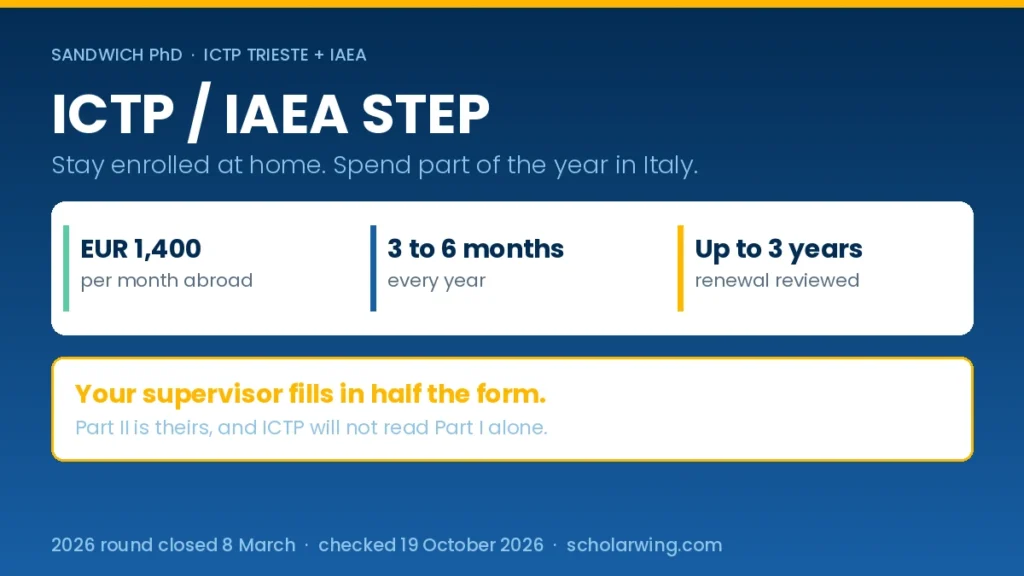
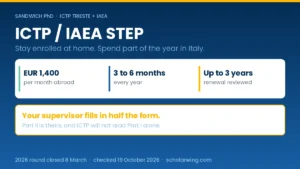
You remain enrolled at your own university, in your own country, and your degree comes from there. ICTP pays for you to spend three to six months a year working at its Trieste campus or a collaborating institute, for up to three years, on €1,400 a month plus travel and medical insurance. That is the sandwich model, and for a student who cannot abandon a job, a family or a funded local position, it solves a problem that a full move abroad creates.
One condition shapes everything else. You cannot complete this application alone.
The part most readers miss
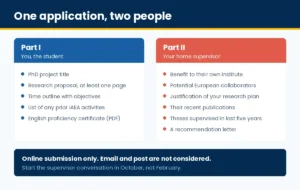
The form splits in two. Part I belongs to you. Part II belongs to your home supervisor, and ICTP will not consider an application where that half sits empty.
Your supervisor has to explain what their own institute gains, name potential European collaborators, justify your research plan, list their recent publications, list the theses they supervised in the last five years, and write you a recommendation letter.
That is not a signature at the bottom of a page. That is an afternoon of their work, built around your project. If your supervisor will not do it, no amount of effort on your side rescues the application, which is why this post goes out in October for a March deadline.
The pattern repeats across the best research funding. The IMU Breakout Fellowship goes further and bars students from applying at all, leaving the nomination entirely to a professor. Our guide on asking a professor for a reference letter covers how to open that conversation, and for STEP you open it now rather than in February.
What you receive
| Item | Detail |
|---|---|
| Monthly stipend abroad | €1,400 per month during each stay at the host institute |
| Travel | Covered |
| Medical insurance | Covered |
| Time abroad | Three to six months per year |
| Length | Up to three successive years |
| First year | Requires a stay of at least three months |
| Home periods | Not funded by STEP — support comes from other sources |
Read the last row twice. STEP funds the months you spend at the host institute and nothing else. The rest of your doctorate runs on whatever your home university, employer or national scheme already provides, so this fellowship supplements an existing PhD rather than creating one.
Years two and three are not automatic either. Renewal depends on approval from the host institute and both supervisors, which means your first stay is also an audition.
Which subjects qualify
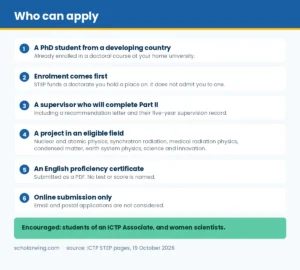
STEP carries the IAEA’s fingerprints, and the field list reflects that: atomic and nuclear physics including nuclear, isotope and laser techniques; synchrotron radiation and applications; medical radiation physics; condensed matter physics; earth system physics; and science, technology and innovation.
The call also welcomes physics and mathematics students broadly, so the boundary is softer than the list suggests. If your work sits near one of these areas rather than inside it, write to ICTP and ask instead of ruling yourself out.
Eligibility criteria
1. A PhD student from a developing country, already enrolled in a doctoral course at your home university. STEP sets no other nationality rule on its page.
2. Enrolment comes first. This funds a doctorate you already hold a place on. It does not admit you to one.
3. A home supervisor willing to complete Part II, including a recommendation letter and a list of theses supervised over the last five years.
4. A research project within the eligible fields, proposed jointly by you and your home advisor. Selection rests on the merit of that thesis project.
5. An English proficiency certificate, submitted as a PDF.
6. Online submission only. ICTP states that email and postal applications are not considered.
Two groups get a push rather than a rule. Students supervised by an ICTP Associate are specifically encouraged to apply, and ICTP seeks equitable participation with particular welcome for women scientists, alongside priority for young researchers.
Step-by-step application process
Step 1, this month: talk to your supervisor. Show them the Part II list. Their answer decides whether the rest of this is worth your time, and you want that answer in October rather than in February.
Step 2, November: pick your host. ICTP assigns a host institute and a co-advisor, but a suggested host institution and a letter from a potential co-supervisor are strongly recommended supporting documents. An application that names a willing co-supervisor is a different application from one that does not.
Step 3, November and December: write the research proposal. At least one page summarizing the project, plus a time outline with objectives. Build it around what the three to six months abroad specifically make possible, because that is the question the committee is answering.
Step 4, December: sort the English certificate. It must go in as a PDF, so a test booked in February is already too late.
Step 5, January: list prior IAEA activities. If you have attended an IAEA workshop, course or meeting, it belongs in the form.
Step 6, February: watch for the call. ICTP publishes it around February with a March deadline. The 2026 round closed on 8 March.
Step 7: submit both parts online, together. Your Part I alone is an incomplete application.
Where this sits among the other ICTP routes
ICTP runs several doors and they serve different people. The ICTP Postgraduate Diploma is a full year in Trieste for someone who has finished a master’s and wants a bridge into a PhD. STEP is for someone already inside a PhD at home. And if you want the doctorate itself delivered abroad from the start, routes like Perimeter Scholars International or our wider PhD scholarships list fit better.
Choosing between them is mostly a question of where you want your degree certificate printed.
FAQ
Whose degree do I get? Your home university’s. You stay enrolled there throughout.
How much is the stipend?
€1,400 a month, during the stays at the host institute only.
How long do I spend abroad?
Three to six months a year, for up to three years. The first year needs at least three months.
Does STEP pay me while I am at home?
No. Support for those periods comes from other sources.
Can I apply before starting my PhD?
No. You must already be enrolled in a doctoral course.
Does my supervisor really have to apply too?
Yes. Part II is theirs, and it includes a recommendation letter and their supervision record.
Which subjects are eligible?
Atomic and nuclear physics, synchrotron radiation, medical radiation physics, condensed matter physics, earth system physics, and science, technology and innovation.
Do I need an English test?
An English proficiency certificate is required as a PDF.
When is the deadline?
The 2026 round closed on 8 March 2026. Expect the next call around February with a March deadline, and confirm on ICTP’s site.
Is renewal guaranteed?
No. Years two and three need approval from the host institute and both supervisors.
Can I email my application?
No. ICTP states that email and postal submissions are not considered.