
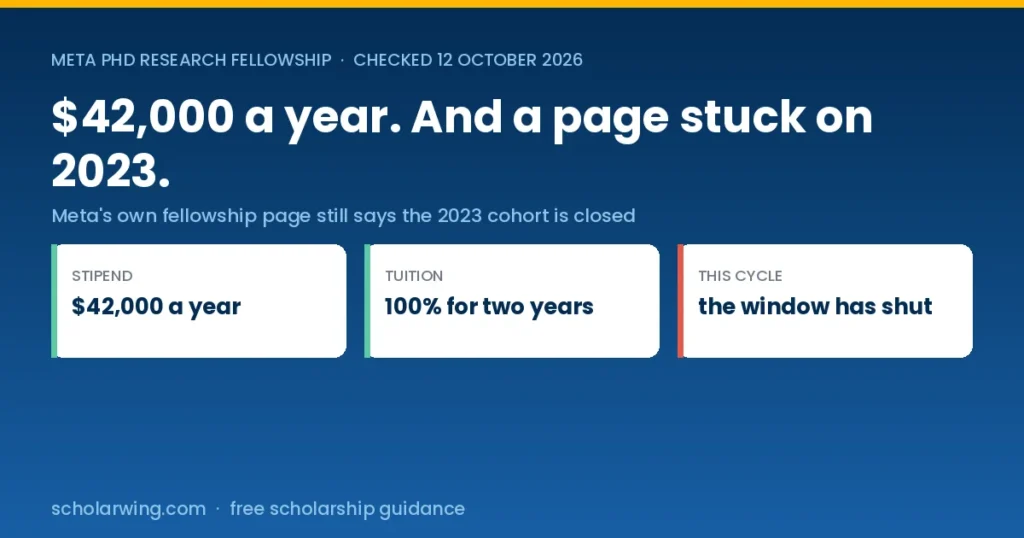
Meta PhD Research Fellowship: $42,000 a Year, and a Funder Page Three Years Out of Date
The Meta PhD Research Fellowship is one of the strongest industry awards a doctoral student can win. Two years of tuition and institutional fees paid in full, plus $42,000 a year as a stipend, plus an invitation to Meta’s annual Fellowship Summit.
It is open to PhD students at accredited universities in any country, in any year of study. No nationality restriction. No age limit. You may hold other funding already.
Now the part we have to be honest about, because it changes what you should do today.
Meta’s own page has not moved since 2023
We opened research.facebook.com/fellowship on 12 October 2026. It says:
“Applications for the 2023 Fellowship cohort are now closed.”
That is Meta’s own fellowship page, and it has sat on the 2023 cohort while three further cycles came and went.
Meanwhile a long list of scholarship sites advertise a 2027 round, with a 20 September 2026 application deadline and a 6 October 2026 recommendation-letter deadline. Those dates appear on aggregator after aggregator. They do not appear on any page Meta publishes.
We will not certify them. What we can tell you is simpler and more useful.
Either reading leads to the same conclusion. The window has shut. If the 2027 round ran on those dates, it closed three weeks ago. If it did not run, there is nothing to apply to. Nobody should start a Meta fellowship application today.
So treat this page as preparation for the next cycle rather than a call to apply.
What the award actually gives
Tuition and institutional fees, in full, for up to two years. Meta pays these directly to your university rather than to you.
$42,000 a year as a stipend, which Meta pays to you, intended to cover living costs, research expenses and conference travel.
An invitation to the annual Fellowship Summit at Menlo Park, where Fellows meet Meta researchers.
A few eligibility details that trip people up.
You must already be a full-time PhD student. Meta states that undergraduates and graduate students in other disciplines are not funded. This is not a route into a doctorate.
Existing funding does not disqualify you. Meta says students who already hold other funding for their PhD may still apply. However, a winner holding a competing multi-year award from another company must disclose it.
Your research must sit inside one of Meta’s published areas. This is the part most applicants treat casually and it decides more than they realize.
The areas Meta funds
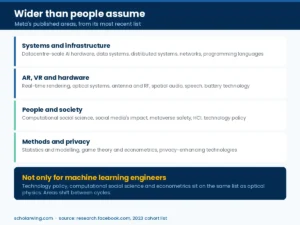
The list below comes from the 2023 cohort, which is the most recent list Meta publishes. Areas shift between cycles, so read it as the shape of Meta’s interests rather than as next year’s menu.
Systems and infrastructure: high-performance software and hardware for datacenter-scale AI, data systems architecture, distributed systems, wired network infrastructure, programming languages and tools.
AR, VR and hardware: computer graphics and real-time rendering for AR and VR, human understanding for AR and VR, optical physics and optical systems, antenna, RF and wireless communication, sound capture and spatial audio rendering, speech and audio processing, battery technology for consumer electronics.
People and society: computational social science, social media’s impact on people and society, meta verse safety, integrity and inclusive, human-computer interaction, technology policy.
Methods and privacy: statistics and modelling, game theory, optimization and econometrics, privacy-enhancing technologies, digital privacy experiences.
Notice how wide that is. Technology policy, computational social science and econometrics sit alongside optical physics. A researcher who assumes this award is only for machine learning engineers is reading it too narrowly.
How Meta actually judges you
Meta states its criteria plainly: the strength of your research statement, your publication record, and your recommendation letters. Thousands of applications go to Meta’s own research teams for review each year.
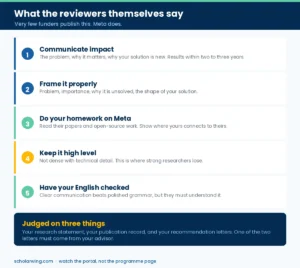
Meta has also published advice from the people who review them, and it is more specific than most funders ever offer. Five points stand out.
Communicate impact. Explain the problem, why it matters, and why your solution is novel against past work. Narrow it to concrete steps producing results within two to three years, and include preliminary results if you have them.
Frame it properly. Structure the statement around the problem, its importance, why it remains unsolved, the shape of your solution, and how your work addresses it.
Do your homework on Meta. Reviewers expect you to have read Meta’s publications, open-source projects and blog posts, and to show where your expertise could enable a new feature or improve an existing one. They also want to know how the fellowship helps your academic career.
Keep it high level. Reviewers say the statement should stay simple rather than dense with technical detail. State your objectives in the abstract and summaries the work clearly.
Have someone check the language. Meta’s reviewers say clear communication matters more than polished grammar, but they must understand the work to value it. They advise non-native English speakers to have someone read the statement first.
That fourth point is where strong researchers lose. A statement written for a journal referee reads badly to an industry reviewer scanning hundreds of applications.
Who should bother
If you are a PhD student in computing, HCI, policy or a related field, this is worth a serious application in the next cycle, and the preparation starts now rather than in September. Read Meta’s publications in your area. Build one or two concrete links between your work and theirs. Ask your advisor early, since one of the two recommendation letters must come from them.
If you are not yet in a PhD, nothing here is available to you, and the useful move is to go and win a funded doctoral position first. Across Europe a PhD is salaried employment with no tuition fee and no nationality restriction our DTU Denmark post, ORFeus guide and TU Delft guide explain that market. Once you are enrolled, awards like this one open up.
If you are already funded, apply anyway. Meta allows it, and the Summit and the contact with Meta’s research teams carry value beyond the money.
How to track the next round
Nobody can rely on Meta’s own fellowship page for dates, which is an unusual thing to write about a company this size, and it is exactly why we checked.
Watch the application portal rather than the programme page. Applications run through metaresearchphdfellowship.smapply.io, and a live portal either accepts registrations or it does not. That tells you more than a stale description page.
Check in August and again in early September. Past cycles have opened in late summer and closed in September, with recommendation letters due a fortnight later.
Ask your university. Many research universities circulate these calls internally and some nominate candidates. Your graduate school office often knows before the aggregators do.
We checked every claim on this page on 12 October 2026, and we will update it the day Meta’s own page changes.