
IBM PhD Fellowship: Paused for This Cycle, and You Could Never Apply Anyway
Two facts settle this one, and neither appears in most articles about it.
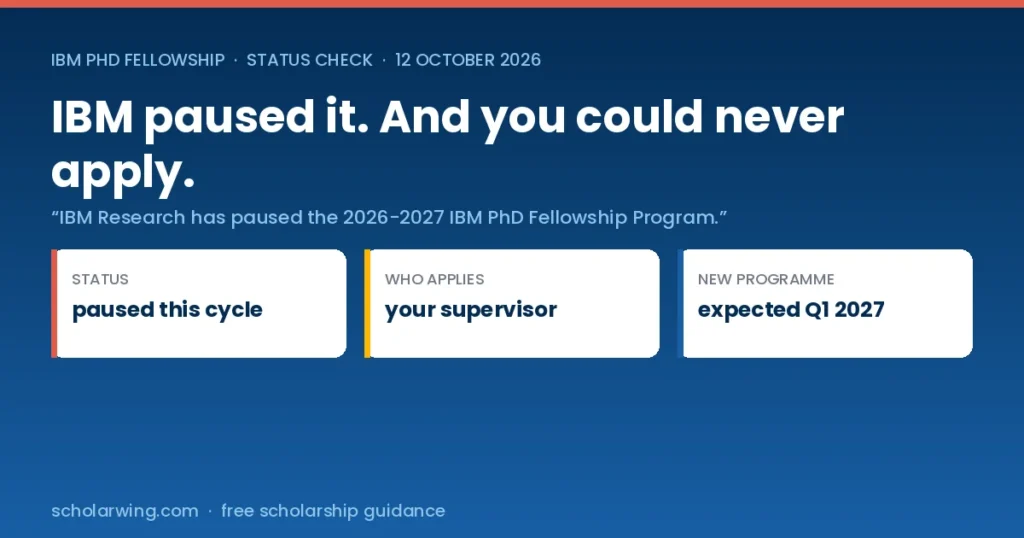
IBM has paused the programme. Its own Academic Awards page states that IBM Research has paused the 2026-2027 IBM PhD Fellowship Program, and that it expects to announce a new programme in the first quarter of 2027.
And you could never have applied anyway. IBM says nomination happens by invitation only, and that students cannot nominate themselves. A faculty member has to put your name forward.
Scholarship sites were publishing fresh “IBM PhD Fellowship 2027” calls as recently as July 2026, complete with Apply Now buttons. There is nothing behind those buttons this cycle.
So read this page as preparation rather than as a deadline. When IBM returns, the students who win will be the ones whose supervisors were ready.
How the nomination actually works
This is the part worth understanding properly, because it applies to a whole class of awards.
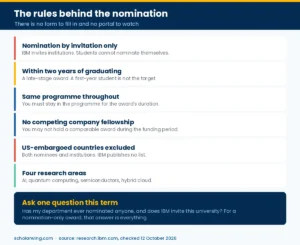
Your faculty member nominates you. IBM requires a detailed nomination proposal from an eligible doctoral faculty member, and that person stays involved through IBM’s review. You are not the applicant. Your supervisor is.
Nomination comes by invitation. IBM does not open this to every university in the world. It invites institutions, which means your university either sits inside that circle or it does not, regardless of how good your work is.
That changes what you do. There is no form to fill in and no portal to watch. The useful move is a conversation with your supervisor and your graduate school office: has this department ever nominated anyone, and does IBM invite this university?
Many departments keep a record. The University of Illinois publishes its IBM Fellowship recipients going back to 1997, and that list shows winners through 2024-2025 and nothing after. For a department with that history, the question is easy to answer.
What IBM asks of nominees
Full-time enrolment in a PhD programme during the award year.
Normally within two years of expected graduation at the time of nomination. This is a late-stage award, not an early one. A first-year student is not the target.
You must stay in the same programme for the duration of the award.
You may not hold a comparable fellowship from another company or institution during the funding period. If Microsoft or Meta already funds you, that matters.
Nominees from US-embargoed countries are ineligible, and so are institutions located in them. IBM publishes no list of its own, so check the current US position rather than assuming. Pakistan does not fall under the comprehensive US embargoes, but a nominating faculty member should confirm before investing effort.
The research areas IBM names are artificial intelligence, quantum computing, semiconductors and hybrid cloud. That is a narrower field than Microsoft’s or Meta’s, and it reflects where IBM Research actually works.
The money depends on your postcode
Here is IBM’s own structure, and it is the starkest we have seen.
Awards for universities in the United States are $40,000.
Awards for other countries vary between $6,000 and $25,000, depending on where the university sits.
Read those two lines together. The same fellowship, for the same research, pays up to about six and a half times more at a US university than at the bottom of the international band.
We are not going to pretend that is unreasonable, because costs differ enormously between countries and the award is meant to support a student within a local cost of living. But a student comparing offers deserves to know it, and almost no article about this fellowship prints both numbers.
IBM also pays the award to the university, with payment made no later than the last quarter of the year.
How the three big industry fellowships compare
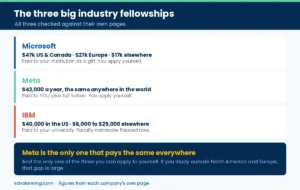
We have now checked all three against their own pages, and they differ far more than their reputations suggest.
Microsoft pays a one-time unrestricted gift to your institution, banded by region: US$47,000 in the United States and Canada, US$27,000 in Europe, US$17,000 elsewhere. Students may apply on their own behalf. Our Microsoft guide covers it.
Meta pays $42,000 a year to the student, plus full tuition for two years, at the same rate anywhere in the world. Students apply themselves. Its programme page has sat on the 2023 cohort for three years. Our Meta guide covers that.
IBM pays the university, bands the amount by country from $6,000 to $40,000, takes nominations from faculty only, and has paused this cycle.
The pattern worth taking away: Meta is the only one of the three that pays the same amount wherever you study, and the only one you can apply to yourself. If you are at a university outside North America and Europe, that difference is large.
What to do with this
If you are in a PhD now, in AI, quantum, semiconductors or cloud, talk to your supervisor this term rather than next year. Ask whether the department has nominated before. If IBM returns in the first quarter of 2027 as it says it expects to, the nomination will be written in weeks, not months, and supervisors who start from nothing miss it.
If you are not in a PhD yet, this award is not available to you and will not be for years, since it targets students within two years of graduating. Go and win a funded doctoral position first. Across Europe a PhD is salaried employment with no tuition fee and no nationality restriction our DTU Denmark post, ORFeus guide and Örebro guide explain that route.
If you want an industry fellowship you can apply to yourself, Meta is the one to prepare for, not this one.
How to know when IBM returns
IBM says it expects to announce a new programme in the first quarter of 2027. That is a statement of expectation rather than a commitment, so treat it as such.
Check research.ibm.com in January, February and March 2027. Check the programme page itself rather than trusting an article, since this is precisely the case where articles ran ahead of the funder.
And ask your supervisor to watch for the invitation, because for a nomination-only award the invitation reaches the university before it reaches the internet.
We checked every claim on this page on 12 October 2026, and we will update it the day IBM’s own page changes.